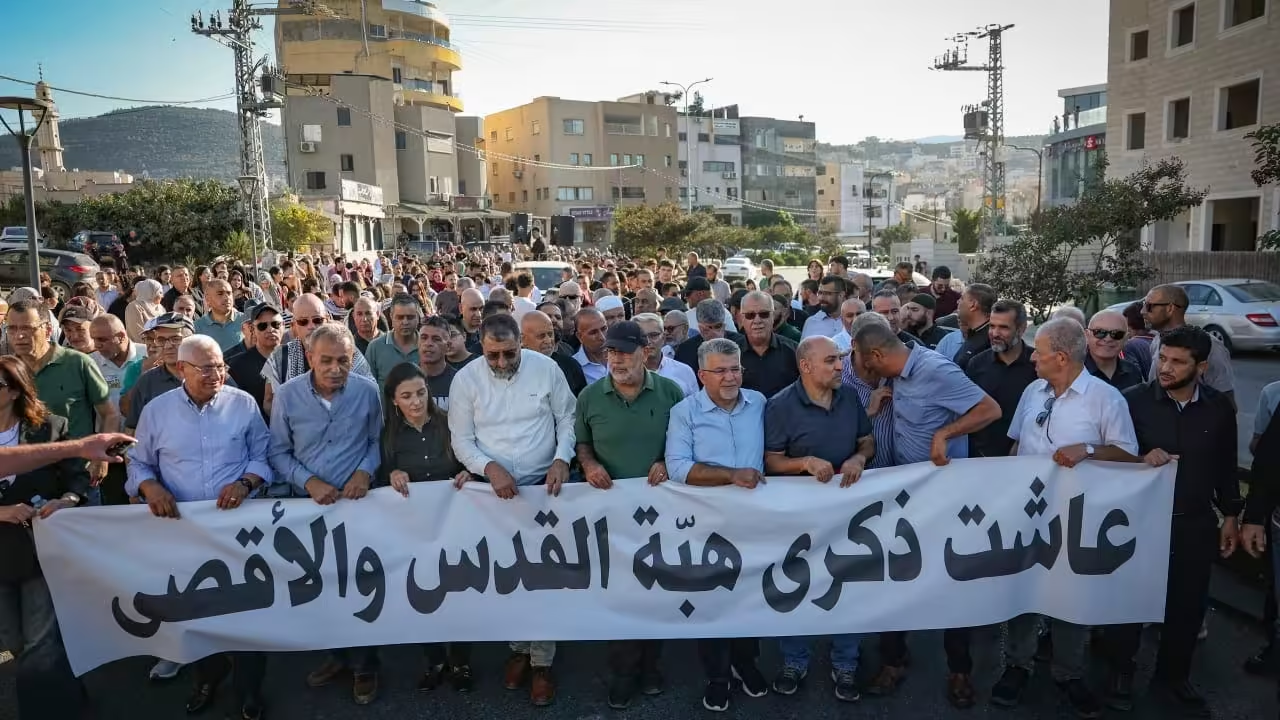

Lina Qassem Zidan and her husband, Ziad, went to a pastry shop in Kafr Manda on Saturday to buy a cake and sweets for their granddaughter’s second birthday. Lina never made it home.
A grenade was thrown at the shop. Lina was killed and three others, including her husband, were injured in the attack.
“My wife was a good woman. She worked, supported us financially, and took care of the family,” Ziad, who has a disability that prevents him from working, told Ynet. “I never imagined something like this could happen.”
Victims of violent crime increasing in Arab communities
Lina was the 200th victim of violent crime in Israel’s Arab community this year, according to the Abraham Initiatives. Hours later, Mohammad Yazan, 59, was shot and killed in Taibeh, bringing the toll to 201.
The figures are staggering. The Abraham Initiatives recorded 252 victims in 2025, making it the deadliest year on record for the community. Arab citizens make up roughly a fifth of Israel’s population but account for a disproportionate share of its homicide victims.
Behind each number is a family living with a loss that cannot be reversed. For many others, everyday activities have become a source of fear. Going to a shop, attending a celebration, or sitting outside one’s home should not mean risking being caught in the violence of criminal organizations.
“We are a completely ordinary family. We have no criminal history, no disputes, nothing,” Lina’s brother-in-law Khaled told Ynet.
“She simply went out to buy a cake for her two-year-old granddaughter. We have paid the heaviest possible price.”
Arab citizens are entitled to the same protection from the state as every other Israeli. Their safety should not depend on whether the violence reaches another city, or on which parties sit in the next coalition.
This is not an internal problem to be left for Arab communities to solve alone. Armed criminal organizations, illegal weapons, and the failure to bring killers to justice are national problems that demand a national response.
National Security Minister Itamar Ben-Gvir must answer for his record. The number of people killed in Arab communities rose from 116 in 2022, before he took office, to 252 in 2025, according to the Abraham Initiatives.
The organization has also accused him of ending programs intended to confront the violence. The crisis predates Ben-Gvir, but that does not excuse the deterioration during his tenure or relieve him of responsibility for the policies and resources under his authority.
Next government has experience to draw on
Yoav Segalovitzwho served as deputy public security minister in 2021-22, made fighting crime in Arab communities a priority. The number of victims fell from 126 in 2021 to 116 in 2022. That decline alone does not prove which measures worked, but the programs and their results deserve a serious review, rather than being discarded for political reasons.
Segalovitz was elected to the new Knesset on the Ra’am list. The party’s success reflects, among other concerns, the urgency many voters attach to the fight against crime. Whether Ra’am joins a coalition is a separate political question. Its place in government cannot be a condition for protecting the people it represents.
President Isaac Herzog called on the next government to act decisively against criminal organizations and illegal weapons. It should do so with a clear plan and an official accountable for carrying it out.
Police need the resources and intelligence to pursue the organizations directing the violence, while prosecutors need the tools and evidence to bring cases to court. The state must also do more to protect witnesses and prevent illegal weapons from circulating.
The government should set measurable targets and report publicly on its progress. More arrests after a horrific attack are necessary, but the test is whether fewer families find themselves mourning a parent, a child, or a neighbor.
Lina Qassem Zidan should have been able to buy a cake for her granddaughter and return home. Israel’s leaders owe her family, and every community living with this fear, more than another expression of shock.
Source: www.jpost.com