
Transcript
[MUSIC PLAYING]
ANNOUNCER: You’re listening to Short Wave from NPR.
[AUDIO PLAYBACK]
[BACKGROUND CHATTER, DOG BARKING]
SPEAKER 1: I could speak volumes about Conrad Ecklie, but I have a crime scene to process, so you’ll have to– you’ll have to excuse me.
[END PLAYBACK]
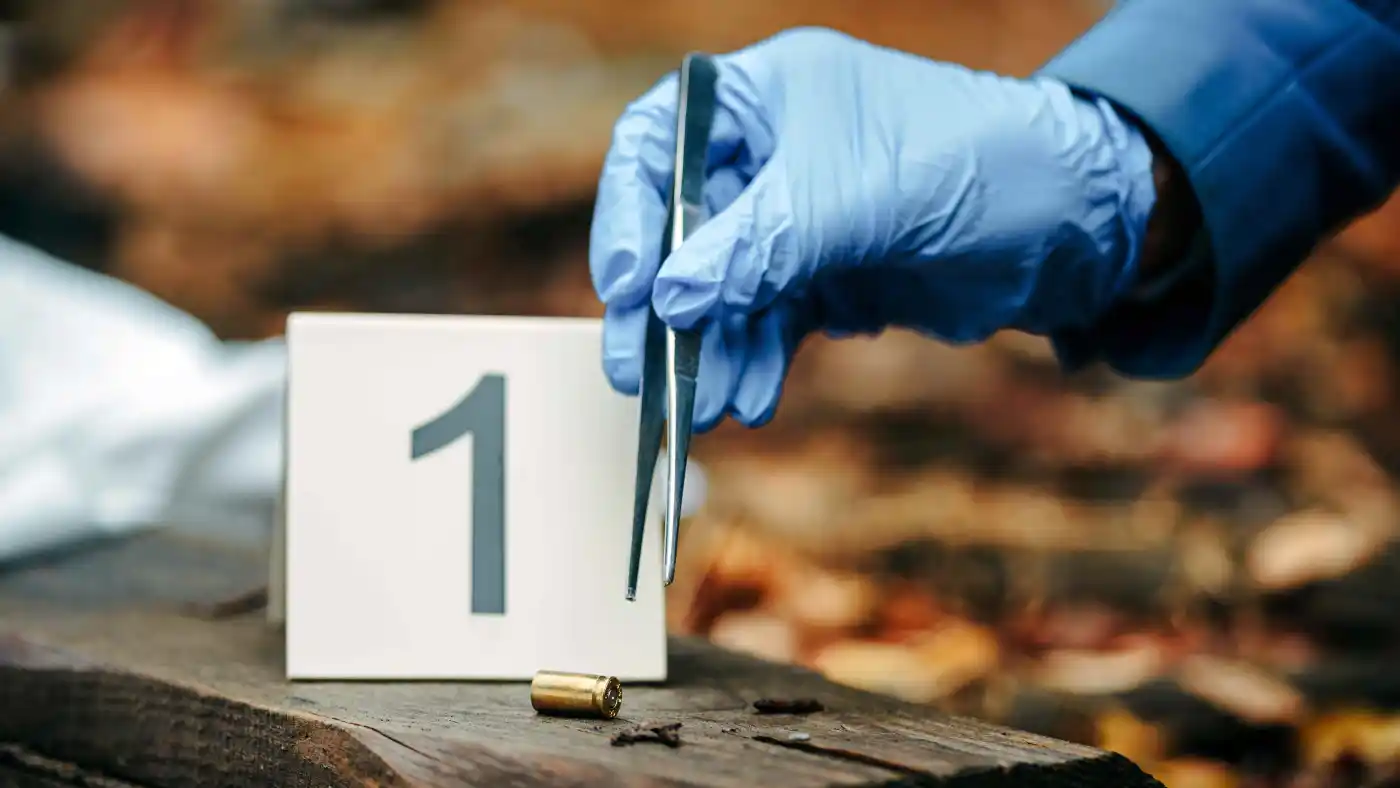
EMILY KWONG: You’ve seen it. I’ve seen it– crime scene investigators doing what they do best– making perfect TV.
[AUDIO PLAYBACK]
SPEAKER 2: Kind of light.
SPEAKER 3: What, are you working for OSHA now? [SCOFFS] This is a Lady Macbeth.
[END PLAYBACK]
CHRIS FABRICANT: Forensic evidence in those shows is presented as conclusive, objective, infallible. They get the bad guy in a half hour and wrap it up.
KWONG: That’s Chris Fabricant, the Director of Strategic Litigation at the Innocence Project. He started out as a public defender in New York City, in the Bronx. And he told us, in the early 2000s, forensic evidence came up all the time in court, the kind presented on TV and widely used by law enforcement in the real world.
FABRICANT: DNA evidence, blood-spatter evidence, what your listeners will think of as ballistics evidence, psychological evidence– the heavier the cases are, the more forensics that are involved in the case.
KWONG: Over the years, Chris watched law enforcement and forensic experts present this evidence as a silver bullet.
FABRICANT: It’s almost always admitted by the court, no matter how vigorous of a challenge beforehand. And it’s almost always accepted by lay jurors as providing an objective, scientific truth that they wouldn’t be able to glean for themselves.
KWONG: But then a watershed report came out in 2009 from the National Academy of Sciences.
FABRICANT: That examined 13 of the most commonly used forensic techniques and found the conclusions that were being accepted in criminal courts were scientifically indefensible.
KWONG: Chris has a simpler term for these techniques. He calls them “junk science.” Anyway, later that year, the White House Office of Science and Technology Policy created a subcommittee on forensic science to address problems and strengthen forensics overall. And then, a few years later, the Innocence Project partnered with criminal defense lawyers, the FBI, and the DOJ to review more than 2,000 criminal cases involving the debunked technique of microscopic hair analysis. It’s progress. But as any true crime enthusiast will tell you, forensic science has not fallen by the wayside– far from it.
FABRICANT: Over half of all known wrongful convictions are attributable to the use of junk science.
KWONG: And Chris says that is a problem. Today on the show, the junk science keeping people in jail. We’re diving into the forensic techniques that have been completely debunked, the ones that should be examined more carefully, and the systems that have kept them alive in criminal courts for so long. I’m Emily Kwong. And you’re listening to Short Wave, the science podcast from NPR.
KWONG: OK, Chris, I’m going to start us off with your words. You have called certain forensic techniques “junk science” and said they don’t come from the world of science.
FABRICANT: Yes.
KWONG: So where do they come from?
FABRICANT: Forensic sciences are often created by law enforcement for law enforcement purposes, often to solve a particular crime. That’s not the scientific method. That’s expedient to get a conviction. And once a forensic technique has been admitted in a criminal court, it’s forever thereafter accepted by other courts. Legal precedent reigns supreme in criminal law. The first time that something is introduced in court and accepted by court, there’s a legal precedent is established. And it’s very, very difficult to get any other court to exclude that evidence.
KWONG: So there’s a lot of forensic science that appears in courtrooms as evidence in TV courtrooms, but also, some courtrooms around the country. There’s so many different tools that have been used in this way. We can’t cover all of them, so let’s just focus on three.
FABRICANT: OK.
KWONG: I want to start with hair microscopy. What is that?
FABRICANT: Hair microscopy is a discredited technique that was used to match suspects to hairs found at crime scenes, fundamentally. So a hair was found in a probative place at a crime scene. A suspect is developed. You pluck some hairs from the suspect, and you examine the questioned hair and the known hair side by side under a microscope and declare a match. But it was dressed up as very sciencey by the FBI, primarily. They claimed that there was a match. Often, they would make a probabilistic statement, like that it’s very, very likely that it came from this suspect, or something along those lines. But what they didn’t know, in reality, was, it could be 1 in 10 people might also match that hair, or 1 in 10 million, right?
KWONG: Whoa.
FABRICANT: They really had no idea. And it was– it took nearly 70 wrongful convictions– 70– before the FBI and the Department of Justice came to the Innocence Project and the National Association of Criminal Defense Lawyers, and admitted that their agents had been overstating the significance of this evidence.
KWONG: And comparing bite marks, I suppose, made by people’s teeth has also been used as evidence. What do you think about that?
FABRICANT: Bite marks are garbage. They should never have been used.
KWONG: Tell me how you really feel. OK.
FABRICANT: There’s nothing probative that could ever come from a so-called bite mark comparison. Eyeballing an injury and determining that it’s a so-called bite mark, the research shows, and anecdotally, from wrongful convictions, forensic dentists are no better than you and me at diagnosing an injury as an adult human bite mark. And beyond that is that these dentists were taking photographs of these injuries at a moment in time. A decomposing body changes hour to hour, day to day, week to week. So a so-called match, you know, could be a match one day and not–
KWONG: Yeah.
FABRICANT: –match the next.
KWONG: One of the most widespread techniques that the FBI has also supported is blood spatter analysis. And what’s interesting about this one– I did a little reading– ProPublica has a really good article about it– that this method was created by a scientist, someone with a chemistry degree who–
FABRICANT: Right.
KWONG: –kind of got into forensics. What do you think of blood spatter work in forensics today?
FABRICANT: Well, there is a there-there with blood spatter evidence, if it’s done by an expert who understands trigonometry, understands the effect of gravity on blood spatter, and understands fluid dynamics, which is an area of research that’s highly technical and highly scientific, and beyond the ken, certainly, of your average crime scene technician. So if it’s done in a way that it can be relatively rigorous and modest in what it can and cannot say, it could be used. The trouble is, blood spatter evidence is often used by under-trained police officers who don’t have a background in mathematics or real science. And it’s used to explain an entire crime scene, how everything unfolded, and way overstated and has led to wrongful conviction.
KWONG: Yeah. I want to talk about the people who are presenting this evidence. You describe them as they’re forensic experts. And they’re presented as having significant backgrounds in science. And that’s a key part of why juries should believe them. What do you think about the people who are the ones taking the stand to share this evidence in trial?
FABRICANT: Well, forensic experts, I should say, are well-intentioned, smart, dedicated, well-trained in their fields, and are trying to do the right thing. You know, they believe that they’re participating in a civic responsibility. Troublingly, many of them look at themselves as crime-fighters or crime-solvers, which is, of course, not a scientist’s role, which is to provide objective, scientific information. The trouble with most forensic experts and in their fields, is that there are less formal training. They don’t have degrees in science. And they’re not required to have degrees in science. And they’ve accepted at face value the overstated and exaggerated claims that their mentors have taught them.
KWONG: Of the methods we’ve described, have any fallen out of favor in a way that you’re like, this is good? It’s the method that’s the problem. Or is it actually the whole field that’s the problem?
FABRICANT: I get asked that question a fair amount. People say that, you know, we’re not using hair microscopy anymore, and we’re not using bite marks, or what have you. And the reality is that we are, in that I get a call all the time from defense attorneys that are seeking to resist the introduction of those techniques. But new junk science emerges every day. Let’s talk about ShotSpotter evidence, right? This is supposed to be a digital, acoustic, forensic technique that allows police officers to detect gunshots and separate those sounds from all other loud noises, and then direct police resources to the sound of gunshots.
KWONG: Wow.
FABRICANT: And that sounds reasonable, right?
KWONG: Yeah.
FABRICANT: But actually, it’s worse than flipping a coin as to whether or not there are actual gunshots. You know, without real scientific scrutiny, the chance of a forensic technique being introduced at trial and being wrong or exaggerated is overwhelming.
KWONG: What you’re describing, the way that forensic science is widely used in courtrooms across the country, of course, has consequences. Your colleagues and you have found that when this happens, it leads to false convictions. How often is that happening, and to whom?
FABRICANT: Well, the “to whom” question is overwhelmingly poor people and disproportionately Black and Brown people. That’s true with everything about the criminal legal system in the United States. This is happening all over. Before I got to the Innocence Project, I had never litigated a capital case. And I naively assumed that in capital litigation, that the science would be much more rigorous, that the evidence would be much more rigorously tested, that the evidence would be more carefully scrutinized, that courts would exclude unreliable evidence because the stakes are literally life and death. But what I have found is the opposite– the higher profile, the higher the stakes, the more capital litigation that I’ve done, the more junk science that I’ve seen.
KWONG: Yeah. And I understand that’s in part because of something called the CSI effect, where jurors are biased towards forensic evidence because of TV, because of how science is portrayed on CSI or Dexter.
FABRICANT: So there are two versions, or two points of view, on the CSI effect. There’s a prosecutor’s point of view, and there’s the defense attorney’s. Prosecutors argue that CSI effect requires them to introduce scientific evidence, because all these crime shows always have scientific evidence, and that jurors are going to expect scientific evidence. And if they don’t get it, they won’t get their convictions.
KWONG: Wow.
FABRICANT: And what the defense attorneys will tell you is that the CSI effect makes jurors credulous about any scientific evidence that’s presented, because as we talked about earlier, crime television and regular news presents forensic science as infallible.
KWONG: Yeah.
FABRICANT: Always catches the bad guy–
KWONG: Interesting.
FABRICANT: –right?
KWONG: What a pickle.
FABRICANT: I’ve got an easy solution.
KWONG: What is it?
FABRICANT: Well, one is that we need to have something like the FDA for forensics. We have to have a government agency that’s testing the validity and reliability of forensic techniques before they’re ever introduced to make life-and-liberty decisions. And the other thing, the easiest free fix that you could have is to blind the experts from biasing information.
KWONG: To make them more like scientists, where there’s–
FABRICANT: Right.
KWONG: –double-blind studies involving the participants.
FABRICANT: Right. Every other area of science goes through–
KWONG: Yeah.
FABRICANT: –hoops to avoid bias improperly influencing a subjective decision. Nothing like that is done in forensics.
KWONG: And you’re saying that forensic experts, whoever’s presenting this evidence should be far more explicit about the uncertainty involved.
FABRICANT: 100%. That’s a good way to put it. You know, I mean, much of these techniques and much of this testimony is presented as though there is no error rate, literally. No such thing. The other is the limitations, you know, appropriate limitation as to what, you know, a, quote unquote, “match” means. You know, it’s that bullet was fired by that gun, that fingerprint was left by that person, and that shoeprint could only have been made by that shoe, and on and on, called individualization testimony. Does this mean that there couldn’t be somebody else in the universe who might also match this? If you eliminate the possibility of mistake and you make claims of individualization, when the science doesn’t support that, you invite wrongful conviction.
KWONG: Chris, if I may, it doesn’t sound like you’re saying, science should not be allowed in the courtroom at all. You want good science to be allowed in the courtroom.
FABRICANT: Absolutely.
KWONG: And what you’re advocating for is that before the trial happens, there is far higher standards for what is allowed into that courtroom.
FABRICANT: Yes. I mean, we have to have upstream fixes on it. You have to have a separate entity determining what an error rate for the field is, and what the personal error rate for the examiner is, and the validity of the technique outside of the courtroom. Because once you get in the courtroom, the gloves are off.
[MUSIC PLAYING]
KWONG: Well, Chris, thank you so much for sharing a slice of your world with us. I know you’re, by day, a lawyer, but you’ve thought deeply about how science shows up in your world. And I thank you so much for your time.
FABRICANT: Thank you for having me.
KWONG: Chris’s book is called Junk Science and the American Justice System. This episode was produced by Hannah Chinn. It was edited by our showrunner, Rebecca Ramirez, and fact-checked by Tyler Jones. The audio engineer was Jimmy Keeley. I’m Emily Kwong. Thank you for listening to Short Wave from NPR.
[MUSIC PLAYING]
Copyright © 2026 NPR. All rights reserved. Visit our website terms of use and permissions pages at www.npr.org for further information.
Accuracy and availability of transcripts for NPR programming may vary. Transcript text may also be revised to correct errors or match updates to audio. Audio may be edited after its original broadcast or publication. The authoritative record of NPR’s programming is the audio record.
Please note that NPR platforms and products also include some programming produced by third parties; NPR cannot guarantee transcripts for that content and some transcripts may be produced using automated or other tools.
Source: www.npr.org