
I knew things were a little off when the first thing I heard on my walk to the AI Music Awards was “the winner…” followed by the sweet voice of Kelly Clarkson.
No, Miss American Idol did not abandon her feud with the Brooklyn bird to capitalize on her newfound appreciation for AI. But as I approached the Mayan Theater in Downtown Los Angeles on a sunny afternoon to check in for Friday’s inaugural “AI Music Awards,” powered by the “Sonic Intelligence Academy” or “SIQA,” I wondered if her voice was so strong as to echo through the nearly century-old theater-turned-nightclub’s walls. Alas, not so: It was Clarkson’s Christmas classic “Underneath the Tree,” playing from speakers at a local YWCA event across the street.
To qualify for the awards, artists needed to register their tracks to SIQA’s “Verified Registry,” which denotes whether the song was fully AI-generated, made with the assistance of AI or featured a cloned human voice to lead the tune (what the group calls a “human + AI hybrid”).
Registered artists then nominate their peers in the 25 categories up for consideration — everything from “AI Song of the Year” to “Best AI Pop Song” to “Best AI Comedic Song” — and then vote on the winners. One of those nominees was Xania Monet, the AI persona of Telisha “Nikki” Jones, who a day earlier won the AI Album of the Year category at SIQA’s inaugural summit and who would eventually go on to win both artist and song of the year, three out of four of the awards’ top categories. (The fourth, producer of the year, went to “DJ Shawn Q.”)
The Sonic Intelligence Academy is the brainchild of software engineer Timirah “TJ” James and her sister Mia James. Since its January launch, it has worked to establish an awards program to counter the mainstream music industry’s aversion to AI. The group believes there needs to be infrastructure that supports those using AI to create music, rather than dismissing its existence, and it hopes to be an AI counterpart to the longstanding Recording Academy that governs the Grammy Awards. It advocates for artists to publicly associate themselves with their AI-powered work, eager to highlight the humans who helped create the product.
It’s a noble, if surprising, decision to embrace its role as counterculture when AI artists continue to pursue a Billboard charting position. Some of its methods are a little overt, perhaps intentionally: After some in the industry spurned the idea of AI-generated music charting on Billboard’s industry-standard charts, the group used a week in January ahead of the Grammys to launch its own charts exclusively for AI music. The Mayan is a 12-minute walk from the Crypto.com Arena, the Grammys’ longtime home.
The moves are not subtle, but subtlety is not the organization’s goal. The group and awards’ existence alone reflects those in the AI music space trying to move past the thorny legal questions surrounding AI music, which have led to lawsuits by artists and record labels against generators like Suno and Udio over copyright infringement, and into a realm of relevance within the genres they’re trying to embody.
It is, in a word, new, and new things mean kinks to work out.
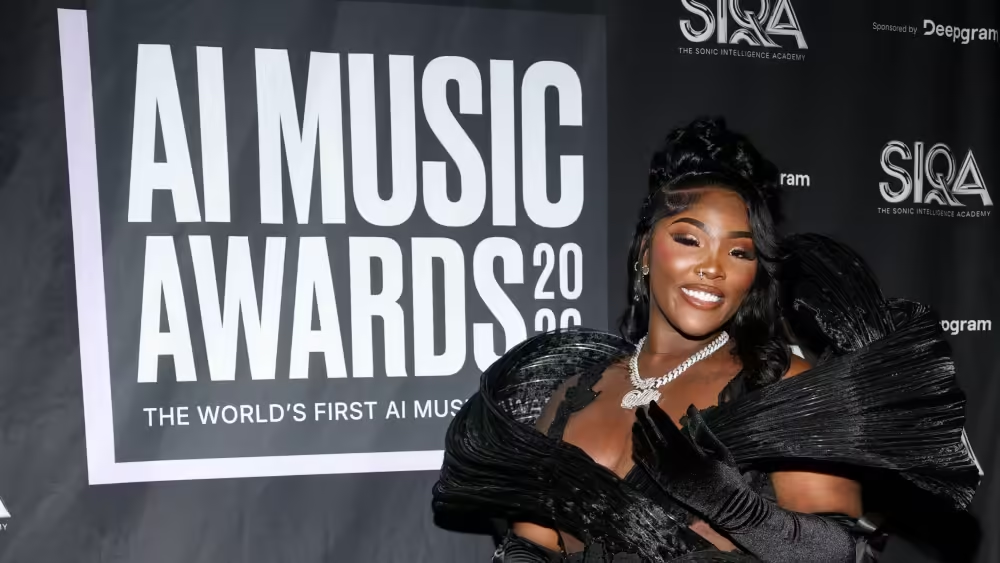
The first kink I noticed was when, as I arrived 30 minutes before the red carpet was set to begin, the doors to the venue were locked. I had to pull on each door before someone opened one, which led me to the check-in stand (bypassing any form of security, which didn’t seem to exist). I entered the foyer and arrived at the makeshift red carpet, where about 12, mostly independent media ventures set up cameras to interview the various nominees, presenters, and VIPs who’d grace the roughly 7-foot-long red carpet in front of one of the two step-and-repeat backdrops. A spokesperson told me 29 media outlets had signed up to cover the event, but that some couldn’t make it because of the sudden flight ground-stop issued by the Federal Aviation Administration around 12:30 p.m. PT. Whether human or AI, aviation afflictions come for us all.
The guests gracing the red carpet were not screens rolled out displaying AI avatars, contrary to a reasonable assumption. Instead, the human creators behind the digital faces strutted the carpet in their Sunday best, treating the night less as music’s biggest night and more as the biggest night for their music. Sequined dresses and colorful blazers strolled through, stopping to speak with outlets like Reuters to the fiery red mohawk-sporting, sequin-wearing host of “The Iconic Punk Oz” Oz Powers to, tucked against a wall and steps from the red carpet, an effective AI red carpet correspondent housed inside a tall, white faux-stone vessel. The contraption was developed by the event’s top sponsor, Deepgram, an AI startup specializing in text-to-speech agents.
The device, which knew the artists and pressed them about the event, struck in me a slight fear about whether people might opt for robot reporters instead of humans, though that fear subsided when I realized this device could not appear on the red carpet because it could not move. The creators seemed more eager to speak to the physical reporters anyway, with some of them emphasizing the human elements of their AI work. Fredro Starr, one half of the rap group Onyx, spent much of the carpet touting the human vocals that made up his AI-beat-laden record “It All Started in Brooklyn,” which he claimed was the first AI album on vinyl.
“You can’t replace [humans],” Starr told me, using the carpet to debut his new moniker, “Mad AI.” “The feeling that you get was what we bring with the spirit of hip-hop. So vocally, you can hear that, but the AI just took it to another level.”
Inside the theater, SIQA tried to bring a party-like feel to the function. A bar at the back of the venue —at a charge — kept well drinks flowing, and the bar top was littered with copies of a sponsored version of the newspaper “Rolling Out” featuring interviews with many of the nominees and James, the SIQA founder. One of those featured, Xania Monet founder Jones, sparked a wave of controversy last year when some of her Monet songs hit some of Billboard’s genre charts, leading to an interview with CBS’s Gayle King and to Kehlani slamming a $3 million record deal Jones received. As she waited for a drink by the bar ahead of the event’s start, Jones told me she wasn’t worried about the AI of it all overshadowing the pursuit of legitimacy within the greater music industry.
“AI is just a tool,” she said. “It just emphasizes what we do. I just feel like we should all be one.”
But despite that lofty goal, the kinks kept rearing their heads.
The event started about 30 minutes past its 6:15 p.m. start time, skipping a planned opening video montage for a dance break performed and choreographed by actor Giovanni Wilson with eight dancers to a seemingly AI-produced song that described — in literal terms — how we were at the inaugural AI music awards. The delay forced the show to skip introducing the nominees for the first half of the awards and instead have presenters just state the winner, robbing some attendees of hearing their names called for what felt like one of their biggest achievements.
The event was hosted by Wilson and podcast host Lana Hout, one half of the podcasting duo the “AI Chicks,” with a three-member house band of real people playing guitar, bass, keys and drums, soundtracking much of the night. The two hosts shared the only two microphones apparently available throughout the night, with a teleprompter loaded with the Claude-generated run-of-show, but they often seemed lost about what category, presenter, performance or commercial break was next.
At one point, Hout and Wilson were confused over whether they would cut to commercial or bring out the two presenters for best AI country artist. They then brought out the two country award presenters, only for Hout to walk back out mid-introduction to interrupt and say that, actually, they would go to commercial break. The award was eventually presented 13 minutes later with a different presenter.
Oftentimes, the use of AI seemed to hover over some of the technical hiccups. Deepgram was meant to power an AI voice that introduced the night’s presenters and nominees, but it often didn’t work and, when it did, talked over many of the presenters. Deepgram also had a commercial that played throughout the evening, but it would sometimes play at random moments even when a commercial break wasn’t called. The Deepgram team sat on the couch to my left, and when I looked over to see their reaction to the madness, one member had her head in her hands.
Early in the night, Wilson tried to introduce a trailer for his latest acting gig, the Terrance Howard-led film “A Good Hand Wasted” that he said used AI to help finish the project, but none of Wilson’s cues seemed to get it to play. Once it finally did, the screen only played a portion of the trailer before Howard’s face even appeared.
“So, ugh,” he said, before raising his hand to summon the audience’s applause.
The teleprompter was not much help, often shifting rapidly as presenters were speaking. The chaos led Wilson, who spent much of the night trying to maintain some decorum throughout the frustration, to joke they were “dealing with a prompter that has Tourette’s.”
The commercials for the event featured Deepgram and a new social network called “Trinity Social,” with the latter’s AI-generated ad featuring a persona wearing a necklace of the Rockstar Games logo encouraging a stadium full of generated people to sign up for the app. A Rockstar spokesperson did not respond to an immediate request for comment on whether it authorized the logo, though if it did not, the ad would represent the latest in AI content lifting copyrighted material without permission, all at an event celebrating a use of AI that has rankled the music industry over similar concerns.
Some of the greatest energy came from the evening’s nearly 10 performances, all of which made the cut despite the event running nearly 40 minutes behind schedule the entire night.
There had been some speculation over how, exactly, songs produced with AI and presented by AI avatars would play on stage. It turns out, through the power of lip-syncing and acting. Some acts, like country artist Ava Bentley and R&B artist EJ Rogers, lip-synced their entire performance, while others relied on hired performers who did even that for them. For “Chaisen Hale,” a project that features a video of an AI-generated boy with AI-generated vocals, a human lookalike singer named John Victor, 14, was brought out to lip-sync to the track.
Nearly all of the performances were backed by the live band and dancers, who were provided to the artists for free by SIQA. Many who produce music with AI say they did so because they could not afford the studio musicians and resources required to bring their tracks to life, which made the reliance on the house band feel more like an opportunity to live out their dreams without the cost often paid by traditional artists who hire such musicians to produce their work.
Some of the only actual live vocals came from a rapper named GodFellow and Grammy-winning singers Eric Bellinger and Candace Wakefield, the latter of whom made a point to note the “hiccups” throughout the night and that she was singing live as she performed a song by AI artist “Aria Blue.” The performances captured much of what remained in the crowd, which grew smaller and smaller as the night progressed.
James, the SIQA founder, acknowledged the “technical difficulties” ahead of presenting Jones with her awards, but she promised those would be resolved ahead of next year’s ceremony.
“Because there will be a next year because this is the new music industry,” she told the crowd around 9:45 p.m., just as it was hitting its hard end time. ”SIQA has created the infrastructure for that industry and for all the artists coming up in that industry.”
And for many of the people in the room, that’s all they wanted. One artist, Sheena Taylor, accepted her award for best AI gospel song for a track called “I Denounce You, Satan,” by acknowledging the intense traumas she endured that led to a religious discovery. Another artist named Ramona Höffel, a 56-year-old woman who spends her days helping disabled people, flew in from Switzerland to represent her AI persona “Vireya” on her first-ever red carpet. (When I addressed her by her given name, she snapped at me.)
“I have a lot of ideas and wishes, and for a long time I paint, then I write, and that’s not enough,” she said, visibly nervous to be the first person to walk the red carpet. “The music gives me room to all this bring outside of my brain.”
I thought about Höffel’s words as I left the venue just after 10 p.m., well past the event’s scheduled 9:30 end, and into the downtown rain. To my right was a line forming to get into the venue for “Club 2010s” night, now delayed due to the prolonged awards show. It’s unclear whether AI music will generate an enduring monoculture in the way the music from the 2010s has, particularly as the larger music industry has mostly ostracized it. But it’s left people like Höffel feeling stronger, which is all someone like 2011 chart-topper Kelly Clarkson could ask for.
Source: variety.com