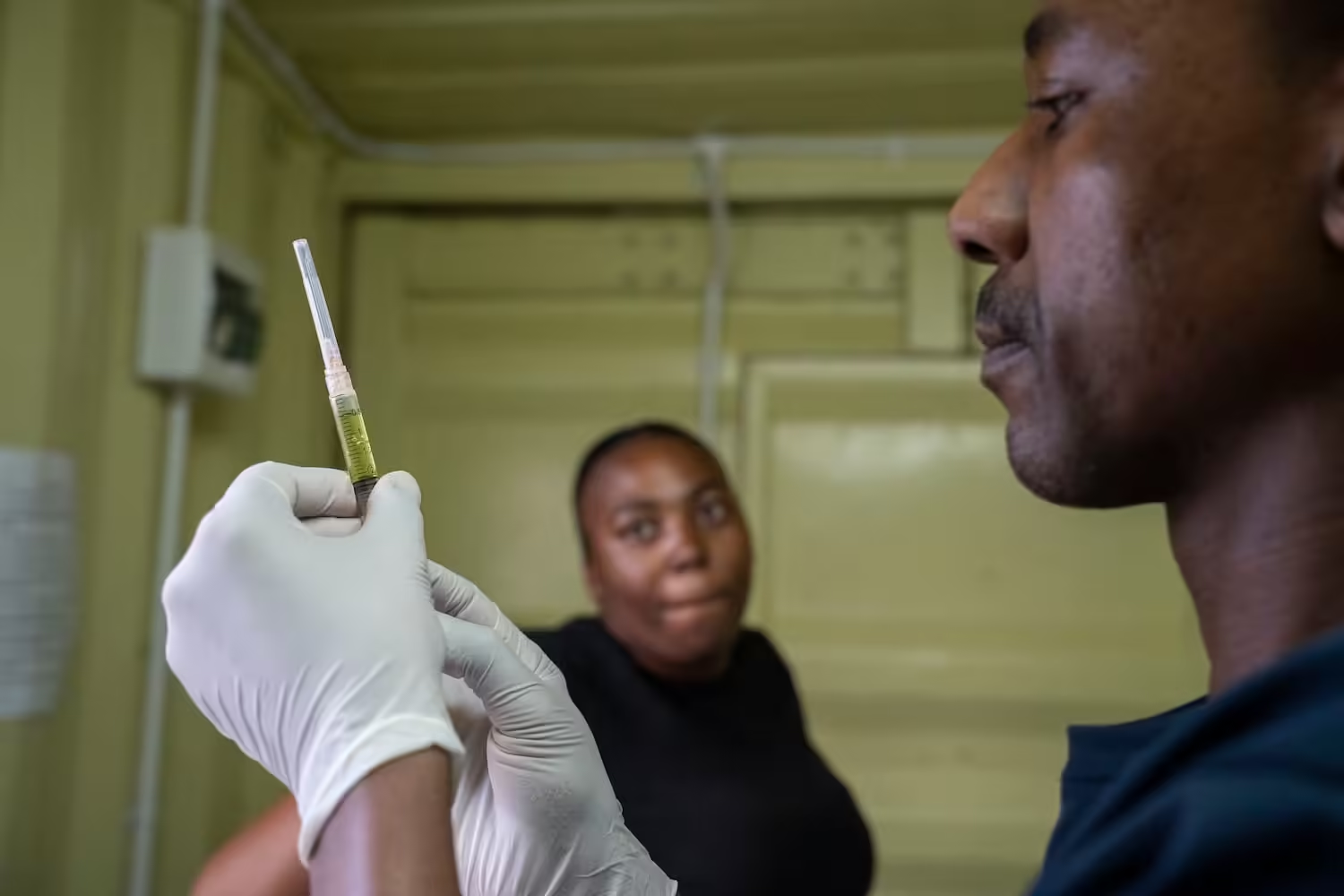

Two years ago, Linda-Gail Bekker was jubilant. She had just led a major clinical trial in South Africa, the epicenter of the global HIV epidemic, testing a new form of prevention that was astonishingly effective. The drug, lenacapavir, is a pre-exposure prophylaxis (PrEP), which blocks the virus from spreading in HIV-negative people. A twice-yearly injection could replace daily pills, offering longer-lasting protection and thus slowing the spread of the virus.
When Bekker, the CEO of the Desmond Tutu Health Foundation in Cape Town, South Africa, announced the results of her trial at the International AIDS Conference in Munich in July 2024, the room erupted in a standing ovation. “There was huge anticipation and excitement. And then January came around, and suddenly that all disappeared,” she said, referring to the start of U.S. President Donald Trump’s second term.
The Trump administration took a chainsaw to global health programs, including the U.S. President’s Emergency Plan for AIDS Relief (PEPFAR), which has provided around $8 billion to South Africa since 2003. South Africa pays for most of its own HIV programs, including 90 percent of its antiretroviral drugs. Still, the collapse of PEPFAR was devastating, shuttering clinics for high-risk groups and leaving thousands of health workers without jobs.
South Africa is home to around 8 million people living with HIV, or around 20 percent of the global HIV population. Approximately 6 million of them are on treatment, but the country still records around 170,000 new infections each year.
When South Africa began rolling out lenacapavir this summer, the landscape had changed dramatically. U.S.-South Africa relations have deteriorated, as Trump has objected to South Africa’s genocide case against Israel in the International Court of Justice and accused the country of committing genocide against white Afrikaners. Those tensions have compounded uncertainty for the HIV program.
Last year, the United States provided South Africa with $115 million to keep core HIV services running, but in June, the Trump administration said it would end all PEPFAR funding for the country in the coming months. Washington also excluded South Africa from global health financing deals struck this year with other African countries. Even as the United States supports the lenacapavir launch elsewhere, it isn’t doing so in South Africa.
In an email, a U.S. State Department spokesperson confirmed that the political rift played a role in the decision to phase out PEPFAR funding. The spokesperson said PEPFAR was never meant to be a permanent initiative and that South Africa is “more than capable of supporting its own health programs” as a middle-income country.
It’s a departure from decades of U.S. foreign policy, said Jirair Ratevosian, a former senior PEPFAR official under President Joe Biden. “South Africa and the United States have never been perfectly aligned on foreign policy,” Ratevosian said. But the United States “was able to compartmentalize those disagreements and still cooperate on other big areas of interest that were aligned, and HIV was always one of those.”
Now, South Africa is left to manage its lenacapavir rollout without its historically biggest donor. It’s an early test of whether the country’s post-PEPFAR transition can become a blueprint for weathering the U.S. retreat from global health—or is a cautionary tale.
South African officials have downplayed the loss of U.S. support. In June, a health ministry spokesperson urged people not to panic, saying the government has “long been working on a self-reliance plan.” Officials have not released a formal plan, but they point to local drug manufacturing, stronger public health systems, and regional collaboration on HIV as important steps.
South Africa had a head start in this effort, as PEPFAR already accounted for less than 25 percent of the country’s HIV prevention funding, compared with around 80 percent in neighboring Mozambique and Zimbabwe, according to the Joint U.N. Program on HIV/AIDS last year.
At the launch of the lenacapavir rollout in June, South African President Cyril Ramaphosa told a stadium crowd that the drug would mark a “turning point” for South Africa. Prevention remains a challenge in the country; until now PrEP has only been widely available as a daily pill, which can be difficult to access or stay on. South Africa planned to roll out a different shot that offers two months of protection last year, but high prices and PEPFAR disruptions stalled that effort.
Experts think the twice-yearly lenacapavir shot could be a game-changer. Modeling suggests that if between 1.7 million and 2.9 million South Africans get on lenacapavir each year, new infections could fall by as much as 31 percent, potentially allowing the country to eliminate HIV as a public health threat as soon as 2039. But first, South Africa must get the drug to people who need it.
In June, Ramaphosa said 3 million people will be offered lenacapavir over the next three years. The government has already secured enough doses to cover 456,000 people, funded with $29.2 million from the Global Fund to Fight AIDS, Tuberculosis, and Malaria. The first tranche was allocated to 360 public health facilities in high-burden districts, but as of mid-October, just under 79,000 South Africans had started lenacapavir, according to health ministry data.
Activists are frustrated by what they view as a sluggish rollout driven by funding gaps, insufficient planning, and regulatory bottlenecks. Some South African clinics have turned away patients seeking lenacapavir, some after running out of doses and others over logistical problems. Early in the rollout, facilities in the capital of Pretoria lacked HIV testing kits—a prerequisite to get the shot—or had not yet trained nurses to administer the drug.
“It’s a drip feed of supplies,” said Fatima Hassan, a human rights lawyer and the founder of the Health Justice Initiative in Cape Town. The U.S. funding cuts and the pace of the rollout are “putting our entire health system in jeopardy and all the gains we’ve made in the last 20 years at risk.”
The government has tried to plug some of the funding gaps left by the United States. Last year, the South African Treasury allocated around $45 million in emergency funding to cover some HIV programs, roughly one-tenth of what PEPFAR contributed in 2024. But that money does not resolve the question of what will happen to these services in the long term.
The State Department spokesperson said the United States would “reconsider future health assistance during the phase-out period”—but only if South Africa takes “concrete, demonstrable action” to remedy the Trump administration’s accusations that its government seizes land from white farmers, among other complaints.
South African Health Minister Aaron Motsoaledi has said the country plans to eventually finance its lenacapavir program itself, with help from donors. “To establish a couple million doses-deep lenacapavir program in the next couple of years, we will need outside help,” said Gesine Meyer-Rath, a health economist at the University of the Witwatersrand and Boston University.
But it is not yet clear which donors will provide that help. The Global Fund, which supported the initial rollout, plans to cut South Africa’s HIV/AIDS funding by 26 percent in its next allocation cycle as it tightens its focus on the poorest countries hit hardest by HIV, TB, and malaria. A South African health ministry spokesperson did not respond to questions about the lenacapavir rollout or its “self-reliance plan.”
South Africa is betting that a generic form of lenacapavir will hit the market just as the initial supply runs out, allowing the government to roll out the drug to hundreds more clinics. Gilead Sciences, the U.S. developer of lenacapavir, agreed to make a generic version available in 120 lower- and middle-income countries, including South Africa, for $40 per person per year; it is expected by the end of the year in Zambia and elsewhere in 2027. The Global Fund negotiated a confidential price with the drugmaker for the initial shots in South Africa and other recipient countries, but brand-name lenacapavir goes for roughly $28,000 per person per year in the United States. South African health officials say the generic price must be brought down to $25 to guarantee “universal access.”
Eventually, South Africa wants to manufacture lenacapavir itself, but that effort has also encountered roadblocks. In 2024, three South African pharmaceutical companies asked Gilead for permission to make generic versions, but they were rejected because they could not handle the 28-step process of synthesizing the drug’s active ingredient. South Africa’s government is now working with Gilead and technical advisors to make local production possible.
Clinicians and civil society groups warn that supply isn’t the only problem—it’s also about getting the lenacapavir shots to those who need it most, including sex workers, men who have sex with men, transgender people, and injectable drug users. But the 12 PEPFAR-funded specialized clinics and community-based outreach for these key populations, which served more than 63,000 people, have not been replaced.
“I do not think that the people who are suffering access issues because of the PEPFAR cuts are going to be the ones to get the drug,” said Kate Rees, a public health specialist at the Anova Health Institute, which suspended its PEPFAR-funded programs. “We know how to reach key populations, and waiting for them in the clinic is not it.”
Meyer-Rath, the health economist, said she has attended early planning meetings with government officials who want to reopen services for these populations and try to integrate patients into public health facilities—but that the budget available is “nonexistent or marginal.”
Another challenge: PEPFAR covered around 40 percent of South Africa’s HIV data workforce, which tracks infections and treatment uptake in HIV hot spots. With fewer of those workers, the patients who miss out on lenacapavir because they fall through the cracks of the traditional health system—as vulnerable groups tend to do—may go uncounted, making it harder to identify problems and surge support where it’s needed.
The next phase of the lenacapavir rollout is fast approaching, and it will test the country’s infrastructure as well as its supply. The first South Africans to receive the drug are due for their second shot in December, and clinics must provide an HIV test and an injection for each of them every six months going forward.
South Africa’s experience is likely to shape rollouts elsewhere, but other early adopters offer their own lessons. Kenya, which launched the drug in February, has used drop-in centers to reach key populations, though it has also struggled with shortages. Meanwhile, Zambia launched with just 500 doses in late 2025, and up to 85 percent of patients there and in Eswatini—which shares a border with South Africa—have returned on time for their second shot, according to Bhekisisa, a South African media outlet.
Lenacapavir is now being scaled up in 12 low- and middle-income countries, with 17 more countries due to receive it by early 2027, according to AVAC, an HIV prevention advocacy group. The rollout of generic lenacapavir next year will be another turning point. It’s a reminder that even if South Africa sticks the landing, there’s still a long way to go to defeat HIV.
“Right now, we are wobbling a bit, and the world is watching us wobble,” Meyer-Rath said. “But basically, it’s either the [South African] government or it’s not. No one will fund the system. We have to.”
Source: foreignpolicy.com