
The dawn of Skydance — the film and TV leviathan that came forth from the biggest media acquisition in 25 years — was enabled by the most influential trend in private investment in a decade: the rise of the family office investor.
“Family office” is cuddly financial jargon for a specific form of holding company that ultrarich people and their relatives rely on to manage their wealth. The proliferation of near billionaires — and billionaires proper — in the U.S. since the stock market boom began in the 1980s has led to the creation of thousands of well-endowed family offices. “The size of this is extraordinary,” says Ian D’Souza, clinical professor of finance at the NYU Stern School of Business. “A lot of people don’t realize just how big they are as an investor class in a global context and their different risk-return drivers.”
Family offices are gaining a level of clout that is having a profound impact on the ownership of media and entertainment assets. Many operate with a low profile — they don’t have the same financial disclosure requirements as other companies and investment firms. Among the most powerful entities flexing financial muscle is Lawrence Investments, the office that handles the prodigious fortune amassed by 82-year-old Larry Ellison, co-founder of software giant Oracle. Ellison is the father of Skydance chairman and CEO David Ellison, the mastermind of Skydance’s quest to bolt together studio and network assets.
The younger Ellison’s one-two punch began last year with his $8 billion acquisition of Paramount and CBS. And then he went in dogged pursuit of Warner Bros., HBO, CNN, Discovery and numerous other channels. It all culminated in the closing of the $111 billion Warner Bros. Discovery transaction on Oct. 6. David Ellison couldn’t have pulled off those head-spinning deals without the full faith and credit backing of the enormous Ellison family wealth held through Lawrence Investments, which has an estimated $160 billion in assets under management. But Ellison’s empire-building boom has been financed with debt.
French billionaire François-Henri Pinault, seen here with his wife, actress Salma Hayek, acquired CAA in 2023 through his Artemis Group.
Corbis via Getty Images
The enlarged Skydance is carrying $80 billion in red ink, and if Skydance doesn’t make its aggressive debt and cost-reduction targets over the next three years, Larry Ellison will personally be on the hook for as much as $40 billion in debt payments to lenders. That’s how far the software mogul, who recently became a major shareholder in the U.S. spinoff of TikTok, went to help finance his son’s Hollywood ambition.
As demonstrated by the Ellison family’s big swing, the influence of family office owners and investors will be markedly different from that of traditional private equity investors, experts say. Among the key differences:
- Family office investors typically invest for the long term. They’re not under the pressure that private equity firms face to sell the company or mount a successful IPO after seven to 10 years.
- They bring expertise to the table, investing in sectors and companies they know well.
- Because family office firms don’t have to answer to shareholders, they have the freedom to pursue “trophy” investments that are seen as burnishing an individual’s or family’s legacy, such as full ownership or partial stakes in sports teams and high-profile entertainment properties.
- They typically don’t have to disclose financial results to anyone beyond their core insiders because they usually don’t take on outside partners or publicly traded debt.
According to data analysis from global investor research firm Altss, the number of family offices has grown at a rate of nearly 5% a year, culminating in more than 8,000 firms managing as much as $5 trillion or more in assets. The top 50 firms have an estimated $2.4 trillion in assets under management; the top 10 alone account for $1.5 trillion.

Kelsey Dake for Variety
Generally speaking, it takes about $250 million in seed money to launch a large single-investor family office. Others are formed with $50 million to $100 million, and sometimes a handful of those firms will join together in a multi-family office. One of the biggest of those is Iconiq Capital, which handles some personal investing for Mark Zuckerberg, Sheryl Sandberg, Jack Dorsey and Linkedin co-founder Reid Hoffman, among others.
The reigning company among family offices remains Walton Enterprises, the $225 billion colossus controlled by the heirs of Walmart founder Sam Walton. Elon Musk, the entrepreneur behind Tesla and SpaceX, funnels some of his personal investments through his Excession family office, valued at $200 billion. Bill Gates’ Cascade Investment is another heavyweight at $170 billion. Amazon pioneer Jeff Bezos holds his roughly 9% stake in the e-commerce giant (which encompasses Amazon MGM Studios and Prime Video) through his Bezos Expeditions office, with an estimated $107 billion in assets under management.
“The ability to create wealth over a short period of time right now is incredible, and because of that, all of a sudden you’ve got someone like Elon buying Twitter and turning it into what he wanted it to be,” says Greg Suess, co-founder and head of Activist Artists Management’s family office practice. “It was unfathomable that you would see an individual be able to buy a company of that size on his own. But that is the way it is now. A lot of these family offices are of the size where they can take swings on major entertainment assets. That has shocked the industry.”
At the same time, fortunes the size of Ellison’s, Musk’s and the Walton clan’s are still outliers — the 1% of the 1%. The more pervasive impact is coming from the many other family offices steered by less than astronomically wealthy people who are drawn to the soft power of media. Think Steve Sarowitz, the payroll-software billionaire whose Illinois-based 4S Bay Partners family office teamed with Justin Baldoni to launch “It Ends With Us” production company Wayfarer Studios.

The Steward family owns the NHL’s St. Louis Blues franchise.
NHLI via Getty Images
David Steward II has also inherited significant wealth from his father, World Wide Technology co-founder David Steward. The younger Steward in recent years has invested in comic-book imprints and the Lion Forge Entertainment animation studio with the goal of bringing more diverse stories to life as family animation films. The Steward family has also worked with NASCAR and Richard Petty Motorsports to sponsor the groundbreaking driver Bubba Wallace, and it was an owner of the family’s hometown NHL team, the St. Louis Blues, from 2012 until selling the stake in 2024.
“Our mission is very much around what we call diverse stories authentically told. It’s about displaying and telling stories from varied backgrounds, whether it be racial, socioeconomic or gender,” the younger Steward says. “We’re a lot more patient with outcomes because we have a higher vision. We’re not only investing to get a return; we’re investing for change. We’re investing in people at the end of the day. So it’s a different kind of philosophy as we look at those things.
“There are three pillars to any family office that I’ve ever been around,” says Edward Hamati, a wealth management pro who is chief investment officer for the Steward Trust and the Steward Family Office. “Trust, treasury and banking — that’s one bucket. Building the corpus, that’s another bucket. Anyone can give you 50 ways that you do that. And then there’s the third bucket, which is, What is this family about and what do we have to care about because of the family? What are they motivated by? What do the kids want? Is there a lot of family politics? You have to think through all that around any family you work with.”
Joe Becher, CAA’s global managing partner and founder of its executive search practice, has felt the same demand that spurred Suess and partners to form Activist. Becher expanded CAA into family office specialty services as he found himself conducting C-suite searches for firms that had been bought out by family offices.
“Probably two to three years ago we started seeing this trend of family offices popping up everywhere, whether it be in media companies or music-catalog businesses or sports franchises,” Becher says. “Very often, instead of us dealing with an owner in isolation or a private equity firm with institutional capital, we were dealing with family offices. They needed our help to understand the assets that they’ve invested in. They needed our help to structure them the right way and build the right operating teams.”

Software magnate Steve Sarowitz backs Justin Baldoni’s Wayfarer Studios through his 4S Bay Partners. Sarowitz, center, at the 2024 premiere for “It Ends With Us” with Wayfarer’s Jamey Heath, Baldoni, Andrew Calof and guest.
Getty Images
Traditionally, the family office investment model was associated with vintage American family fortunes such as the oil money of the Rockefellers or the publishing and media empires of William Randolph Hearst and E.W. Scripps. Hearst and Scripps still operate as well-established media companies. But their governance structure makes them essentially family offices that are run by trusted staffers who ensure that the generational wealth keeps flowing to heirs for decades to come.
But nothing has animated the family office sector lately like the availability of sports teams and music catalogs. The latter is seen as a form of timeless physical media that will retain value no matter how much music consumption changes in the streaming era. On the other hand, sports franchise deals are usually driven by raw passion and bragging rights.
“There’s only so many of them, and so that sense of paying for scarcity and legacy impact are important drivers for family offices that don’t really exist for other types of pooled capital because they have a time-duration problem,” D’Souza says. Some first-generation wealth generators thrive on the challenge of turning around properties like sports teams or rehabilitating beloved fashion or retail brands. “They feel like, ‘I made it once; I can do it again,’” says D’Souza, who has served as a board member for numerous family offices over the years.
At best, a family office can bring to the table resources and in some cases synergies with other holdings for an acquisition. Steward II notes that the company’s work with NASCAR and driver Wallace led to World Wide Technology upgrading the racing circuit’s digital infrastructure to help it make the most of AI and other cutting-edge tech.
Steward II emphasizes that the company can’t completely ignore financial results. But it has the luxury of options. “We do have the investments that are a little bit colder and distant and more financially oriented. And then we have this entrepreneurial pile, and in that pile comes [ideas] by way of passion and by way of utilizing the relationships that we have,” Steward says. “Everything we’ve done in sports and entertainment has been led by those two things. We want to see change in the industry as well. So how can we best not only put our creative foot forward, but how can we leverage our relationships for change as well?”
The flood of investment and financing dollars flowing into a broad range of industry deals in recent years has turned the private investment vehicles of the ultra-high-net-worth crowd into the most courted players in global investing. “It has become recognized that families are more viable owners of various assets than they were considered to be in the past,” Activist’s Suess says. “The wealth has grown so much. They’ve become business rock stars.”
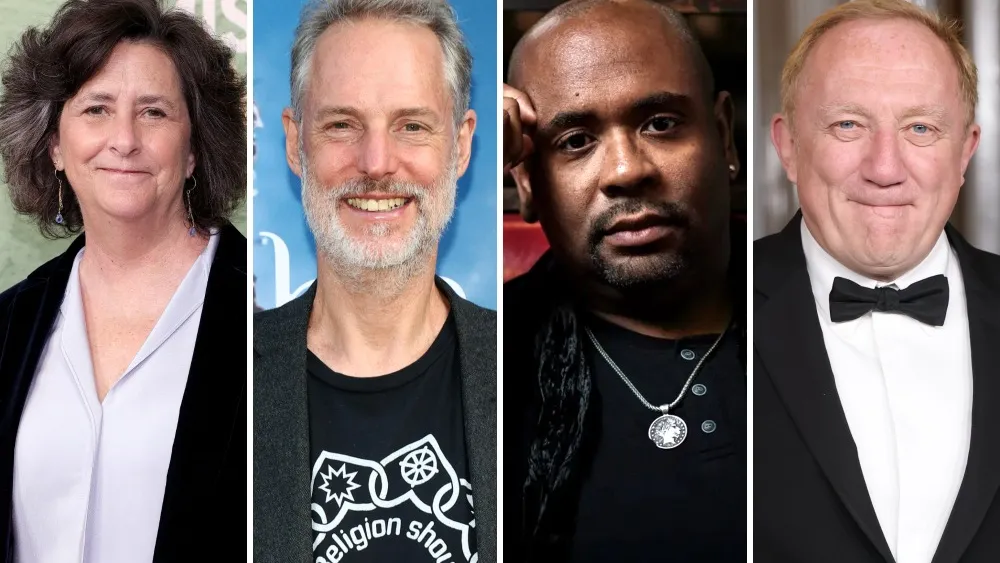
(Pictured top: Family office investors Gigi Pritzker, Steve Sarowitz, David Steward II and François-Henri Pinault)
Source: variety.com