

key takeaway
California has made significant progress toward health coverage for all, but persistent racial and ethnic disparities and harmful federal and state policy changes threaten to reverse that progress. New ongoing state revenue is essential to protecting access to health care, addressing inequities, and minimizing the harm of upcoming coverage cuts.
Health coverage helps Californians see a doctor, fill a prescription, or get behavioral health care when they need it, while protecting them from medical costs they cannot afford. Medi-Cal, California’s Medicaid program, provides free or low-cost coverage to more than 1 in 3 Californians, including children, pregnant individuals, seniors, and people with disabilities. Covered California — the state’s health insurance marketplace established through the Affordable Care Act (ACA) — provides an option for people who do not qualify for Medi-Cal and lack affordable coverage through work. Medicare provides coverage for adults age 65 and older and some people with disabilities. Together, these programs reach millions of people across every stage of life and form the backbone of California’s public health care system.
California has built on these programs to make substantial progress toward health coverage for all, but barriers to getting and keeping coverage persist. Recent federal and state policy choices threaten to widen these gaps and reverse earlier gains. For example:
- H.R. 1, which President Trump signed into law in summer 2025, reduces federal Medicaid funding and imposes new requirements that will make Medi-Cal harder to obtain and maintain.
- California has frozen Medi-Cal enrollment for certain immigrant adults and approved additional coverage restrictions targeting immigrants.
- The expiration of enhanced federal premium tax credits — which the Republican-controlled Congress refused to extend last year — has made Covered California health insurance harder to afford for Californians with low and moderate incomes.
The five facts below examine California’s coverage gains, persistent inequities, and declining Medi-Cal enrollment among immigrants and children. They highlight what is at stake and the steps state leaders can take to prevent further coverage losses. The companion publication, Affordable Health Care Is Out of Reach for Many Californians, examines the financial barriers people face even when they have health insurance. Together, these publications show why affordable health coverage is essential to Californians’ health and financial security.
1. 1 in 3 Californians Count on Medi-Cal for Health Care, but Deep Federal and State Cuts Threaten Access to Care
Medi-Cal provides free or low-cost health care to nearly 1 in 3 Californians under age 65 and is one of California’s most effective tools for expanding health care access and advancing health equity. More than half of Medi-Cal enrollees are Latinx Californians, who are most likely to work in low-wage jobs without access to employer-sponsored insurance.
Medi-Cal ensures that millions of Californians can see a doctor, fill a prescription, or get behavioral health care when they need it. But federal policy changes enacted in H.R. 1 will make it harder for people to keep their health care coverage. The law sharply reduces federal funding for Medicaid — cutting tens of billions in federal funding every year — and adds new eligibility and access restrictions that could cause 1.3 million Californians to lose coverage.
For those not eligible for Medi-Cal, Covered California remains a vital source of coverage. In 2026, nearly 2 million Californians purchased insurance through the marketplace, a near-record high. Yet the affordability of this coverage is at risk. H.R. 1 cut support for the marketplace, and Congress failed to extend the enhanced premium tax credits that had made coverage more affordable. The result was swift and severe: More than 1 in 5 Californians (22%) who lost their enhanced premium tax credits cancelled their health insurance in 2026, twice the 2025 rate. And, premiums nearly doubled, on average, for Covered California enrollees.
2. California’s Uninsured Rate Remained Low in 2025, but Large Increases Are Expected
California made substantial progress in expanding access to health coverage over the past decade. Key drivers of this success include the federal Affordable Care Act and state initiatives, such as expanding full-scope Medi-Cal to all income-eligible Californians regardless of immigration status. As a result, the share of Californians without health coverage has generally decreased since 2011, and this trend continued in 2025 as the uninsured rate fell to 4.5%, according to California Health Interview Survey data.
However, recent state and federal funding cuts and policy changes moved California away from providing health care for all — as a result, the share of Californians who lack health coverage is expected to increase. Federal Medicaid cuts — including work requirements and more frequent eligibility checks — combined with state cuts limiting immigrant Californians’ access to health care will reverse the historic progress California has made in lowering the uninsured rate. Research from the Berkeley Labor Center estimates that 4.6 million Californians will be uninsured by 2030 and the uninsured rate will rise to 14.7%, more than double what it was in 2025. Without state action, millions of Californians will face more medical debt and impossible choices between caring for themselves and their families or other basic needs.
3. Health Inequities Are Largest for Latinx Californians
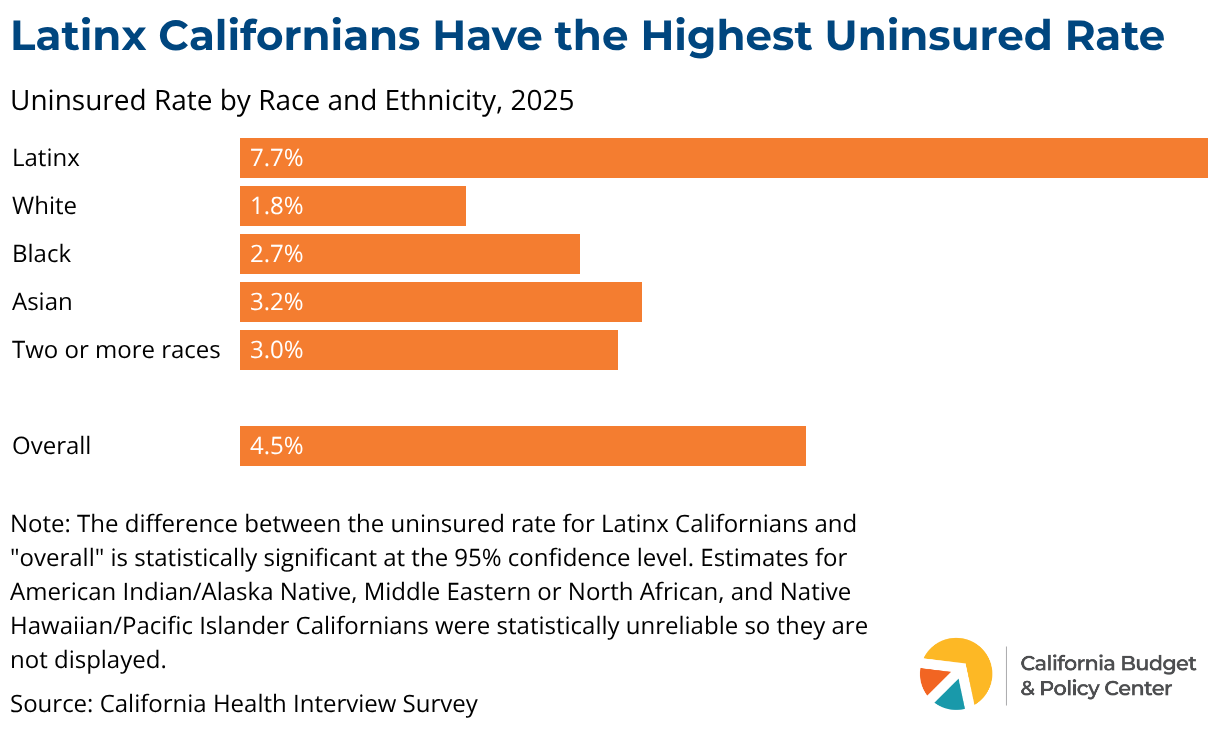
While the uninsured rate has fallen over time, racial disparities persist in California. For example, Latinx Californians had the highest uninsured rate (7.7%) among racial and ethnic groups in California in 2025, continuing a trend from 2023 and 2024. Racial disparities in health coverage highlight the profound and enduring impact of racist policies and practices, which block Californians of color from equal access to health care. Addressing racial disparities in health coverage requires targeted outreach and education efforts along with other antiracist policies to improve health and well-being for Californians of color.
Unfortunately, federal and state cuts targeting immigrants’ access to Medi-Cal will worsen existing disparities for Latinx Californians. Over half of all Medi-Cal enrollees (51.4%) are Latinx and about half of all immigrants in California are Latinx. An estimated 1 million Latinx Californians could lose coverage due to federal cuts alone. These cuts will harm the health and well-being of millions of Latinx Californians and will increase health inequities that are already significant.
4. Immigrant Enrollment in Medi-Cal Is Already Sharply Declining Before Major Restrictions Take Effect
In January 2024, following a decade of incremental expansions, all Californians with low incomes were eligible for Medi-Cal regardless of immigration status. Up until June 2025, the number of immigrants in this expansion group enrolled in Medi-Cal was steadily increasing as people were able to access the health care they need, which helps their health, the health of communities, and the state’s economy. However, enrollment of this expansion group has since sharply declined, dropping 24% between June 2025 and June 2026.
H.R. 1 and state cuts to health care access have specifically targeted immigrants and their access to care, including the elimination of Medicaid eligibility for immigrants with humanitarian status, the Medi-Cal enrollment freeze for undocumented Californians, and Medi-Cal premiums for only undocumented Californians. However, many of the most harmful of these cuts have yet to take effect.
Even so, federal and state actions targeting immigrants have increased fear and confusion among immigrant communities. This includes last year’s data intrusion as well as heightened immigration enforcement and detention activity. These threats to the safety and lives of immigrant Californians have led to a fear of use of public benefits, even when people remain eligible. This chilling effect is likely to continue, and combined with cuts targeting immigrants taking effect soon, the recent enrollment decline will worsen without state action. This will leave many immigrant Californians without access to health care.
5. Children’s Medi-Cal Enrollment Is Falling Despite State Coverage Protections
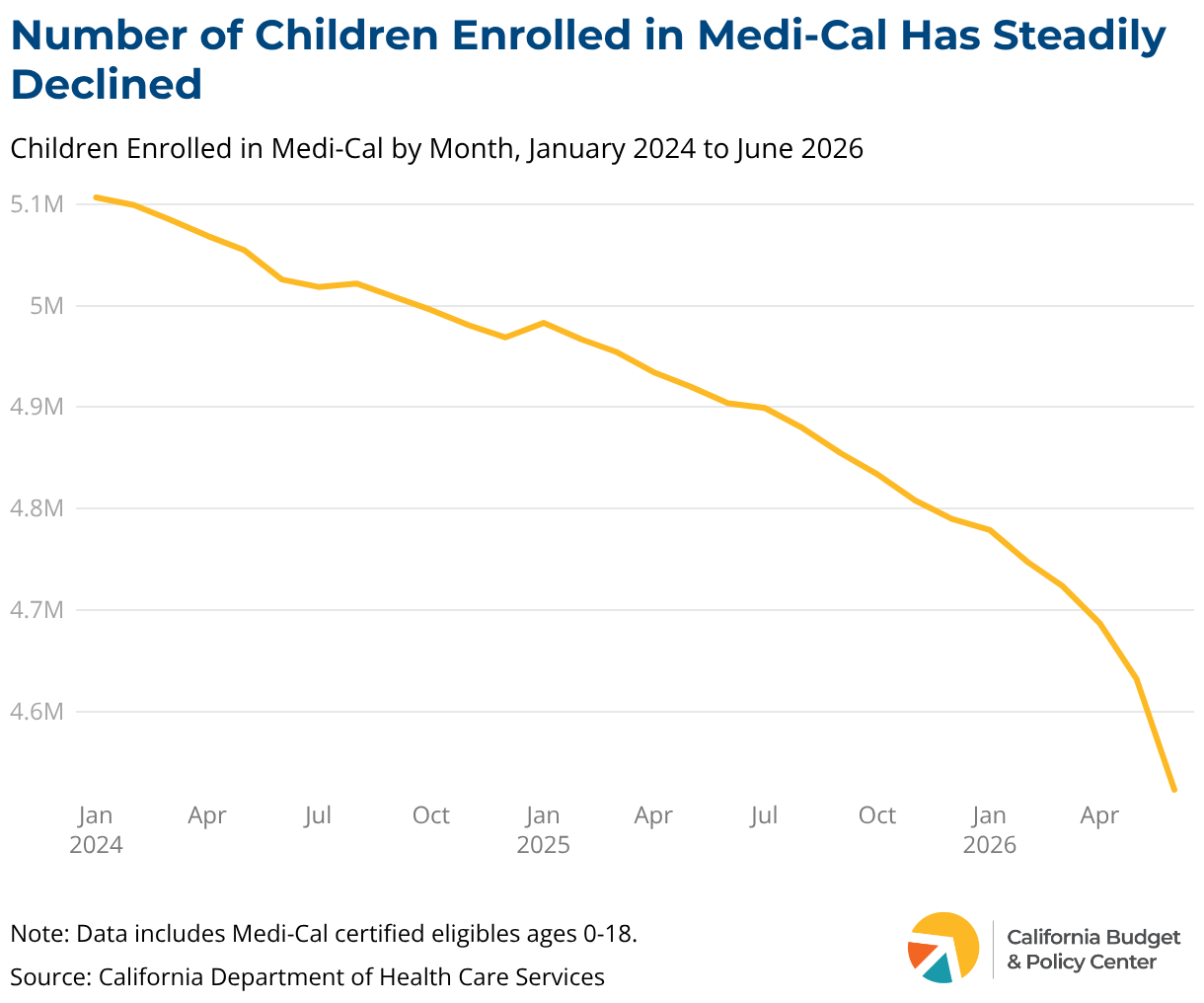
Medi-Cal provides comprehensive health coverage that supports children’s growth and development. California has taken important steps to protect this coverage, including allowing income-eligible children to enroll regardless of immigration status. Yet nearly half a million fewer children were enrolled in Medi-Cal in June 2026 than in January 2025, a roughly 10% decline. Declining enrollment does not necessarily mean that all these children have become uninsured, but it raises concerns about whether eligible children are losing access to coverage.
Administrative barriers, confusion about changing eligibility rules, and immigration-related fears may be contributing to this decline. Children can remain eligible for Medi-Cal even when their parents lose coverage, but families may not understand these different eligibility rules or may struggle to navigate renewal paperwork. Fear of immigration enforcement and the sharing of personal information can also discourage eligible immigrants and mixed-status families from enrolling or maintaining coverage.
These challenges could intensify as new federal and state policies take effect in 2027. Although children under 19 are exempt from work reporting requirements, new paperwork demands on parents could make it harder to maintain coverage for the whole family. Protecting children’s eligibility alone does not ensure that they stay enrolled.
Maintaining coverage is especially important when families are struggling to meet basic needs. In California, 1 in 6 children (16.6%) lived in poverty in 2025, more than double the rate in 2021. For families already struggling to afford housing, food, and child care, paying for a child’s medical needs can put other necessities further out of reach. Medi-Cal provides a critical layer of protection by helping children get preventive care and treatment without adding financial strain to their households. Ensuring eligible children stay enrolled protects both their health and their families’ ability to make ends meet.
Looking Ahead, Policymakers Can Take Action to Protect Access to Health Care
California has made significant progress towards providing health care for all Californians, but disparities across racial and ethnic groups have continued to persist. H.R. 1 and state budget and policy decisions will reverse that progress and increase inequities as more harmful federal and state cuts go into effect next year, unless state leaders take meaningful steps to minimize the harm to people’s access to health care.
New ongoing state revenue is essential to this response. Raising revenue from wealthy individuals and profitable corporations who are benefitting the most from newly expanded federal tax breaks would help California replace lost federal funding, reverse harmful state cuts, and sustain investments in coverage and care. The next governor and Legislature should prioritize these revenue solutions to protect access to affordable care without shifting more costs onto households already struggling to meet basic needs.
Alongside raising revenue, state leaders should:
Communicate proactively, regularly, and effectively with Medi-Cal enrollees.
Prevent Medi-Cal premiums from taking effect.
End the Medi-Cal enrollment freeze for undocumented Californians.
Use state dollars to extend full-scope Medi-Cal to immigrants with humanitarian status.
Use automation to protect coverage under work reporting requirements.
Set new Medi-Cal cost-sharing requirements at the lowest possible level.
Source: calbudgetcenter.org