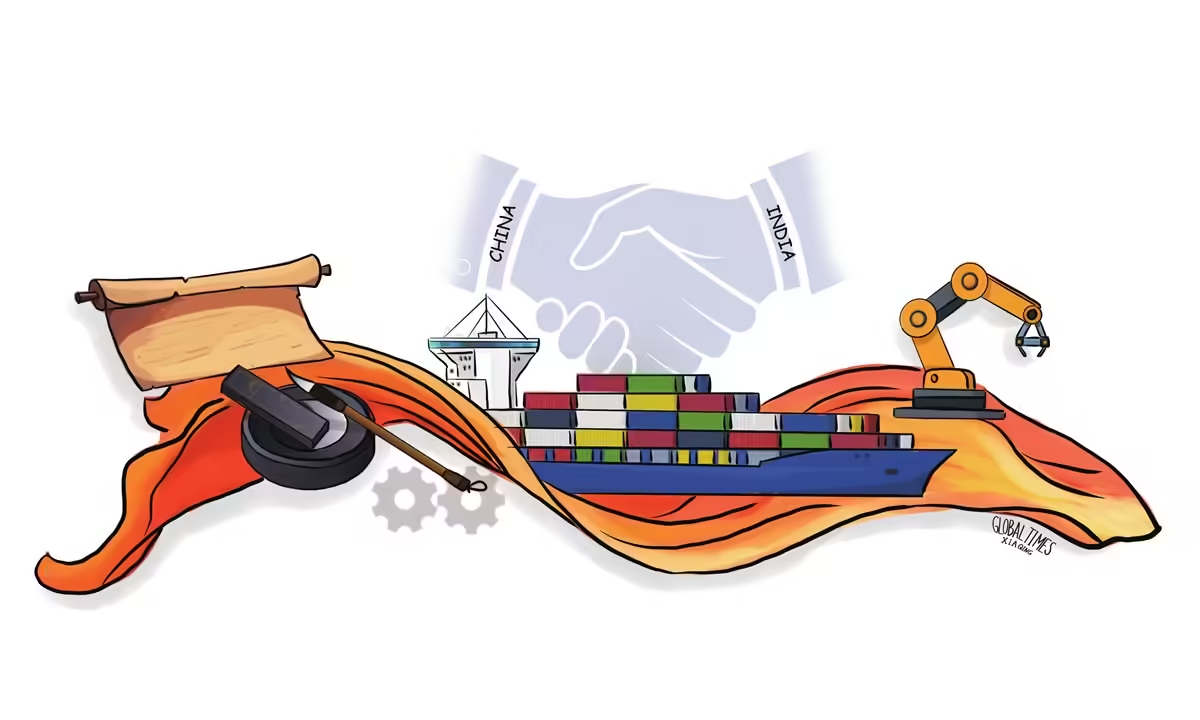

China, India Illustration: Xia Qing/GT
India’s trade deficit with China is drawing fresh scrutiny. Business Standard has projected that the figure could reach $150 billion in fiscal year 2027. In the debate, China’s so-called non-tariff barriers have been singled out by some in India as the biggest hurdle for Indian exports. But India may be looking in the wrong place for the causes of its trade imbalance.
Where, then, does the imbalance come from? A large part of the answer lies in the different economic structures of the two countries. India’s growth has long been driven more by services than by manufacturing, which accounts for only about 13 percent of its GDP. This is also reflected in the composition of its exports to China, which have traditionally included a large share of agricultural products and raw materials.
That pattern is beginning to change. Indian exports to China rose almost 40 percent in the five months through August, an analysis of Indian official data shows, with electronics and engineering goods among the biggest drivers. This points to the gradual expansion of India’s manufacturing capabilities. But building an industrial base and broadening an export basket take time.
Starting from a relatively modest base, India cannot be expected to close the trade gap overnight. A double-digit increase in exports is no small achievement. Rather than judging progress solely by the size of the trade deficit, India should recognize that strengthening its export capacity is a gradual process, and that the recent growth offers grounds for patience.
China has never deliberately pursued a trade surplus with India, nor has it deliberately used so-called non-tariff barriers to restrict Indian exports. On the contrary, China welcomes more high-quality Indian products that meet the needs of its market. The task for India is to develop a wider range of products that Chinese consumers and businesses want to buy, rather than unfairly blame China or expect one-sided trade benefits. Ultimately, much will depend on India’s own efforts to strengthen its manufacturing base.
Strengthening manufacturing does not mean reducing imports from China. India imports a wide range of raw materials, intermediate and capital goods from China, including auto components, electronic parts and mobile phone components. These inputs feed into Indian production, helping manufacturers make finished goods for both domestic consumption and export markets. Chinese imports are therefore an important part of the supply chain supporting India’s manufacturing growth and export capacity. More people in India are beginning to recognize this.
A more rational view of trade would allow India to make better use of the opportunities before it. The recent double-digit growth in China-India trade points to the complementarity of the two countries’ industrial chains. That is a positive development, and the opportunities it creates should not be lost to an outdated fixation on trade deficits.
Calls in India for greater access to the Chinese market are themselves a recognition of its importance to Indian exporters. Given the complementarity of their industrial bases, China and India have room to open their markets further to each other’s goods and businesses. But openness cannot be a one-way street. India should reconsider its restrictions on Chinese businesses and products, ease market access and create a more welcoming environment for Chinese companies. If it expects greater openness from China, it should be prepared to offer the same in return.
China and India are both developing countries, and development is their common ground. As each pursues its own growth, closer economic engagement can create opportunities for both. An irrational fixation on the trade deficit should not be allowed to obstruct that process.
Moving beyond such anxiety would be in India’s own interests. Ultimately, a stronger manufacturing base and greater use of trade opportunities will do more to narrow India’s trade deficit than fixation on the gap itself.
Source: www.globaltimes.cn