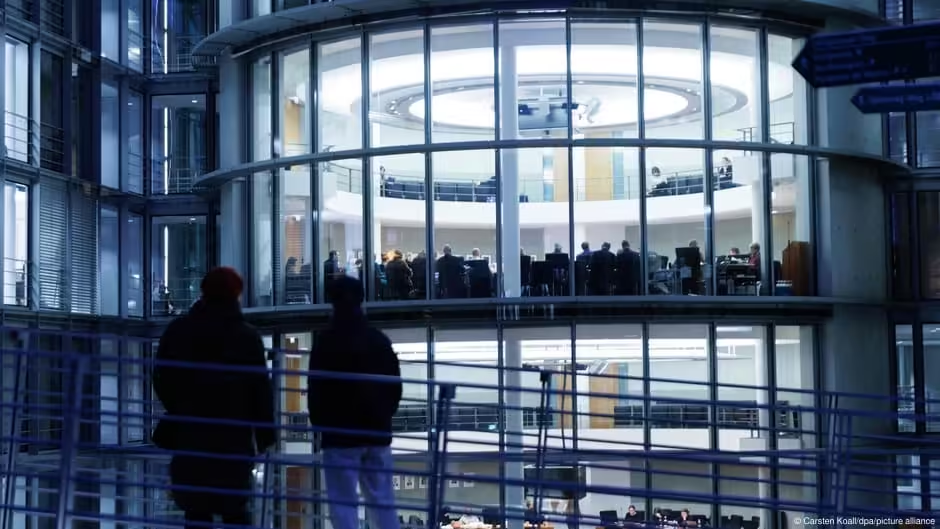

Budget committee concludes marathon session on 2027 spending plans
Politicians on the Bundestag budget committee burned the proverbial candle at both ends heading into Friday morning, trying to finalize details of the federal government’s spending plans for 2027 before the year’s end.
The session took over 15 hours, and already politicians are talking about areas where they still see room for further improvement or alteration — but the document does at least stand in such a form in which it can take effect without too many complications.
Including all spending plans, in the core budget and from the so-called “special funds” for infrastructure and military modernization, new debt constitutes around a third of total spending plans.
In total, the plan is to take out new debt worth just over €210 billion ($233 billion), while taking in a little less than €400 billion in taxes.
That’s the second-highest level of new debt in the post-war history of the Federal Republic of Germany. Even at the height of the COVID pandemic in 2021, new debt was only slightly higher, at €215.4 billion.
We’ll break down more of the details and cover some of the reactions in later posts.
Edited by:Dmytro Hubenko
https://p.dw.com/p/5PPIR
Quantum Systems says Bundeswehr drones back in skies after cyberattack
German defense industry startup Quantum Systems said its drones were operational worldwide once again, including with the Bundeswehr military, after a cyberattack by “hostile actors” last month.
The company had announced the cyberattack on Thursday, amid reporting from the Financial Times that also said the Bundeswehr had grounded its drones from the company.
“The fleet is operating normally around the globe — including Germany and the Bundeswehr,” a Quantum Systems spokesperson said in an emailed statement to the Reuters news agency. “The Bundeswehr was the only customer to ground their systems as a precaution.”
The company, based near Munich, had earlier said it uncovered an “active cyberattack” by hostile actors.
“The threat was contained thanks to the swift response of our IT and security teams in close and transparent collaboration with the authorities,” it said in a statement, adding there was no risk for end users and operators using its unmanned systems.
Quantum drones are used by Ukrainian armed forces in their defensive war against Russiaamong others.
“Companies at the forefront of supporting Ukraine are being targeted precisely because our work is critically relevant to customers’ security,” the company said. “Being aware of this responsibility, Quantum Systems has mitigation plans in place and strives to fulfil the highest standard of data and system security.”
Edited by:Dmytro Hubenko
https://p.dw.com/p/5PPhs
CDU’s Middelberg: ‘Weak point’ of budget is ‘we have not yet saved enough’
Senior Christian Democrat Union (CDU) politician Matthias Middelberg appeared on ZDF television this morning to discuss the budget breakthrough.
He identified one “weak point” after the overnight negotiations.
“We have not yet saved enough, we still need to save a lot more,” he said.
Middelberg said that in his view the government would not be able to “collect the funds,” because that would put too much tax strain on people and businesses.
Therefore, he said, “the government must make cutbacks.”
Middelberg acepted that it wasn’t clear how to do this, speculating that “perhaps there are subsidies or some other things” that could be ripe to be trimmed.
He said the leadership of the coalition government’s CDU/CSU and Social Democrats would “consider this question very closely once more.”
Edited by:Dmytro Hubenko
https://p.dw.com/p/5PPWJ
Rising insolvency rates continue, stats office says
The German government statistics agency Destatis has published new figures on insolvency filings for the month of August.
A total of 2,067 companies registered insolvencies with German courts during the month, Destatis said, 4.4% more than in the same month in 2025.
The data operates on something of a delay, because the government tracks when courts grant the status, which can be almost three months after the initial application at times.
The increase has been a rolling trend this year. From January to August, 17,252 companies have filed for insolvency, 6.6% more than in the same period last year.
However, the total sum of debts forgiven in insolvency proceedings is actually quite considerably lower than in the first eight months of last year, at €25.9 billion ($28.7 billion) rather than €37.2 billion, because fewer large companies have gone bust.
More individuals are also filing for bankruptcy protection than in 2025, although the rise is somewhat less sharp. In August, 6,301 people gained insolvency protection, 2.8% more than last August. For January through August, the year-on-year increase is more modest, at 1.2%.
Edited by:Dmytro Hubenko
https://p.dw.com/p/5PPQU
In numbers: What are the core points of the budget?
Here are a few of the core statistics about 2027’s overall spending plans:
- Total spending in the core German budget will rise to €560.9 billion (roughly $620 billion), compared to €524.5 billion last year
- Tax revenues are predicted to rise slightly, to €396.2 billion
- The figures only classify net new debt in the core budget at just under €123 billion because another €38.4 billion is deemed deductible as part of long-term investment in infrastructure, combating climate change and defense
- €57.8 billion will be borrowed as part of the “special fund” for infrastructure development and climate neutrality
- And another €29.6 billion is being borrowed as part of the military modernization special fund
- That leads to total new borrowing of just over €210 billion, the highest on record excepting 2021’s level of €215.4 billion
Edited by:Dmytro Hubenko
https://p.dw.com/p/5PPNV
Welcome to our coverage
Moin! Here’s hoping you slept more and better than the Bundestag’s budget committee. Or if not, at least let’s hope that you had more fun.
Its members worked towards the dawn in a session lasting over 15 hours, trying to iron out the last wrinkles in spending plans for 2027.
The proverbial white smoke emerged at around 6 in the morning in Berlin, with word of a finalized agreement.
If you were tired of talk and criticism of the “debt brake” and the “black zero” (a promise not to take any new debts) in the years following the eurozone debt crisis, rest assured we can assign such chatter to the history books for now.
The borrowing plans for 2027 — if you incorporate new debt taken out as part of so-called “special funds,” for instance for the military and infrastructure, rather than as part of the core budget — are the second highest in the history of post-war Germany.
The country only took out more new debt in 2021, at the height of the COVID pandemic and even then it was very close indeed.
We’ll bring you more news and reactions on this, and whatever else breaks around the country, as Friday develops.
Edited by:Dmytro Hubenko
https://p.dw.com/p/5PPID
Source: www.dw.com