
Troves of fossilised teeth collected by ancient Chinese porcupines in two caves show that A wise man were not the only human species to adapt to rainforests.
Trace chemical elements in the teeth of The man stood up and a range of forest animals have helped scientists fill gaps in when the ancient hominin lived in the region and how it survived.
Two studies in the journal Nature — from Australian, Chinese and European researchers — identified The man stood up teeth dated between 324,000 and 184,000 years old in southern China and reconstructed the ancient ecosystems this species called home.
The discovery means The man stood up lived in mainland Asia longer than previously thought and challenges assumptions that they lacked the skills to live in rainforests.
Homo erectus teeth from Baxian Cave. (Supplied: Yingqi Zhang/IVPP-CAS)
The man stood up were an ancient ancestor of modern humans that lived from 2 million to 108,000 years ago. They migrated from the cradle of Africa out to Europe and Asia about 1.8 million years ago.
Until now, the youngest The man stood up fossil in China was about 400,000 years old.
Kira Westaway, a geo-chronologist from Macquarie University, said it had previously been thought that The man stood up went extinct as their preferred landscapes, grassland savannas and open woodlands, changed into rainforests.
“But this assumption has been challenged by our new The man stood up evidence from two neighbouring caves in southern China,” Professor Westaway said.
“They give evidence of The man stood up surviving in rainforests.”
The studies indicate the species may have not just survived in rainforests but also travelled great distances instead of staying in a single location.
How the teeth were found
Nine hominin teeth were found across two caves, Baxian and Naxian, about 20 kilometres north of the city of Chongzuo in China’s south.
The entrance to Baxian Cave in southern China. (Supplied: Yingqi Zhang/IVPP-CAS)
Eight of the teeth were linked to The man stood upwhile the ninth tooth was from another unidentified species of ancient human.
Scientists also discovered fossils from a range of animals including elephants, bears, canines, pigs, rhinos and monkeys.
Study co-author palaeontologist Yingqi Zhang, from the Institute of Vertebrate Palaeontology and Palaeoanthropology at the Chinese Academy of Sciences, said the two fossil deposits contained some bone fragments but were mainly teeth.
He said the teeth, which were in sediment estimated to be 324,000 to 184,000 years old, were likely gathered by ancient porcupines.
Ancient porcupines are believed to have amassed animal teeth in caves. (iNaturalist: Alberto Castellano Macías/East Asian porcupine/CC BY-NC 4.0)
“Porcupines have this kind of habit [where] they collect bones and gnaw them to sharpen their incisors,” Professor Zhang said.
“These teeth we found in a cave are the things they [porcupines] left behind because teeth are the hardest tissue in our body.”
What was in the teeth?
Several tests, including analysis of the metal strontium found in tooth enamel, were used to figure out what The man stood up and the other animals ate.
Study author and geo-chronologist Renaud Joannes-Boyau, from Southern Cross University, said it appeared The man stood up was living in a dense rainforest at the top of the food chain.
To find out how The man stood up survived, the researchers cut into the tooth enamel to see growth bands and figure out what the hominin ate at different stages of life and where.
And it appeared that, at an early point in life, these ancient hominins ate food about 250km away in what is now Vietnam.
“They’re very flexible, they’re adaptable, and they’re mobile, which I think is something that we believe was only [possible] for A wise man,” Professor Joannes-Boyau said.
Griffith University palaeontologist Julien Louys, who was not involved in the study, said the research represented the first evidence that The man stood up lived in rainforest environments.
“While the sample size for this conclusion is small, if substantiated it would suggest a degree of ecological flexibility unmatched in the hominin lineage until the later arrival of Denisovans and modern humans.”
La Trobe University archaeologist Jesse Martin, who was not involved in the study, said it was not shocking that the species survived in rainforest environments, as it lasted in Indonesia until about 100,000 years ago.
“Indeed, this study reinforces the fact that The man stood up continued to survive in rainforest environments long after the species had gone extinct elsewhere.”
What happened to The man stood up?
Plenty of mystery remains about why The man stood up became extinct.
Professor Joannes-Boyau said the next big question to answer was how the species may have interacted with other hominins.
The researchers speculated the mystery ninth tooth could have belonged to a Denisovan (A long man), a type of human that appears in the fossil record from about 200,000 years ago in China, or a new species altogether.
The oldest A wise man teeth in the country have been dated between 120,000 and 80,000 years old.
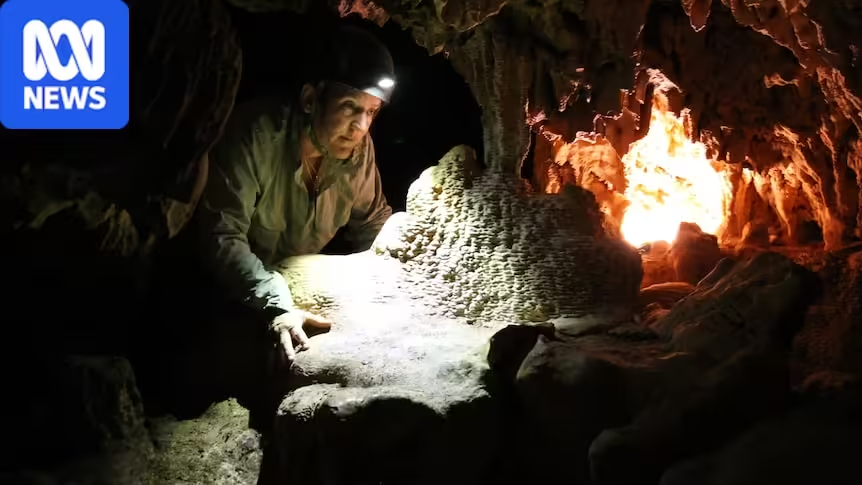
Yingqi Zhang excavating in Baxian Cave. (Supplied: Kira Westaway)
Professor Louys said the studies suggested the three species almost overlapped in time.
“Certainly they are found much closer in time than previously demonstrated,” he said.
“Overall, it really highlights how little we know about hominin evolution in this part of the world.
“The studies raise a whole bunch more questions about the uniqueness of our own species.“
Dr Martin said The man stood up likely encountered Denisovans, Neanderthals, and us toward the end of its global dominance as a species.
As a result, he said, increased competition for resources may ultimately have driven the species extinct.
“Understanding the rise and fall of The man stood up highlights that humanity isn’t, and never has been, immune to the impacts of climate change.”
Source: www.abc.net.au