TL;DR
- 6.9% of finance-linked repos contain secrets: GitGuardian found secrets in 6.9% of active finance-linked public repositories in 2025, versus 5.6% across public GitHub, with 48,819 secrets detected, up 22.9% from 2024.
- Five minutes from GitHub search to Key Vault: Microsoft documented AI agents searching public GitHub for exposed credentials and reaching Azure Key Vault data in five minutes, while Storm-3358 began using ARTEX against financial institutions in October 2026.
- 446 sensitive secrets valid at first detection: Of 2,639 sensitive secrets in finance-linked repositories, at least 446 were valid when first detected. Deleting a secret doesn’t invalidate it, so exposed credentials must be revoked or rotated.
Microsoft has confirmed that attackers are using ARTEX, an agentic AI penetration testing framework, against financial institutions. In October 2026, a threat group began using the framework to exploit vulnerabilities in internet-facing applications.
But web vulnerabilities aren’t the only attack path. In a separate investigation, Microsoft documented attackers directing AI agents to search public GitHub for exposed credentials using company names and service-specific keywords. In one case, an agent went from GitHub search to exfiltrating Azure Key Vault data in just five minutes.
GitGuardian’s analysis of public GitHub in 2025 found secrets in 6.9% of active public repositories associated with financial institutions, compared with 5.6% across public GitHub overall.
For banks, insurers, and payment providers, the financial services cybersecurity question is what an attacker could find in their own public GitHub footprint, and whether those credentials still work.
What Microsoft observed in financial-sector attacks
On Nov. 6, Microsoft Threat Intelligence identified Storm-3358 as the threat actor behind the recent financial-sector activity. Storm-3358 is a financially motivated intrusion cluster based in Cambodia that primarily targets financial institutions in Southeast Asia, although Microsoft has also observed attacks against a smaller number of large financial organizations globally.
The group’s observed attacks combined ARTEX with conventional automated tools to identify vulnerabilities in internet-facing systems. Attackers exploited flaws such as anonymous file uploads and server-side request forgery (SSRF), then deployed open-source remote access trojans, including WISP, vshell, and AdaptixC2, to establish persistence and support lateral movement.
Rather than introducing entirely new attack techniques, ARTEX can help automate reconnaissance, exploitation, and post-compromise activity that would otherwise require more direct operator involvement.
Removing ARTEX from its original repository hasn’t stopped its spread. The framework’s creator took it down on Oct. 8, 2026, just 74 days after the first commit. But GitGuardian researchers identified 102 forks and ARTEX-named repositories appearing during the takedown week. By Nov. 7, the broader ARTEX family matched 1,428 Shodan services.
How AI agents turn exposed credentials into access
Since August 2026, Microsoft has observed threat actors using agentic AI tooling to submit large volumes of searches to public GitHub. The queries often combine a target organization’s name with keywords associated with secrets, cloud services, or AI providers.
Once an exposed credential is discovered, an agent can attempt to use it to authenticate to connected systems and conduct follow-on activity. Microsoft’s investigation documented agents using compromised application credentials to sign in as service principals, enumerate cloud resources, and retrieve additional secrets from Azure Key Vault.
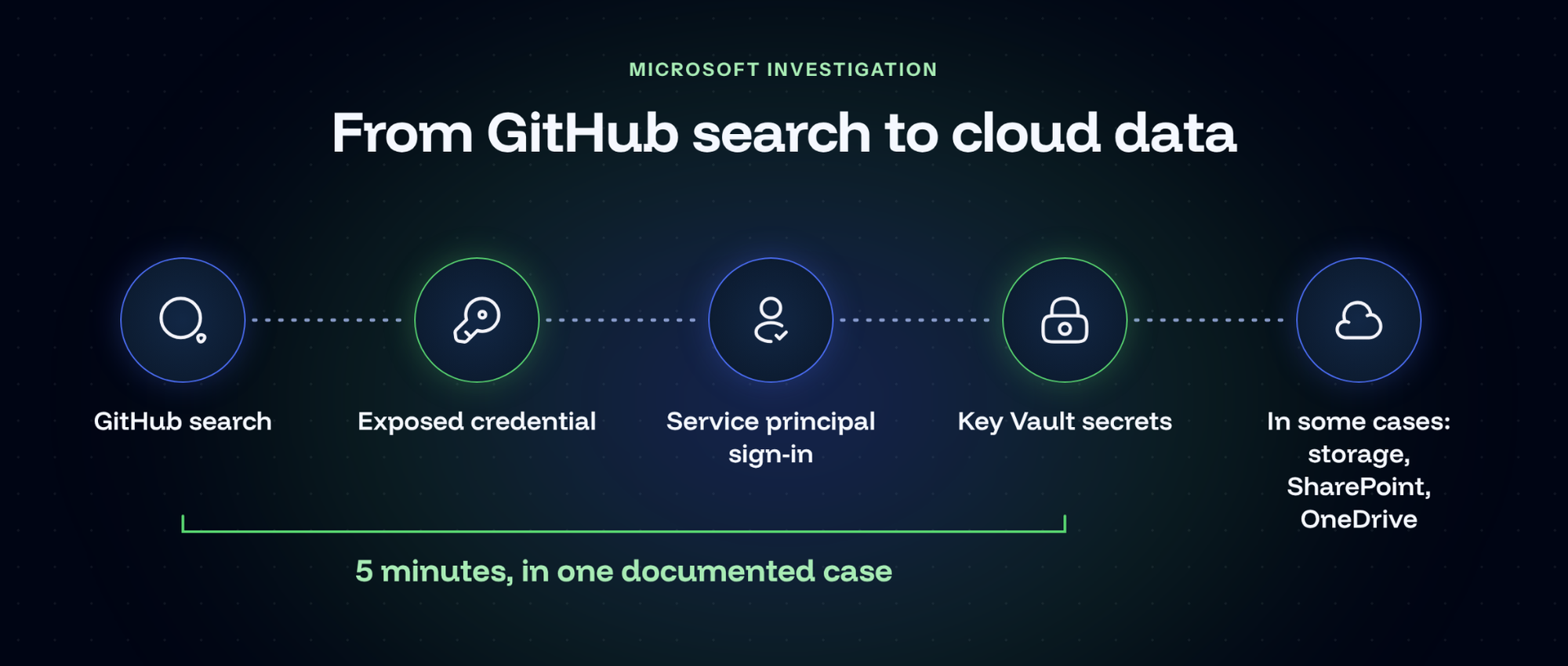
In some cases, the attackers accessed resources across Azure and Microsoft 365, including storage accounts, SharePoint, and OneDrive. Microsoft also observed agents adjusting cloud API requests after unsuccessful attempts, demonstrating their ability to adapt during an intrusion.
The financial-sector report identifies credentials compromised from public sources among techniques observed in recent ARTEX-related attacks, although Microsoft does not specifically attribute that technique to Storm-3358.
Google’s latest threat intelligence research reinforces the credential risk. Across intrusions affecting financial services and other industries, Google Threat Intelligence Group and Mandiant documented attackers harvesting valid credentials from public GitHub, then searching internal repositories, cloud services, and data stores for additional secrets. The researchers also observed attackers using agentic frameworks to automate further exploitation of compromised networks.
In a controlled ARTEX experiment, GitGuardian researcher Guillaume Valadon tested a build that contained no dedicated secrets scanner against a synthetic repository with nine planted credentials.
The agent found eight of nine secrets using ordinary commands, including git and grep. It began searching within 6 to 13 seconds, even when given a general request to assess the repository’s security posture rather than an explicit instruction to find credentials.
Crucially, only two of the nine planted secrets were present in the repository’s current files. Others were distributed across its history, branches, and other locations.
The experiment involved one model, one ARTEX build, and a synthetic repository supplied directly to the agent. The model also refused to exploit the credentials, so the test did not establish real-world exploitation success.
What it demonstrated was that an agent doesn’t need a purpose-built secrets scanner to locate credentials, including ones removed from current code.
Financial-sector repositories contain secrets at above-average rates
GitGuardian’s analysis of public GitHub activity in 2025 identified 41,658 active public repositories associated with financial institutions. Of those, 2,874 contained at least one secret, putting the sector’s repository prevalence above the GitHub-wide average.
The analysis also revealed the volume of exposure and how much of it remained potentially usable. 48,819 secrets were detected in finance-linked public repositories in 2025, a 22.9% increase from 39,733 in 2024.
These included credentials associated with cloud environments, CI/CD systems, identity providers, data storage, and private keys. Among the detections were 1,224 PostgreSQL and 692 MongoDB credentials, although their individual validity could not be established from the available data.
Of 2,639 sensitive secrets detected in finance-linked repositories, at least 16.9% (446) were confirmed valid at first detection. And the actual proportion may be higher. Validity checking was unavailable for 59% of those sensitive secrets, meaning many could not be confirmed as either active or inactive.
Exposed credentials can also remain usable long after they first appear in public code. Across public GitHub overall, GitGuardian’s State of Secrets Sprawl 2026 report found that 64% of the valid secrets detected in 2022 were still active four years later.
These findings establish higher repository prevalence; they reveal a substantial pool of exposed secrets associated with financial-sector development activity, including credentials confirmed valid at first detection.
Why private repositories don’t eliminate public credential exposure
Financial institutions typically apply strict controls to their internal source code. But even organizations with mature code security programs can have credentials exposed on public GitHub, because public exposure doesn’t necessarily originate in a corporate-owned repository.
Developers contribute to open-source projects, maintain personal repositories, experiment with new tools, and interact with code outside their employer’s infrastructure. Credentials can be copied into those environments and committed publicly, beyond the visibility of scanners limited to company-owned repositories.
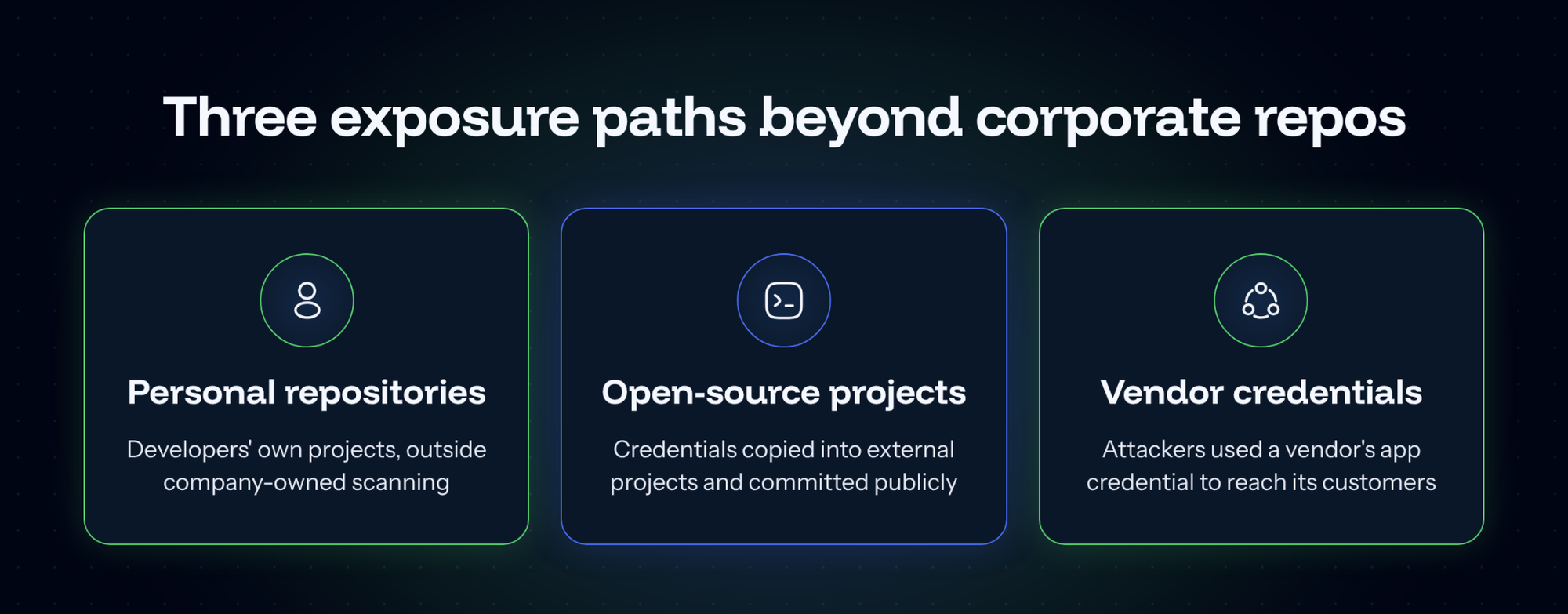
GitGuardian’s analysis identified 35,903 developers who committed to public GitHub in 2025 using an email address associated with one of 132 tracked financial institutions.
This doesn’t mean all exposed secrets are corporate credentials. It does demonstrate the scale of public development activity associated with financial institutions, including contributions outside their official repositories. And it captures activity attributable through a corporate email domain.
Third-party providers create another exposure path. In its Nov. 5 investigation, Microsoft documented a case in which attackers obtained a multitenant application credential belonging to a vendor. They subsequently used that compromised credential to access multiple downstream customer tenants.
A financial institution can secure its internal repositories and still be exposed through credentials belonging to a software vendor, service provider, or external integration. The potential impact depends on what the compromised credential can access. An application credential with permissions across multiple environments may allow an attacker to reach systems beyond the organization where it was originally exposed.
For regulated financial institutions, these dependencies also carry compliance implications. Under the US banking agencies’ computer-security incident notification rule, bank service providers must notify affected banks when an incident materially disrupts, degrades, or is reasonably likely to disrupt or degrade covered services for four or more hours. Banks face a separate requirement to notify the OCC within 36 hours after determining that a qualifying notification incident has occurred.
An exposed credential alone does not trigger these requirements, but incidents involving compromised third-party access can have consequences beyond the initial intrusion. Credential security also intersects with broader requirements for access control and operational resilience, as explored in our discussion of non-human identity security and financial regulation.
What financial services cybersecurity teams should do now
For financial-sector security teams, the priority is to understand which credentials are already publicly exposed and what access they could provide.
That means looking beyond corporate-owned repositories to identify credentials associated with developers’ public GitHub activity, including personal repositories and external projects. Teams should determine which credentials are still valid, who owns them, what systems they can access, and whether they show evidence of misuse.
Removing a secret from a repository does not invalidate it, and deleting a commit doesn’t erase copies already present in Git history. Revoking or rotating an exposed credential is what removes the compromised access. Microsoft’s guidance is to treat publicly exposed credentials as compromised, even when the original disclosure has been removed.
Start by understanding what an attacker searching for your institution could already find.
Run GitGuardian’s free GitHub Security Audit using your organization’s domain to identify potential secret exposure associated with your developers’ public GitHub activity. Then investigate the findings and revoke or rotate exposed credentials.
FAQ
What is ARTEX?
ARTEX is an agentic AI penetration testing framework. It can automate reconnaissance, exploitation, and post-compromise activity that would otherwise need more direct operator involvement.
Its creator took it down on Oct. 8, 2026, 74 days after the first commit. That didn’t stop its spread: GitGuardian researchers identified 102 forks and ARTEX-named repositories during the takedown week, and the ARTEX family matched 1,428 Shodan services by Nov. 7.
Is ARTEX being used against financial institutions?
Yes. Microsoft Threat Intelligence reported on Nov. 6, 2026, that Storm-3358, a financially motivated group based in Cambodia, began using ARTEX against the financial sector in October 2026.
The group mainly targets financial institutions in Southeast Asia, plus a smaller number of large financial organizations globally. It combined ARTEX with conventional tools to exploit flaws such as anonymous file uploads and server-side request forgery (SSRF).
How do AI agents use leaked credentials to reach financial systems?
Microsoft observed attackers directing AI agents to search public GitHub with a target organization’s name plus keywords tied to secrets, cloud services, or AI providers. When an agent finds a working credential, it tries to authenticate to connected systems.
In one case Microsoft documented, an agent went from GitHub search to exfiltrating Azure Key Vault data in five minutes. Agents also signed in as service principals, enumerated cloud resources, and adjusted requests after failed attempts.
How common are leaked credentials in financial-sector GitHub repositories?
More common than average. GitGuardian’s analysis of public GitHub in 2025 found secrets in 6.9% of active public repositories associated with financial institutions, compared with 5.6% across public GitHub overall.
GitGuardian detected 48,819 secrets in finance-linked public repositories in 2025, a 22.9% increase from 2024. Of 2,639 sensitive secrets, at least 446 were confirmed valid at first detection.
How do financial institutions’ credentials end up on public GitHub?
Often outside corporate repositories. Developers contribute to open-source projects, maintain personal repositories, and experiment with new tools, and credentials can be copied into those places and committed publicly.
GitGuardian identified 35,903 developers who committed to public GitHub in 2025 using an email address from one of 132 tracked financial institutions. Vendors are another path: Microsoft documented attackers using a vendor’s multitenant application credential to reach downstream customer tenants.
What should financial services security teams do about exposed credentials?
Start by finding what an attacker searching for your institution could already see, including credentials tied to developers’ personal and open-source GitHub activity, not just corporate repositories.
Then confirm which credentials are still valid, who owns them, what they can access, and whether there’s evidence of misuse, and revoke or rotate the exposed ones. GitGuardian’s free GitHub Security Audit is a quick first check using your organization’s domain.
What the ARTEX FBI Alert Means for Credential Security
The FBI’s ARTEX alert shows AI agents reaching privileged access in under three hours, while leaked credentials stay valid for years. Here’s what that gap means for defenders and how to close it.
How to Measure Time to Revoke for Exposed Credentials
Learn how to measure time to revoke for exposed credentials using validation and invalidation timestamps, remediation SLAs, and CISO reporting metrics.

Source: blog.gitguardian.com