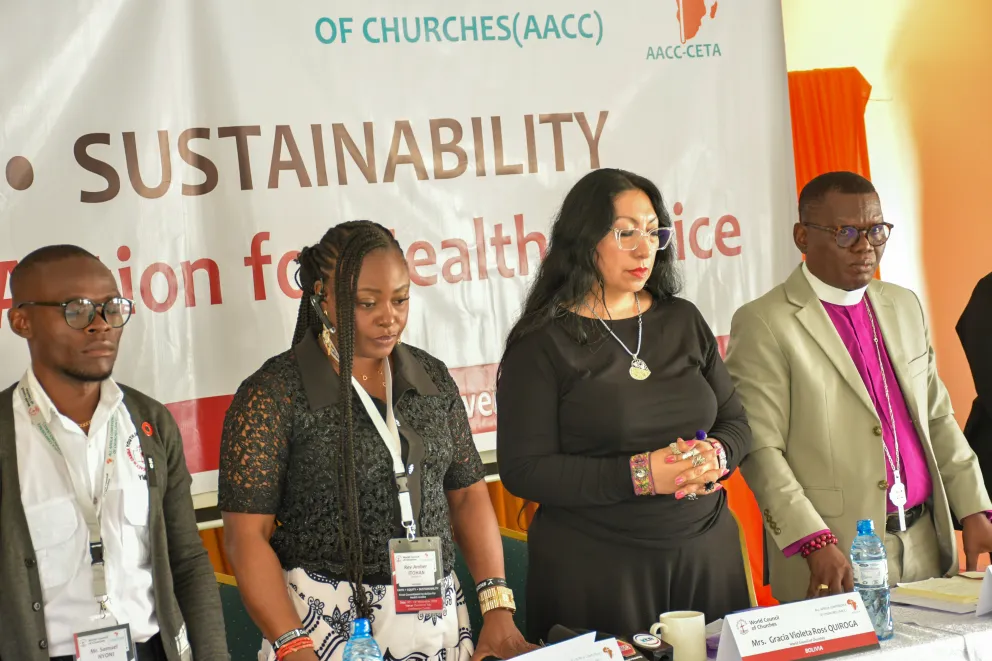

The World Council of Churches (WCC) and the All Africa Conference of Churches organized the gathering in Nairobi from 10-12 November. This is the second “Think Tank on Sustainable Financing and Global Fund Advocacy” by the two organizations.
The gathering comprised 21 participants from 10 African countries including faith leaders, representatives of communities living with HIV and AIDS, young people, civil society representatives, and partner organizations.
“We gather here at a defining moment. We have, on the one hand, amazing scientific progress, innovations on HIV, tuberculosis, and malaria. We have treatments that work faster, mosquito nets that have responded to resistance, and faster diagnostics for tuberculosis,” said Gracia Violeta Ross, WCC programme executive for HIV, Reproductive Health, and Pandemics.
Yet, these were not available for everyone, particularly in Africa, unless international cooperation made them available, said Ross, adding that progress in science was facing a reduction in funding from the international community.
“That’s why the World Council of Churches decided to bring together religious leaders and people living with HIV to see how we can sustain this response with faith and science,” she said.
Ann Njeri Kioi, director for Gender, Women, Youth, and Sustainable Population, and focal person for Health and Healing for the All Africa Conference of Churches, said the participants explored the progress made against the disease and asked hard questions on how to protect the gains when the money for health was under pressure.
“Africa has made progress against HIV, AIDS, tuberculosis, and malaria. That progress is not an accident. It was paid for, worked for, and prayed for by all of us. It cannot be lost. Commitment made on paper must be turned into action. That is why faith leaders are speaking here today,” said Kioi.
“The statistics we are hearing are not just numbers. These are people. They are members of our congregations. They are our family members and our communities.”
She said the churches and faith communities are present where the people live long before the programmes start and long after they have ended.
“We therefore speak…not as observers, but as people with a duty of care and a voice that must be used,” she said.
The participants warned gains achieved in two decades against the diseases are under threat, as pressure on international assistance mounts, public debt increases, domestic budgets are constrained, and unmet demands for health services grow.
“These realities threaten the gains made over the last two decades and require renewed political commitment and collective action,” said Rev. Amber Itohan Erinmwinhe, national coordinator and executive secretary of the Nigerian Network of Religious Leaders Living with or Personally Affected by HIV and AIDS.
The faith leaders warned against making sustainability a justification for the withdrawal of international solidarity and challenged the international partners to stand with them at this time of the shift.
“We welcome the international commitment demonstrated for the Global Fund and call on all donors to honour and rapidly convert their pledges into resources that can reach communities and save lives,” she said.
Samuel Nyoni, a youth advocate from Zambia said the people of faith believed that health was a technical and a financial issue, as well as a matter of human dignity, justice, and solidarity.
“Our lived experiences form our existence,” he said.
Rev. Godson Dogbeda Teyi Lawson Kpavuvu, president of the Methodist Church in Togo, said the faith leaders’ response in the new stage of the struggle will focus on prevention, because the treatment is already there.
“We know how to treat, but we are treating people while some of our communities are still being found HIV positive. So, we need to be proactive to invest our energy and also our communication system through the gospel on prevention activities,” he said.
Source: www.oikoumene.org