
Updated 41 minutes ago
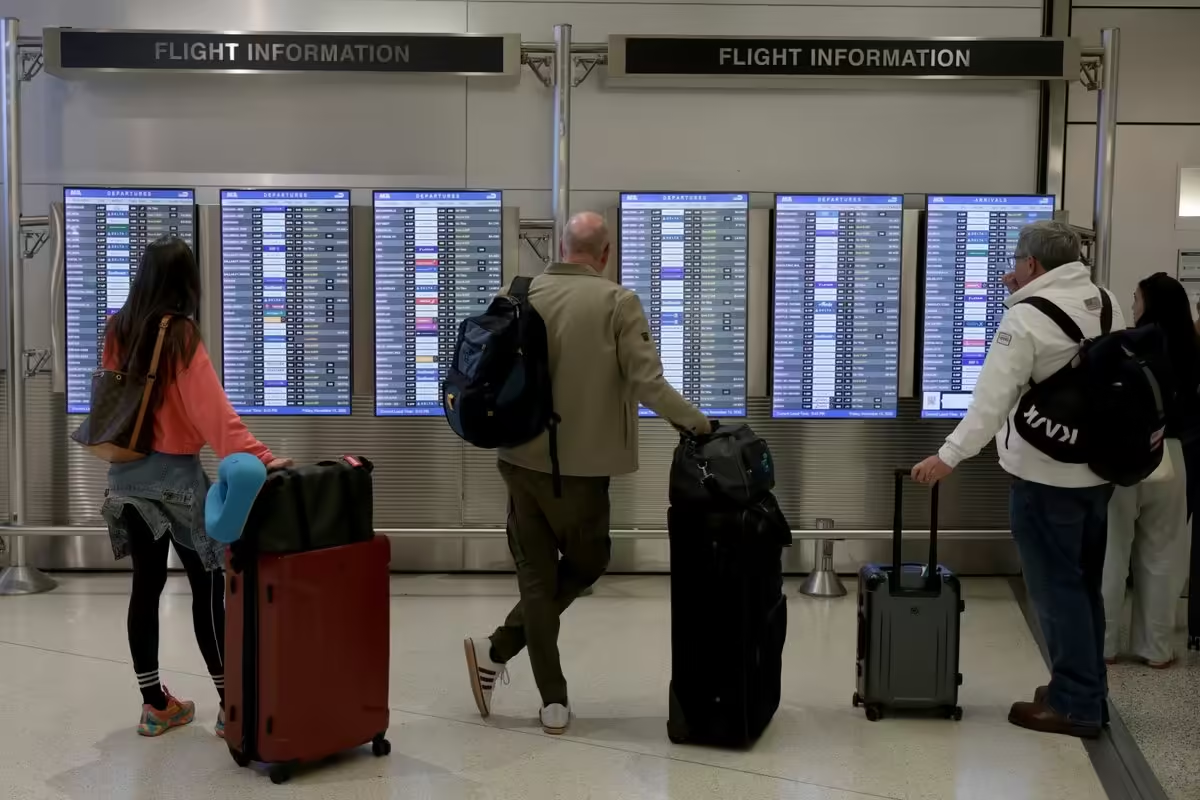
On a typical Friday November evening, millions of passengers would be hopping on flights for pre-Thanksgiving weekend trips and journeys home after work. But on November 13, domestic and international flights throughout the U.S. completely ground to a halt at about 4 P.M. EST. The stop was lifted at approximately 8:15 P.M.
The Federal Aviation Administration (FAA) cited a “temporary telecommunications outage,” in a post on Xand all flights have been grounded “out of an abundance of caution.” Later Secretary of Transportation Sean Duffy said that air traffic technology had become overwhelmed.
“What we have is an incredibly old air traffic control system,” Duffy said at a news conference. “Our routers actually got overloaded with data,” Duffy said, adding that “they started to give us inconsistency in the data from those routers. And because of that, we shut the system down.”
On supporting science journalism
If you’re enjoying this article, consider supporting our award-winning journalism by subscribing. By purchasing a subscription you are helping to ensure the future of impactful stories about the discoveries and ideas shaping our world today.
The sweeping aviation disruption came three days after the FAA expanded its Strategic Management of Airspace, Routes and Trajectories system, known as SMART. The FAA previously tested the system in the National Capital Region, the airspace around Washington, D.C., in September. The artificial intelligence-driven system is intended to synthesize data on weather patterns, flight paths, traffic flow and controller staffing metrics in order to “reduce delays and cancellations,” according to the FAA’s description. As of November 10, it was deployed across all 22 air traffic regions in the country. At the news conference on Friday, Duffy warned that unless the country’s air traffic control systems are further upgraded there may be more disruptions to air travel. Duffy called on Congress to fund upgrades to the system.
Such nationwide groundings are exceedingly rare. The last time the FAA stopped flights was for 90 minutes on January 11, 2023, to address an outage in its Notice to Air Missions (note) system, which informs pilots and operators about potential safety hazards. Before that, flights were halted immediately following the September 11, 2001 terror attacks.
The FAA Telecommunications Infrastructure is managed by L3Harris, a Silicon Valley-based aerospace and defense company and a contractor for federal government agencies. L3Harris did not immediately respond to Scientific American’s requests for comment.
Ruth Stilwell, a former air traffic controller and aerospace policy expert, speculated earlier on Friday that the outage may be due to a software problem, such as a software update gone awry in the Voice Switching and Control System, which manages communications between pilots and air traffic controllers. It is not Microsoft software, Stilwell emphasizes, referring to the widespread Microsoft product outage that occurred on Thursday into Friday. CBS News reported that a software update to the private communications system may have triggered a system-wide reboot, causing it to crash.
“It would be unusual for them to do a software update during the day, but the FAA is very short-staffed,” Stilwell says. Department of Government Efficiency-related cuts laid off hundreds of FAA workers last year.
“This is yet another example of how brittle our air transportation system is in our country,” says Missy Cummings, at George Mason University and a former fighter pilot whose research focuses on responsible AI in transportation. “This has been a problem over several administration, and the Trump administration made the situation much worse with all their cuts.”
Even if the problem, software-related or otherwise, was small in scale, it’s standard procedure to ground planes while attempting to communicate through other channels with pilots who have already taken off, Stilwell says.
“The ground stop was the right thing to do,” Stilwell says. “Planes in the air are the top priority. The safety of those flights is way more important than anybody’s delay. The planes on the ground are safe.”
This is a developing story and will be updated.
Subscribe to Support Independent Journalism
Great science journalism requires human expertise, time, effort and creativity. And it costs money. That’s why I and the journalists here at Scientific American hope you’ll join our community.
When you subscribe, you are supporting staff and freelance journalists who are passionate about telling science stories that are true, important and compelling. Our editors and reporters are often experts in their fields, which means they understand the nuances of big discoveries and can untangle the breakthroughs from the hype. With a subscription, you are also supporting rigorous fact-checking to ensure the words we publish are precise and accurate. And you’re supporting original illustrations, graphics and photos that bring you closer to an advanced laboratory, an ice sheet in Antarctica or a space mission in orbit. You’re helping us craft other types of high-quality journalism as well: Our newsletters are carefully written, edited and curated by staffers you have or will come to know and love. Our Science Quickly podcast is based on original reporting, collaboration with editors and scientists and exacting production.
Subscriptions keep this engine running so we can continue to deliver thoughtful, rigorous and independent science journalism to you. In an era of viral misinformation, this work is crucial. If you value what we do, I hope you’ll consider joining us as a subscriber
Source: www.scientificamerican.com