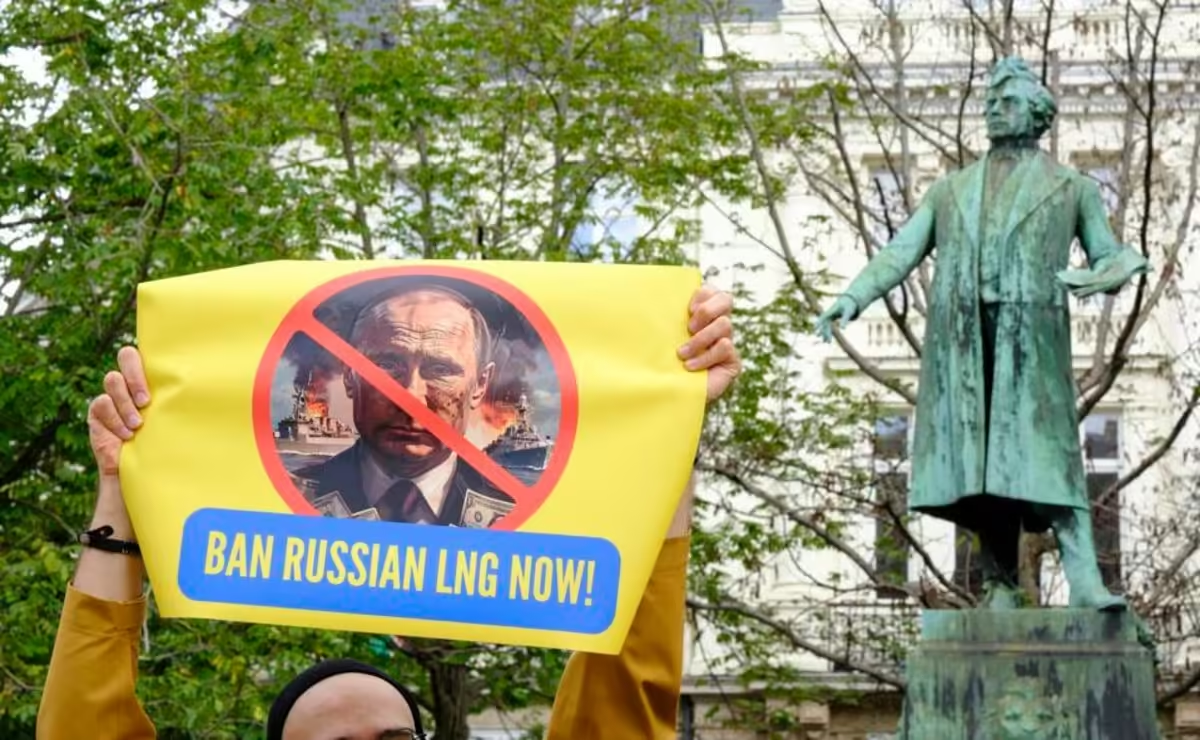

In less than seven weeks, Europe’s last long-term contracts for Russian liquefied natural gas will die. Buyers in France and Spain still want the gas. The European Union outlawed it anyway. The ban takes effect January 1, in the middle of Europe’s tightest gas winter since Russia’s full-scale invasion of Ukraine. This is the moment when Europe learns the cost of its principles.
Russia invaded Ukraine without provocation, and Europe decided to stop funding Russia’s war with its gas purchases. With the Iran war now squeezing global supply, Europe still buys some Russian gas, but it has written its exit into law. Washington, meanwhile, is loosening sanctions on Moscow. Europe has chosen the right side of history. For that position to succeed, Europe will need not just U.S. LNG but also an American president who values America’s allies more than he does strongmen.
Europe should never again buy “one molecule” of Russian gas, EU Energy Commissioner Dan Jørgensen said in March, weeks after the Strait of Hormuz closed and gas prices spiked. Russia, he argued, had weaponized energy against Europe.
It’s easy to forget how far Europe has come. Before the invasion, Russia shipped 152 billion cubic meters of gas to the EU a year, about 45% of its imports. By 2025, that had fallen to 36 billion cubic meters, or 12%.
Twelve percent is still a lot of money for the Kremlin. EU countries spent about $6.7 billion on Russian pipeline gas and $7.6 billion on Russian LNG last year. That is roughly $14 billion flowing to a government at war with a European neighbor.
The law now drives that number to zero. The EU banned short-term LNG contracts in April and short-term pipeline contracts in June. Long-term LNG contracts end January 1. Long-term pipeline contracts end September 30, 2027, or November 1 at the latest if a country struggles to fill its storage. The EU has also closed the side doors: EU companies may not buy, sell, or ship Russian LNG anywhere in the world after the ban takes effect.
The only serious challenge sits in court. Hungary and Slovakia, which still pipe Russian gas through the TurkStream line under the Black Sea, have each sued at the European Court of Justice. Slovakia—and Hungary’s previous government—argue that the ban is a sanction in disguise, which would have required unanimous approval. But that court often takes years to rule, and the ban stands while it deliberates.
So where will Europe’s gas come from? Mostly from the United States, which is exactly what President Trump demanded. At the United Nations last year, he accused NATO allies of “funding the war against themselves” by buying Russian energy and threatened tariffs if they didn’t stop. Europe also pledged to buy $750 billion of American energy as part of its July 2025 trade deal with Washington. America supplied 59% of the EU’s LNG in the first half of 2026.
The Institute for Energy Economics and Financial Analysis expects the U.S. to overtake Norway this year as Europe’s largest gas supplier, and to provide as much as 80% of its LNG by 2028.
Europe did what Trump asked. Trump then eased the pressure on Moscow himself.
Two Directions
(COMBO) This combination of file photos created on January 16, 2017 shows US President-elect Donald Trump (December 16, 2016 in Orlando, Florida) and Russian President Vladimir Putin (top, October 19, 2016 in Berlin). US President-elect Donald Trump has given a joint interview to The Times and Bild newspapers on January 15, 2017, where he suggested he may try to strike a deal with Russian President Vladimir Putin over his nuclear arsenal. (Photo credit should read ODD ANDERSEN,JIM WATSON/AFP via Getty Images)
Europe is tightening by law. Washington is loosening by executive choice.
In March, as the Iran war sent oil prices soaring, the Trump administration temporarily lifted sanctions on Russian oil. European Council President António Costa called the move “very concerning, as it impacts European security.” The relief kept coming. The administration later waived sanctions on Russian diesel exports through April 2027.
Then, on October 16, President Trump waived the Lindsey O. Graham Sanctioning Russia and Iran Act, which he had signed only a month earlier. The law would have imposed a 500% tariff on Russian goods and 100% tariffs on the biggest buyers of Russian energy. Kirill Dmitriev, Vladimir Putin’s investment envoy, hailed the waiver as “a truly historic moment.”
That same month, EU Energy Commissioner Jørgensen went the other way. He told Hungarian media that the EU will keep its ban even if Russia and Ukraine reach a peace deal. U.S.-brokered talks resumed in Abu Dhabi this month, but Moscow still rejects a ceasefire and demands that Ukraine surrender territory it holds.
The contrast matters because of who is fighting whom. Ukraine is defending its territory and its democracy against an invader. Yet Washington has too often cast Volodymyr Zelensky as the obstacle to peace. Zelensky called Trump’s waiver of the Graham sanctions wrong and predicted more of the same: “Sanctions relief will continue.”
The administration has said lower fuel prices justify the waivers. But the midterm elections are now over, and pump-price politics no longer explains the pattern. What remains is a record of easing pressure on the aggressor while the victim keeps fighting.
Europe is not in a position to lecture anyone. From January through October, EU ports took in 14 million tons of LNG from Russia’s Yamal plant in the Arctic, worth about $10 billion, more than Europe spent on Yamal gas in all of 2025. Buyers were stockpiling before the ban. Between January and May, Russian pipeline imports rose 7% and LNG imports rose 11%.
Belgium got 40% of its LNG from Russia last year, much of it through the port of Zeebrugge. And the Institute for Energy Economics and Financial Analysis warns that Europe is trading one dependence for another, swapping Russian molecules for American ones. A few years ago, that warning would have sounded absurd. America’s backing was never in doubt, and no one compared Washington’s actions with those of Moscow. That some now do says less about Europe’s choices than about America’s.
All of that is fair. But Europe is still moving in the right direction.
Europe Holds The Line

People watch the liquefied natural gas (LNG) tanker, Golar Tundra (Rear), a floating storage and regasification unit, on March 20, 2023 in the port of Piombino, Tuscany, after it arrived overnight from Singapore. A new floating storage and regasification unit considered crucial to Italy’s energy independence arrived in Tuscany on March 19, 2023. (Photo by Filippo MONTEFORTE / AFP) (Photo by FILIPPO MONTEFORTE/AFP via Getty Images)
Europe has cut its reliance on Russian gas from nearly half its imports to an eighth, and it has set a legal date for zero. It is doing so at real cost. Gas prices at European trading hubs reached their highest level since late 2022 this fall, and storage entered the heating season at record lows. Still, the EU refuses to reopen the Russian tap.
Dependence on America should, in theory, be more benign. Buying gas from an ally is not the same as buying it from a country shelling your friendly neighbor’s power plants.
But this newfound arrangement with the United States only works if Washington behaves like an ally. Indeed, Europe’s stand against Putin now runs through American LNG terminals. The president who controls that leverage can use it to back the democracies holding the line, or treat it as one more chip to trade with Moscow.
Jørgensen put Europe’s choice simply: Europeans should stand “shoulder to shoulder against Putin to help our friends in Ukraine.”
The United States used to say the same thing, and mean it. Russia started this war. Europe has chosen to stop financing it with Russian gas purchases, even as it pays to help Ukraine defend itself. Whether that choice survives the winter depends less on the EU than on Washington, and on whether America remembers which side it is on.
This article was originally published on Forbes.com
Source: www.yahoo.com