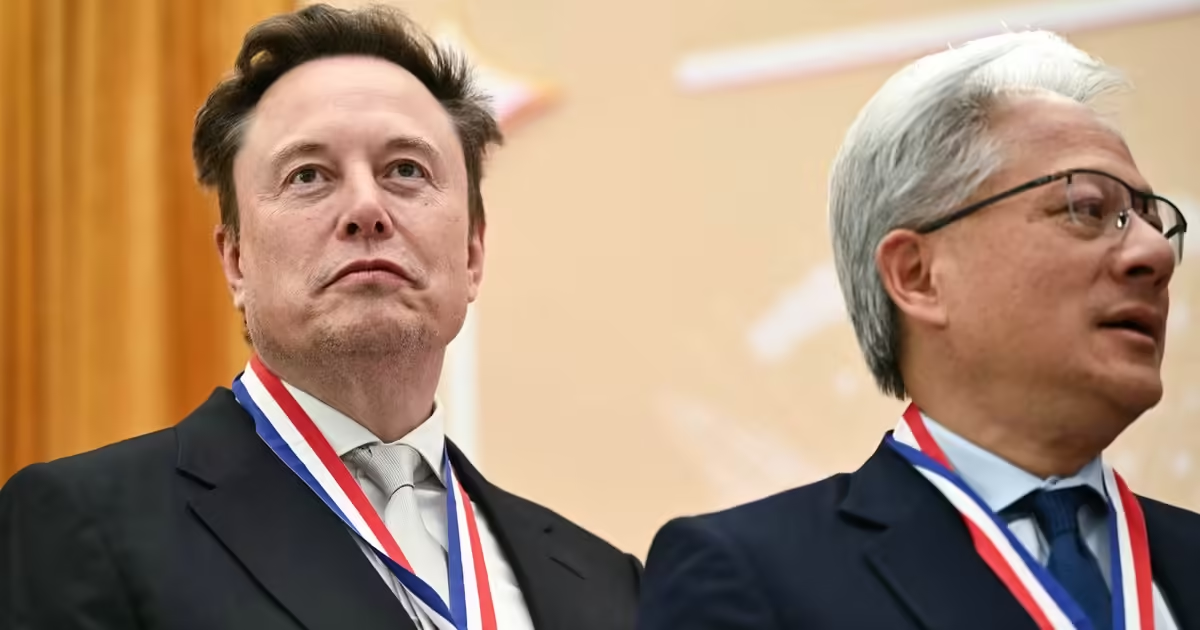

More than 158,000 people had signed an open letter calling for Huang’s reinstatement by Sunday, including over 7,500 signatories who identified themselves as Nvidia employees—equivalent to about 18% of the company’s workforce.
The campaign has received support from Musk, Epic Games founder Tim Sweeney, Y Combinator president Garry Tan and former Uber chief executive Travis Kalanick.
The Financial Times reported that Huang had discussed a possible return with people close to him, in an account subsequently carried by Reuters. An ally told the newspaper that supporters were assembling a group of Silicon Valley executives to lobby for his reinstatement and seek White House support.
Nvidia has not publicly confirmed that its board is considering restoring Huang as chief executive.
The company said on 12 November that Huang had resigned as president, chief executive and director with immediate effect, ending his 33-year leadership of the chipmaker he co-founded.
Chief financial officer Colette Kress is serving as interim chief executive while Nvidia searches for a permanent successor. The board said its customer commitments, operations and product roadmap would continue without interruption.
Musk joins the campaign to restore Huang
Musk publicly endorsed the campaign on X, saying he would sign a petition seeking Huang’s return.
The Tesla and SpaceX chief later argued that Huang had personally managed crucial supply-chain relationships at Nvidia and warned that the company could lose some agreements built around his leadership.
The campaign’s supporters are asking Nvidia’s board to return Huang to the company while an independent investigation establishes the facts surrounding the controversy that preceded his resignation.
Huang stepped down after reports concerning personal relationships, including an alleged association that raised questions in Washington about national security and Nvidia’s compliance with restrictions on advanced chip exports to China.
The allegations do not, by themselves, establish that Nvidia violated American export rules or that its African partnerships were compromised.
US Treasury Secretary Scott Bessent has opposed Huang’s return, saying Nvidia should look outside the company for new leadership and undergo a substantial change. Some American lawmakers have also called for Nvidia and Huang to answer questions about the company’s export-control safeguards.
Neither the petition nor Huang’s reported interest in returning obliges Nvidia’s board to reinstate him.
Nvidia’s leadership crisis reaches Africa
The contest over Nvidia’s leadership matters beyond Silicon Valley because the company supplies the processors underpinning a growing network of African AI factories and data centres.
One of its most important partners on the continent is Cassava Technologies, founded by Zimbabwean billionaire Strive Masiyiwa.
Cassava is Nvidia’s first cloud partner headquartered in Africa. Nvidia is also an investor in the company, alongside Google, British International Investment, the US International Development Finance Corporation and other institutional shareholders.
Cassava plans to deploy Nvidia-powered AI infrastructure in South Africa before expanding further across Nigeria, Kenya, Egypt and Morocco.
The company’s programme is designed to install 12,000 graphics processing units across the five countries over several years. About 3,000 were assigned to the initial South African phase.
Bloomberg previously estimated that the infrastructure programme could require as much as $720 million, based partly on the cost of Nvidia’s processors and the wider systems needed to operate them. Cassava has described the figure as a potential investment requirement, not money already spent across all five countries.
Nvidia’s own account says the programme could reach $720 million and confirms that Cassava is expanding from South Africa into the four other markets.
The facilities are intended to allow African companies, governments, researchers and technology developers to train and run AI systems without sending all their data and computing work outside the continent.
Egypt anchors another major AI push
Egypt has emerged as another important part of Nvidia’s African expansion.
Vodafone Business and Cassava are developing what they describe as Egypt’s first sovereign AI data centre, which will use Nvidia’s computing technology to provide locally hosted processing capacity.
The initiative was unveiled alongside a broader partnership involving Vodafone Business, Cassava and Egyptian industrial group Elsewedy Electric to develop Africa Data Centres Egypt.
That wider data-centre project is expected to begin with 20 megawatts of capacity during its first three years and could eventually scale to 200 megawatts.
Egypt’s communications ministry said its first phase could attract approximately $200 million in foreign investment, rising to $1 billion if the entire planned development is completed. It could also create about 200 direct and 2,000 indirect jobs.
The $1 billion figure applies to the broader Egyptian data-centre development—not solely to Nvidia processors or the sovereign AI facility.
South African technology group Altron also operates an enterprise AI factory powered by Nvidia infrastructure. These partnerships show how deeply African computing projects have become tied to the American company’s hardware, software and access to scarce high-performance processors.
African commitments remain intact—for now
No African partner has announced that Huang’s departure will delay or cancel an existing project.
Nvidia’s board has explicitly said customer commitments and the company’s technology roadmap will continue, while Cassava’s expansion programme predates the current leadership crisis.
However, Huang played a significant personal role in building Nvidia’s relationships with technology companies and data-centre operators. Any prolonged leadership uncertainty could raise questions about processor allocations, investment priorities and future partnerships, particularly in markets competing with much larger American, European and Gulf buyers for limited computing capacity.
Africa’s bigger concern is not simply whether Huang returns, but whether Nvidia’s next chief executive continues investing in regional partners and allocating advanced processors to markets that still account for a small share of global computing capacity.
Nvidia’s third-quarter results on 17 November will be Kress’s first major public test as interim chief executive and could provide the earliest indication of whether the company’s international AI strategy will change.
Source: africa.businessinsider.com