
When Victorians first went to the polls in the horse and buggy days of 1856, fewer than 52,000 property-owning men voted.
Only two years after the Eureka Rebellion, the new colony was decades from becoming a Garden State — but the first democratic saplings were being planted, such as the then-novel idea of the secret ballot.
Victoria was one of the first societies to introduce the secret ballot in the mid-1850s – a concept adopted in the UK in 1872 and the US by the mid-1880s. (Supplied: State Library of Victoria)
Women were barred from voting, as were Indigenous Australians and men who rented or were itinerant workers (property qualifications were surprisingly stubborn for Victoria’s upper house, lasting nearly a century until 1952).
While paper ballots marked in school halls are one constant from those quasi-democratic days, Eureka-era Victorians would barely recognise democracy 2026-style.
More than 4.7 million Victorians are set to vote by November 28 — the largest number on record.
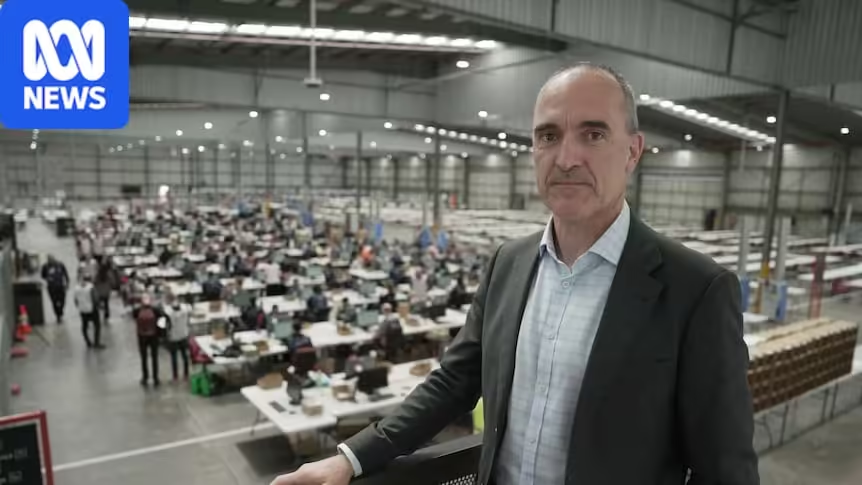
Several organisational centres have been established by the Victorian Electoral Commission to prepare for the November 28 poll. (ABC News: Patrick Stone)
Spearheading the Victorian Electoral Commission, Sven Bluemmel is the person tasked with making sure the process runs smoothly.
For the 2026 state election, the VEC will operate roughly 1,700 election day voting centres.
Taking a moment from the mammoth logistical and technical task, Mr Bluemmel told the ABC that the commission was more than prepared — not only for November 28 but the work beforehand and afterwards.
“The key message for the people of Victoria: There are plenty of voting options,”
he said.
“We have early voting, election day voting, postal voting, absent voting as well. Plan ahead and make sure you have your voice heard.”
Early birds flock to the polls
Much like AFL, Saturday is no longer the solitary game day for Victoria — neither for Aussie rules nor democracy.
The VEC is forecasting that more than half of Victorians will vote early for the first time, skipping the democracy sausage at the November 28 charity barbecue for a more convenient moment. Early voting starts today.
Sven Bluemmel says 300,000 more Victorians will vote at the 2026 election compared to the 2022 poll. (ABC News: Patrick Stone)
Mr Bluemmel said the VEC was boosting the number of early voting centres from 150 at the previous poll to more than 200 this month.
“We’re expecting an even larger proportion of Victorians to vote early,” he said.
“I suspect it’s convenience. Rather than finding time on election day itself, people want to vote on a day convenient to them.“
The VEC prints 25 million ballots and the commission has only days between the ballot being drawn and voters heading to the early polls.
Working around the clock in November, the Victorian Electoral Commission spends years planning for state general elections as well as the occasional by-election. (ABC News: Patrick Stone)
“We don’t know if we’re going to have three lower house candidates or 20,” Mr Bluemmel said.
“In Victoria, we have one of the tightest election timeframes in Australia — from when the writ is issued to when we have to return it. There are so many things that have to work in sequence.
“We have people working around the clock at key points of the election cycle.”
Upper house reforms
VEC commissioner Sven Bluemmel is urging Victorians to be aware before voting of how the upper house ballot has changed at this year’s state election. (ABC News: Patrick Stone)
One major change this cycle is the way Victorians elect their Legislative Council representatives.
“Unlike the lower house, you’re voting to put five people into the parliament,” the VEC boss says.
“Victoria was one of the last states to have a group voting ticket. That’s been abolished.
“Now you can vote, numbering at least one to five groups above the line or numbering at least one to five candidates below the line. The idea from that is that you will see exactly where all your preferences go.
“The good thing is that it’s very similar to the way people voted at the 2025 federal election in the Senate.
“How to vote cards are only a suggestion. How you complete your ballot paper is completely up to you.”
On election night, timing is everything
Victoria’s Legislative Assembly – the lower house where governments are formed – has 88 constituencies statewide, with 45 seats needed for a majority. (ABC News: Patrick Stone)
Polls close across Victoria at 6pm on November 28.
Small rural booths often have their count done and dusted not long after 7pm. Some larger polling stations in Melbourne often have a result closer to 10pm — processing thousands of ballots.
“In the seat of Lowan, we have more than 50 voting centres over a wide geographic area while in a metro (constituency), we might have only a dozen or so,” Mr Bluemmel said.
With shrinking rural populations, VEC decisions over the operation of some regional booths has been a source of controversy this election cycle. Several booths that were operational in 2022 have not been recommissioned in 2026.
Technology has also rapidly advanced over the past four years but the VEC commissioner said that did not necessarily speed up the counting process.
“We will always prioritise accuracy over speed,” Mr Bluemmel said.
Three and four-cornered contests
Victorians can avail themselves of several voting options, from postal to the traditional Saturday polling. But the VEC expects early voting to be the most popular method in 2026. (ABC News: Patrick Stone)
More Australians than ever voted for minor parties and independents at last year’s federal election.
Mr Bluemmel expects that trend to occur at the Victorian election and the VEC has factored that trend in for its lower house preference count.
“Clearly no one wants to wait two or three weeks (for an indicative election result),” he said.
“What we do on election night is we do a two-candidate preferred count. The important thing is … it is only indicative.”
Thousands of employees — both permanent and casual staff — are needed to ensure the democratic process runs smoothly. (ABC News: Patrick Stone)
It took weeks from election night for a winner to emerge in some three-cornered contests at the 2025 federal election.
“In the past, it used to be a lot more straightforward because most (constituencies) had two leading candidates or two leading parties,” Mr Bluemmel said.
“That picture is getting a lot more complex now.
“We’ll getting three and four-cornered contests and we will have to do our best based on our analysis of the polling data to decided who are the two candidates most likely to receive the most preferences at the end. That can be quite tricky.”
Loading…
Source: www.abc.net.au