
As US President Donald Trump prepares to meet Asian leaders in the Philippines next week for the 49th ASEAN Summit, his administration is holding secretive talks with Myanmar’s military-backed government, the same regime the US has accused of genocide.
Five years ago, Washington imposed sanctions on Myanmar’s military leadership and downgraded diplomatic ties following a 2021 coup that ousted an elected government.
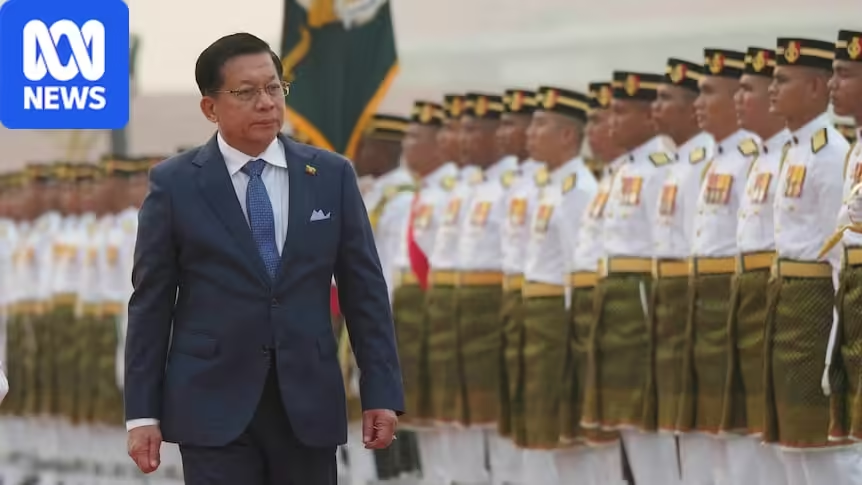
This year, however, senior Trump administration officials have travelled to Tokyo and Myanmar’s capital, Naypyidaw, for talks with coup leader-turned-president Min Aung Hlaing.
The goals of the diplomacy include countering China’s influence in the region and potentially gaining access to Myanmar’s “bountiful rare earth resources”, according to a US State Department document.
But the outreach has raised concerns among human rights advocates that Washington’s pursuit of strategic interests could help rehabilitate a military leadership accused of widespread atrocities.
Debbie Stothard believes pressure on Myanmar’s government should not be weakened, with attacks on civilians ongoing. (ABC News: Haidarr Jones)
“It’s pretty shocking and almost illogical that the US would engage in secret talks with a sham president elected by a sham election,” said Debbie Stothard, chair of the International Network for Economic, Social and Cultural Rights.
“The military junta views engagement at this level as something that’s encouraging and positive for them.
“They see this process as legitimising them, and that is very bad news indeed for civilians on the ground and for regional security.”
‘Hostage diplomacy’
The diplomatic opening followed the detention of an American businessman at Yangon airport on June 11 by Myanmar authorities.
Adam Castillo, 40, a former head of the American Chamber of Commerce in Myanmar, was detained for three months after being accused of financial impropriety, allegations he denied.
Adam Castillo was detained in Myanmar earlier this year. (Supplied)
A former US Marine, Mr Castillo was reportedly lobbying Washington to lift sanctions against Myanmar in exchange for negotiating American access to the country’s vast rare earth deposits. He also ran one of Myanmar’s largest security companies.
Mr Castillo’s detention provided an opening for Washington to establish direct contact with the military leadership, said Hunter Marston, director of the Lowy Institute’s Southeast Asia Program.
“A delegation of US representatives travelled to Naypyidaw to secure the release … that was the supposed setting or context for the US delegation to visit Myanmar,” Dr Marston said.
“But it also paved the way for more substantive discussions about changing US policy and engaging with the Myanmar military regime.
“It seems like his detention was essentially hostage diplomacy, and the release was used tactically to secure talks with Washington.
“I think that played right into the hands of the Myanmar regime, but I think it also served as a useful pretext for Washington to engage in discreet talks with the military.”
Loading…
The race for rare earth riches
Analysts believe the discussions surrounding Mr Castillo’s release may have opened the door to broader negotiations over access to Myanmar’s rare earth minerals, potentially in return for a normalisation of relations.
Since his release in September, meetings between senior US officials, led by Michael Vance, the Assistant Secretary of State for Intelligence and Research, and Myanmar’s military-backed government have continued. The latest took place in Tokyo in October.
Rare earths are essential to manufacturing a wide range of modern technologies, from computer screens and electric vehicles to solar panels and advanced weapons systems.
Clusters of rare earth mines along the Lwe River network in Myanmar. (Reuters: 2025 Planet Labs PBC/Handout)
They are also crucial for producing the semiconductors or chips that power artificial intelligence, Dr Marston said, making them “really important to a number of US business interests”.
“Whoever supplies today has the upper hand in the race for artificial intelligence,” he said.
While the US remains a leader in technological innovation, it is heavily dependent on foreign suppliers for the minerals needed to manufacture many of these products.
Myanmar has emerged as a major source of supply, with more than 600 rare earth mines, according to the Stimson Center. Much of its output is exported to neighbouring China, which dominates the global processing of rare earths.
That dominance has become a growing concern for Washington as competition with Beijing intensifies, and the Trump administration seeks to diversify critical mineral supply chains.
But securing access to Myanmar’s deposits will be difficult. Many of the mines are located in Kachin State, near the Chinese border, in areas controlled by ethnic armed groups fighting the military government.
Dr Marston said China’s entrenched position in the industry would make it difficult for Washington to establish an alternative supply chain.
“It controls something like 90 per cent of the world’s global rare earth production. So it’s unlikely that the United States is going to succeed in circumventing Chinese control over these supply chains,” he said.
A win for the junta?
For Min Aung Hlaing, however, the renewed US engagement represents a significant diplomatic breakthrough.
The former military chief ousted the elected government of Nobel laureate Aung San Suu Kyi in February 2021 and became president this year following elections widely dismissed by opposition groups and international critics as a “sham”.
Since the coup, Min Aung Hlaing has sought to rebuild relations with regional and international powers, including India, Russia, China and Myanmar’s South-East Asian neighbours.
Xi Jinping shakes hands with Min Aung Hlaing in Beijing in 2026. (Reuters: Lintao Zhang/Pool)
Vladimir Putin meets Min Aung Hlaing in Moscow in 2025. (Reuters via pool: Pavel Bednyakov)
Myanmar’s efforts to improve its standing with the US began in July 2025, when the government hired a US lobbying firmthe DCI Group, for more than $US3 million ($4 million) a year.
The US lobbyist Roger Stone, a longtime friend and ally of Mr Trump, is listed as a consultant for the firm. In 2019 he was convicted of obstructing a congressional investigation into whether the Trump campaign colluded with Russia to win the 2016 election, but was later granted clemency by the president.
According to documents filed under the US Foreign Agents Registration ActMr Stone “provided public affairs services” to Myanmar’s Ministry of Information, aimed at “rebuilding relations between … Myanmar and the United States”.
Donald Trump pardoned Roger Stone in 2020. (AP: Andrew Harnik)
Ms Stothard believes those lobbying efforts have made an impact.
With Mr Trump seeking access to Myanmar’s strategic mineral resources, analysts believe the president could also press regional leaders to reconsider the country’s exclusion from high-level ASEAN meetings in Manila next week.
Myanmar’s civilians
The diplomatic developments come as the conflict inside Myanmar continues to intensify.
Since the coup, fighting between the military, pro-democracy resistance groups and ethnic armed organisations has killed an estimated 100,000 people and displaced millions more.
In September, weeks after US officials held talks with Myanmar’s leadership in Naypyidaw, the military launched an air strike on a crowded marketplace in Rakhine State, killing more than 50 people, according to local reports.
Human rights advocates say renewed engagement with the generals, particularly any consideration of easing sanctions, risks weakening international pressure on the military to end its campaign against civilians.
“It’s going to harm the US just as much as it harms the rest of us,” Ms Stothard said.
“The UN and all legitimate human rights organisations have very clearly documented war crimes and ongoing genocide against the Rohingya and crimes against humanity in Burma.”
Source: www.abc.net.au