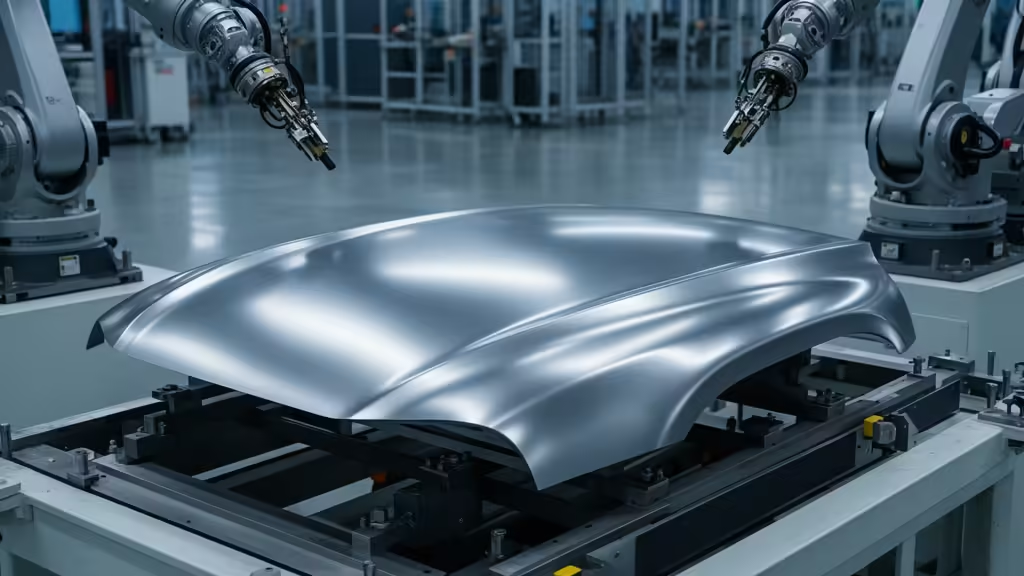

Automotive researchers have established a comprehensive engineering framework that integrates structural design, stiffness optimization, and manufacturing feasibility to produce a single-piece aluminium vehicle hard-shell rooftop. By replacing multi-piece assemblies with an integrated component produced through sheet metal deep drawing, the engineering methodology achieved a 30 percent reduction in component weight alongside a 96 percent drop in the number of sheet metal parts. The systematic transition consolidated manufacturing workflows by eliminating 63 percent of operational steps and reducing baseline manufacturing duration by 95 percent, while preserving structural stiffness. Unlike conventional assemblies that rely on extensive joining and sealing operations, the resulting monolithic structure prevents joint-related water ingress and removes mechanical fasteners entirely. The investigation establishes a repeatable, transferable research reference model that links theoretical design principles, computer-aided optimization, numerical forming simulations, and physical press trials into a unified decision-making workflow for lightweight vehicle structures.
Hard-shell rooftops serve as vehicle-mounted accessories designed to provide durable, comfortable, and rapidly deployable shelter for outdoor recreational activities such as camping and overlanding. Within the broader vehicle accessory sector, roof-mounted shelters are generally divided into soft-shell and hard-shell variants. Soft-shell units feature flexible fabric enclosures manufactured from canvas, cotton, polyester, or nylon materials, which fold away when not in use but typically require external support frames and up to fifteen minutes of manual assembly. In contrast, hard-shell rooftops utilize rigid, self-supporting outer structures fabricated from aluminium, Acrylonitrile Butadiene Styrene, fibreglass, or carbon fibre. Equipped with internal lift mechanisms such as gas struts or mechanical hinges, hard-shell models can be erected in less than one minute without auxiliary framing. Beyond convenience and physical stability, rigid shells offer superior resistance to wind, cold temperatures, rain, and solar ultraviolet radiation, while sheltering integrated auxiliary electrical systems, interior lighting, phone charging ports, sleeping mattresses, and personal storage compartments from weather exposure.
Despite their functional utility, current commercial aluminium hard-shell rooftops are constructed as polylithic assemblies composed of numerous discrete sheet metal segments. An onsite examination of commercial production lines revealed that a typical polylithic rooftop shell requires twenty-three distinct sheet metal parts joined through an intricate sequence of welding, riveting, bolting, and adhesive bonding. This multi-piece architecture introduces significant operational drawbacks, including elevated structural mass, complex logistics, extended assembly cycles, and high labor costs. Furthermore, the extensive mechanical seams and joint interfaces create persistent vulnerabilities to water leakage and joint degradation under continuous service vibrations. In commercial manufacturing, joint sealing frequently necessitates secondary sealing applications and post-production rework to correct seam leaks. Consequently, vehicle accessory manufacturers have faced persistent trade-offs between structural rigidity, assembly complexity, overall component mass, and long-term joint reliability under outdoor operational conditions.
To establish an empirical baseline for evaluating structural and process improvements, researchers conducted rigorous method and time studies under standard operating conditions at an automotive production facility. Method study procedures recorded the physical progression of component assembly, mapping every workstation, counting individual parts, tracking operator distribution, and documenting manufacturing sequences for products built for commercial distribution. Concurrent time studies quantified task durations for each fabrication step under ordinary factory working conditions, deriving representative mean operational times. The resulting baseline metrics established that completing the structural shell of a polylithic rooftop required joining twenty-three individual aluminium panels using 182 rivets, 10 structural bolts and nuts, 600 millilitres of Sikaflex adhesive compound, and 1.8 metres of Tungsten Inert Gas weld seams. Together with subsequent surface finishing, these upstream assembly operations required an aggregate processing time of 127 minutes and 30 seconds per unit, providing a rigorous benchmark against which monolithic deep-drawn fabrication could be evaluated.
In evaluating alternative material options for vehicle rooftops, researchers examined the relative advantages and constraints of advanced composite materials such as carbon fibre. Carbon fibre composites exhibit high specific strength, high stiffness-to-weight ratios, excellent corrosion resistance, and remarkable fatigue endurance under cyclic road vibrations. However, widespread commercial adoption of carbon fibre shells remains constrained by prohibitive raw material prices and capital-intensive production methods involving resin infusion, automated fibre placement, specialized curing tooling, and extended autoclave cycles. Furthermore, composite manufacturing carries inherent quality risks such as internal void formation caused by trapped atmospheric gases or solvent evaporation during resin storage and curing, which compromise mechanical strength. In addition to elevated labor and tooling expenditures, forming integrated stiffening ribs directly into monolithic shapes is considerably more straightforward in ductile sheet metal forming than in composite lamination schedules. As a result, ductile aluminium alloys formed through deep drawing represent a practical balance between mass reduction, dimensional consistency, manufacturing simplicity, and commercial production economics.
The engineering design optimization framework formulated by the authors rests upon three interconnected theoretical foundations that guide development from initial conceptualization to physical press trials. First, Design for Manufacturability principles established by Boothroyd and colleagues provided guidelines to streamline geometric features, eliminate separate fasteners, minimize forming operations, eliminate sharp internal corners, and consolidate the assembly into a single monolithic part. Second, lightweight automotive structural principles were applied through geometric optimization in SolidWorks software, ensuring that the removal of internal framework members did not compromise mechanical stiffness under service loads. Material selection was simultaneously guided by a specialized decision support system evaluated across cost, formability, tensile strength, hardness, and corrosion parameters. Third, deep drawing theory formulated by Groover supplied the scientific basis for finite element manufacturability assessments, utilizing forming limit diagrams, material stress-strain characterization, and plastic deformation criteria to ensure reliable fabrication under industrial press conditions.
Operationally, the framework structures research activities across four primary milestones: initial monolithic computer-aided design modelling, stiffness geometry optimization, deep drawing feasibility analysis, and physical prototype fabrication. Input factors define the physical constraints of the rooftop, including an external envelope of 2,300 millimetres in length and 1,400 millimetres in width to match target vehicle roof dimensions, allowable structural deformation limits under static loading scenarios, and the experimentally characterized mechanical properties of aluminium alloy AA1050. Within the conceptual workflow, mediating computational mechanisms translate these geometric and material boundaries into an optimized component. SolidWorks 2023 was employed to establish initial solid geometries and surface tooling configurations, while custom numerical routines formulated in MATLAB executed the structural optimization. Numerical forming simulations conducted in AutoForm software evaluated material behavior, safe forming limits, local sheet thinning, and unloading springback before tool fabrication, ensuring that virtual models satisfied rigorous manufacturability criteria prior to capital expenditure on physical dies.
To compensate for the elimination of structural stiffeners, internal frames, and welded brackets without increasing sheet thickness, engineers introduced integrated stiffness geometries pressed directly into the monolithic shell. The geometric attributes of these longitudinal ribs were parameterized according to length, width, height, and total quantity, and subsequently evaluated using Taguchi Design of Experiments methodology. In the mathematical optimization formulation, the objective function sought to maximize structural stiffness subject to geometric boundaries, minimum rib spacing requirements, and sheet metal forming limits. Spacing between adjacent ribs was governed by an analytical relationship accounting for total sheet width, rib width, and rib count to prevent mutual forming interference. Forming constraints restricted rib height between 10 and 30 millimetres, length between 1,150 and 2,100 millimetres, and individual rib width between 50 and 100 millimetres to prevent localized necking or tearing during press descent. Computational optimization resolved an optimum configuration consisting of four longitudinal stiffness geometries, each measuring 2,100 millimetres in length, 75 millimetres in width, and 30 millimetres in height, achieving an optimized structural stiffness value of 105.75 Newtons per millimetre.
The optimized monolithic model was subsequently imported into AutoForm forming simulation software to verify deep drawing manufacturability across three critical performance indicators: formability, sheet thinning, and geometric springback after tool release. Finite element forming evaluations revealed that 99.00 percent of the shell surface exhibited safe plastic strain within the green operational zone of the forming limit diagram, confirming that material deformation remained safely below the forming limit curve without imminent localized necking. Minor strain concentrations below one percent were confined to tight corner radii where material draw-in is inherently complex, yet these strains remained well below critical splitting thresholds with zero percent failure. Thinning evaluations demonstrated minimal material reduction ranging between 0.026 and 0.142 millimetres from the original 1.5-millimetre AA1050 blank thickness, representing less than ten percent maximum thinning. This observed thinning remains well below the standard 10 to 20 percent allowable threshold for AA1050 and far beneath the 25 percent critical failure boundary, while simulated post-forming springback displacements ranged from negative 0.409 millimetres to positive 0.688 millimetres, fully satisfying the acceptable dimensional tolerance band of plus or minus 1.0 millimetre.
Physical validation was completed by manufacturing a full-scale prototype using commercial press tooling consisting of a matched punch, die cavity, and blank holder calibrated on a deep drawing press. An aluminium AA1050 blank was positioned and successfully drawn in a single press stroke requiring 6 minutes and 49 seconds, replacing the 127 minutes and 30 seconds previously expended on upstream polylithic assembly, welding, and surface polishing. Dimensional accuracy and surface quality were verified through visual inspection under controlled lighting and non-contact optical metrology using ZEISS INSPECT 3D software. Metrological analysis confirmed uniform material flow, consistent thickness distribution, and an absence of wrinkling, tearing, orange-peel effects, or surface scoring. In structural comparisons based on global displacement under identical boundary constraints, the monolithic rooftop demonstrated high stiffness-to-weight efficiency while completely eliminating 192 mechanical fasteners and potential joint leakage paths. Downstream assembly operations, such as installing perimeter rubber edge seals and mounting handles, remain identical for both designs, confirming that the single deep drawing process yields a fully consolidated structural shell ready for standard final outfitting.
Subject of Research: Automotive engineering framework for deep-drawn lightweight monolithic hard-shell vehicle rooftops
Article Title: Framework for the design of an automotive lightweight monolithic hard-shell rooftop
Article References: Chirinda, G. P., Matope, S., & Sterzing, A. (2026). Framework for the design of an automotive lightweight monolithic hard-shell rooftop. Discover Vehicles, 2(1), Article 4. https://doi.org/10.1007/s44465-026-00009-0
Image Credits: AI Generated
DOI: 10.1007/s44465-026-00009-0
Keywords: deep drawing, monolithic design, hard-shell rooftop, automotive lightweighting, sheet metal forming, stiffness geometry optimization, AA1050 aluminium, AutoForm simulation, Design for Manufacturability, structural stiffness, part consolidation, forming limit diagram, springback analysis, finite element analysis, overlanding accessories, manufacturing feasibility, process consolidation
Source: bioengineer.org