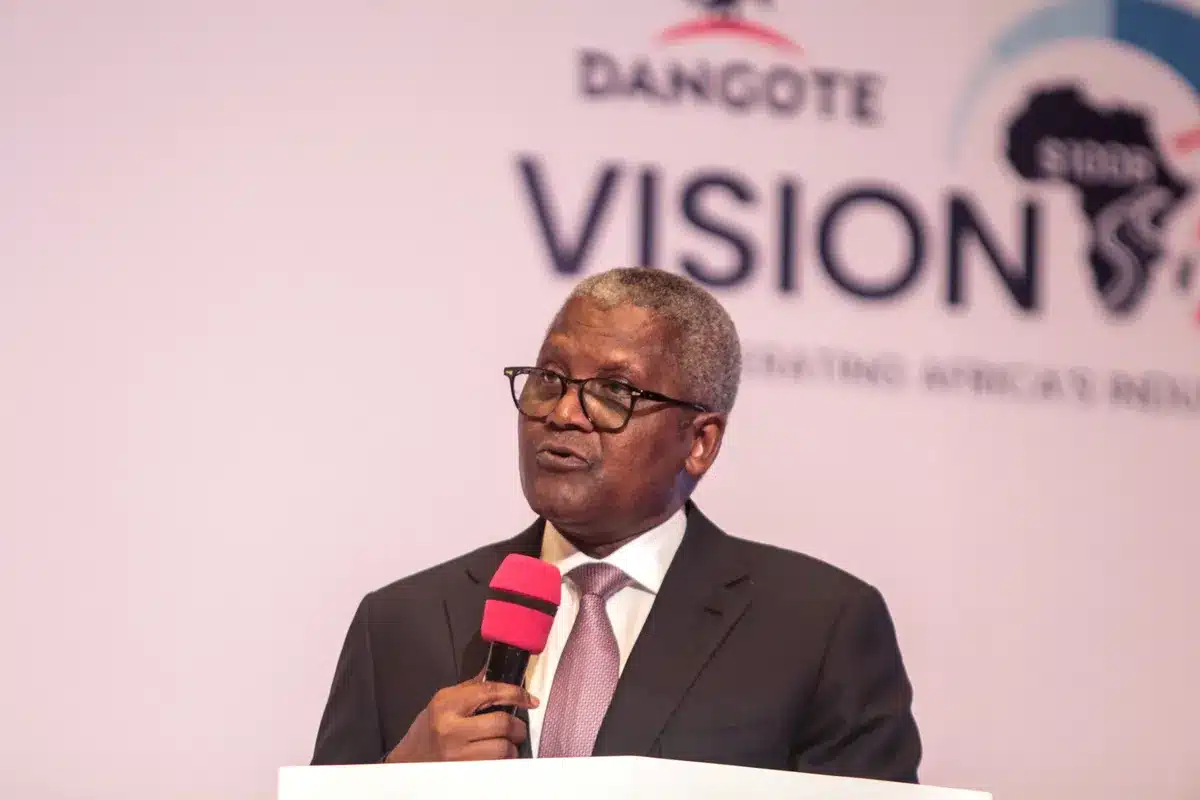

Picture a map of Africa with five new pins in it. Djibouti. Ethiopia. Namibia. Kenya, twice. Each pin carries a billionaire’s signature and a very large cheque.
Aliko Dangote wants those pins to become a network of fuel and fertiliser that spans the continent. His group is aiming for $30 billion in yearly core earnings by 2030, up from about $3 billion, on $100 billion in revenue.
To get there, Dangote raised his Africa investment target to $60 billion on November 4, up from $50 billion.
He made the announcement in Namibia, at the launch of one of the five bets below.
The plan behind the cheques
Most of the money should come from his own businesses. The group says it will lean mainly on cash its operations generate, which reached $1.2 billion in free cash flow in 2025.
Refining and fertiliser sit at the heart of the plan. Vision 2030 targets 1.4 million barrels a day of refining and 12 million tonnes of fertiliser a year, against 650,000 barrels a day today.

His daughter, Fatima Aliko-Dangote, says the goal is to process more African resources in Africa.
The countdown
Our ranking weighs size, reach and risk.
5. Djibouti’s $660 million pipeline, shared with Ethiopia:
Ethiopia has no coastline, so most of its fuel arrives through Djibouti’s port and rolls inland on trucks. Dangote and Ethiopian Investment Holdings plan to cut those trips with a 120 kilometre pipeline from Damerjog to Dewele on the border.
Work starts with a storage terminal at Damerjog that can hold 375,000 cubic metres.
Leaders broke ground on September 24, and Ethiopia’s prime minister’s office says the system should run within 18 months.
4. Ethiopia $4 billion fertilizer plant:
In Gode, in the Somali region, Dangote is building one of the world’s largest urea plants, with room for three million tonnes a year.
The bill began at $2.5 billion, then passed $4 billion in May after a 110 kilometre gas pipeline and a 120 megawatt power plant joined the plan.
Dangote holds 60% and Ethiopian Investment Holdings holds 40%, with completion targeted for 2029.
The plant aims to cut the country’s dependence on imported fertiliser.
3. Namibia $2.5 billion fuel storage facility:
On November 4, Dangote broke ground near Walvis Bay on a tank farm for 600 million litres of diesel and petrol. It is about eight times the size of Namibia’s existing national storage.
A planned pipeline network of about 1,700 kilometres would push fuel inland toward Botswana, Zimbabwe, Zambia and possibly Congo.
Dangote promises cheaper pump prices, and Namibia’s president called the project a landmark.
The real test will come once fuel flows and drivers see what they pay.
2. Kenya $327 million pipeline stake:
Moreover, Kenya is shaping to become the billionaire’s most prefered destination for investment on the continent.
Last month, Kenya Pipeline Company shares changed hands for KSh42.5 billion, and Dangote confirmed two days later that he was the buyer.
His 24.76% stake sits just below the 25% level that would force a takeover offer. It makes him the second largest shareholder after the government.
The pipeline serves virtually all East African countries, with Uganda also owning a stake in it.
1. Kenya $16 billion refinery:
Dangote’s largest investment so far in 2026 is the Dangote’s Kenya refinery now under construction in Lamu.
At Lamu, Dangote broke ground on September 30 on a plant that will process 700,000 barrels of crude a day. Building should take about 40 months, so fuel is not expected before around 2030. The site will also host a 1,000 megawatt power plant and fertiliser and chemical units.
Dangote plans to fund about 70% with debt. Kenya has talked of a 10% stake worth about $500 million through its National Infrastructure Fund.
The bet
Add the five headline values and you reach about $23.5 billion. It comes to roughly 40% of the new $60 billion target, though partners share several of these projects, so not all of it is Dangote’s cash.
Source: businessfront.com