
It took Jensen Huang more than three decades to build Nvidia into one of the world’s most valuable companies. In just five trading sessions, its shares reportedly plunged 18 per cent, wiping approximately $913 billion off its market valuation. The circumstances surrounding that decline present an extraordinary case study in corporate reputation, institutional power and the consequences of concentrating a company’s credibility in a single individual.
Huang, Nvidia’s co-founder and longtime CEO, has publicly acknowledged an extramarital relationship following reports that the woman involved, Chinese business executive Alice Huang, was suspected by American intelligence officials of acting on behalf of Beijing. More recently, allegations of a second relationship, this time involving a senior Nvidia executive reporting directly to Huang, have surfaced, raising further questions about conflicts of interest and leadership accountability. According to a report by The New York Times, US intelligence officials believed Alice Huang may have been recruited by Chinese intelligence. China has rejected the allegations as groundless. There is no established public finding that she engaged in espionage, that Jensen Huang knowingly assisted a foreign intelligence operation, or that sensitive information was compromised.
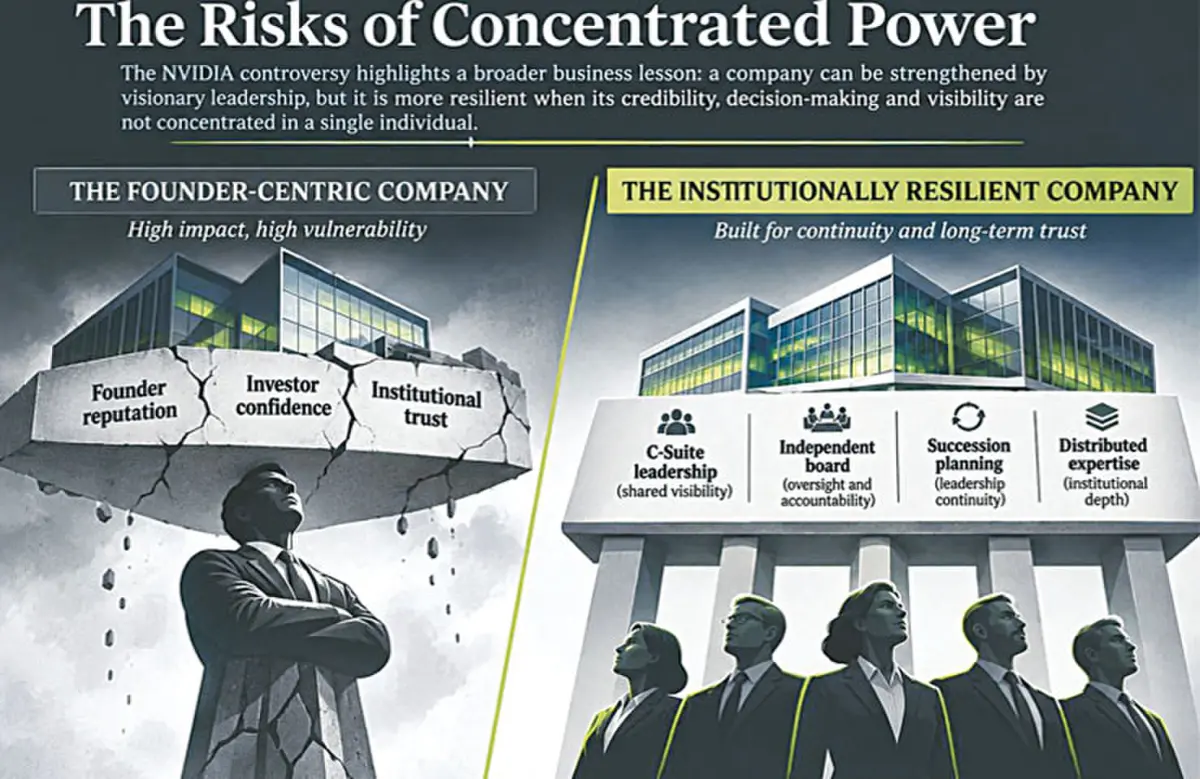
The Nvidia board has initiated an independent investigation. Huang has since resigned. An investigation, of course, is not a verdict. But the reputational consequences of uncertainty rarely wait for one. Huang’s extraordinary influence over Nvidia is inseparable from its success. His long-term conviction about parallel computing helped transform a graphics-chip manufacturer into a company central to the global AI economy. His vision, personal credibility and leadership became powerful corporate assets. Yet therein lies the paradox. The individual who builds an institution can also become its greatest vulnerability. When a company’s identity is inseparable from its founder, personal conduct acquires institutional consequences. Questions surrounding one individual’s judgment can rapidly become questions about an organisation’s governance, integrity and future. The reputational risk is amplified because stakeholders struggle to distinguish between the credibility of the person and that of the enterprise.
Reputation has tangible economic consequences, influencing investor confidence, access to capital, commercial relationships, regulatory scrutiny and talent retention. The stakes become considerably higher when the organisation itself is strategically important to a country.
Nvidia sits in a unique place defined by artificial intelligence leadership, semiconductor geopolitics, US-China competition and American national-security policy. Huang has played a visible role in discussions between Washington and Beijing over access to advanced computing technology. This raises a broader question about the relationship between private enterprise and national reputation. In an increasingly interconnected global economy, certain corporations have become extensions of their countries’ technological credibility and economic influence. Their commercial decisions can shape diplomatic relationships, trade negotiations and perceptions of national competitiveness. When leadership credibility is questioned, the consequences can, therefore, extend beyond shareholders to governments, international partners and national interests. The challenge is to manage legitimate security concerns without allowing unproven allegations to become judgments about entire countries or communities.
For Pakistan, the Nvidia controversy offers a particularly relevant reflection. Across our business landscape, from established family enterprises to emerging technology startups, organisations are frequently built around powerful personalities. Founders become synonymous with their companies, their personal networks drive commercial relationships and their visibility becomes central to institutional identity. This concentration is often deliberate. In environments where institutional trust can be difficult to establish, a credible, charismatic founder can attract investment, open doors and lend legitimacy to a business. But the danger emerges when the founder’s reputation becomes the company’s reputation, when relationships belong to individuals rather than institutions, and when decision-making authority and stakeholder confidence are concentrated in one person. The vulnerability is not necessarily misconduct but dependence. And this is where corporate governance and strategic communications must work together.
Pakistani businesses often invest in developing the visibility of their founders and CEOs. Far fewer appear to give comparable attention to the deliberate disbursement of visibility across C-suite leadership, developing multiple credible voices capable of representing the organisation’s expertise, values and strategic direction. This is about more than distributing media appearances. A visible, empowered leadership team signals institutional depth, continuity and the existence of expertise beyond one individual. It reassures stakeholders that the organisation’s future is not entirely dependent on the judgment, relationships or reputation of its founder. But visibility without authority is cosmetic. The distribution of public credibility must be accompanied by genuine delegation of responsibility, independent board oversight and credible succession planning. For Pakistani startups seeking international investment, these considerations are particularly significant. Investors are backing an enterprise’s future, not merely the persuasive abilities or personal networks of its founder. The same principle applies to family-controlled businesses seeking to build institutions that endure across generations. Huang’s leadership helped create extraordinary value. The present controversy does not erase those achievements. But it exposes the fragility that can arise when an institution becomes so closely identified with one person that uncertainty surrounding the individual unsettles confidence in the whole. The question for business leaders is whether they are building organisations that can stand independently of them, or organisations whose fortunes remain inseparable from their own. The ultimate price of concentrated power is revealed when an institution must prove that it can be trusted independently of the person who made it successful.
The writer is a strategic communications adviser.
Published in Dawn, The Business and Finance Weekly, November 16th, 2026
Source: www.dawn.com