
Victoria’s cooling property market has delivered a $5 billion blow to the state’s budget forecasts less than a month before the state election.
An average of $1.3 billion a year is set to be shaved from the state’s tax revenue over the four-year forecast period, according to a fiscal update handed down today.
“This is primarily driven by downgrades to land transfer duty and land tax, reflecting a decline in property market activity amid higher interest rates and other factors,” the update said.
The government is still on track to deliver operating surpluses over the outlook period — but the expected average of $300 million a year is a significant reduction from the $1 billion forecast in the May budget.
And net debt will be slightly lower than previously forecast, owing to a lower-than-anticipated debt position in 2025-26.
Debt will climb to $197 billion in 2029-30, about $2 billion less than previously forecast.
But interest expense payments continues to eat into state coffers.
The fiscal update shows annual interest payments will be $8.9 billion this year — $24.3 million a day — rising to $11.9 billion in 2029-30, or $32.8 million a day.
“Victoria’s finances are deteriorating and economic headwinds are accelerating,” said Martin Codina, executive director of the non-partisan campaign group Amplify.
“Victoria urgently needs a plan to stop borrowing and pay down debt so that all Victorians can have confidence in the future,” he said.
The books spell out nearly half a billion in savings since the last budget and also clarify that a clandestine myki surcharge uncovered by the auditor-general earlier this year, which Premier Ben Carroll said would abolished, will formally cease to exist on January 1.
Migration changes, material costs threatening state’s outlook
The tax-reliant state is still expected to capture $9.2 billion in land transfer duty and $7.6 billion in property-related taxes in the current financial year.
The drop in property-related taxes was just one of several risks to Victoria’s economic outlook that the report said “have increased in recent months and are elevated”.
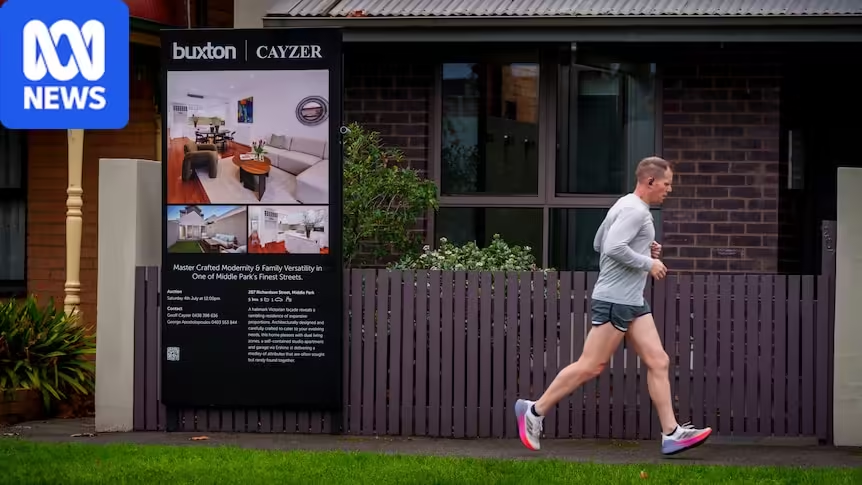
Falling prices in some parts of Melbourne’s housing market is estimated to shrink stamp duty and land tax revenue. (774 ABC Melbourne: Simon Leo Brown)
Among them was recently announced federal changes to migration.
“If net overseas migration declines by more than currently expected, this could weigh on the longer-term economic outlook for the state through fewer consumers, lower education exports and a smaller pool of workers,” the report said.
It also warned increased fuel and material costs, some linked to the prolonged conflict in the Middle East, could cause further cost headaches for Victoria’s infrastructure projects.
Colin Brooks took on the role of Victorian treasurer in August this year. (ABC News: Danielle Bonica)
Asked if his government took responsibility for the property market downturn, Treasurer Colin Brooks said the entire country had witnessed a similar decline, particularly in the eastern states.
“This is something that’s impacting the whole country, driven by inflation, interest rates and also some changes in the federal budget settings as well,” he said.
Mr Brooks said the $2.4 billion operating surplus recorded last financial year assured the state could responsibly deliver projects moving forward.
Auditor urges ‘long-term’ approach to budget repair
Melbourne has been at the forefront of a cooling property marketwith declining auction clearance rates and subdued price growth linked to a slowdown in investment.
Mr Carroll has vowed to reverse increases to land tax unveiled in 2023 as part of a post-COVID budget repair plan if Labor is re-elected next month.
The tax, along with high interest rates and changing tenancy laws, have been credited with an exodus of property investors from Victoria.
In a separate report tabled today, the auditor-general’s review of the Treasury’s papers showed the state continued to record operating cash deficits, and called for more long-term approach to budget repair.
“The current fiscal strategy remains focused on short-term outcomes. While recent operating financial results have improved, fiscal cash deficits persist, debt remains relatively high, and long-term expenditure pressures continue to grow,” the report saide
“Recent government initiatives do not go far enough to address the state’s financial challenges or strengthen long-term financial resilience.“
Coalition backtracks on SRL vow as $1bn figure revealed
The Coalition has conceded that it will not pause construction on the contentious Suburban Rail Loop despite saying its policy is to “pause and review” the $34 billion project.
The government has confirmed pausing construction works, including tunnel boring, would cost at least $1 billion.
Jess Wilson’s opposition has now said that it would not pause construction if elected on November 28.
Shadow Attorney-General James Newbury today qualified that work would only be paused if that did not breach existing contracts.
The Coalition had previously said workers would still be paid when work was stopped.
“The tools will be downed on anything that is not a breach of contract,” he said, adding that workers would still be paid.
Works are already underway on the Suburban Rail Loop and the government has said pausing them would cost at least $1 billion. (ABC News: Simon Tucci)
Contracts totalling $15 billion have already been signed, and tunnelling is underway.
The cost of pausing and altogether cancelling the $35 billion SRL East has remained unclear throughout debate about the project’s future, but frontbencher Anthony Carbines today said it would cost taxpayers $1 billion to “stop the project”.
Mr Brooks, the treasurer, said the Coalition had now “effectively” adopted Labor’s position.
“[It’s] a complete backflip, they’ve effectively admitting they were lying to the Victorian people,” he said.
Mr Carroll already cut $1 billion from the project, in part by cutting overpasses, walkways and car parks attached to planned stations.
He has also vowed to find another $1 billion through a “technical” review.
The first stage of a broader rail project spanning decades, SRL East is intended to link Cheltenham and Box Hill in Melbourne’s east, but has been subject to speculation over whether its price tag and funding model are reliable.
Loading…
Source: www.abc.net.au