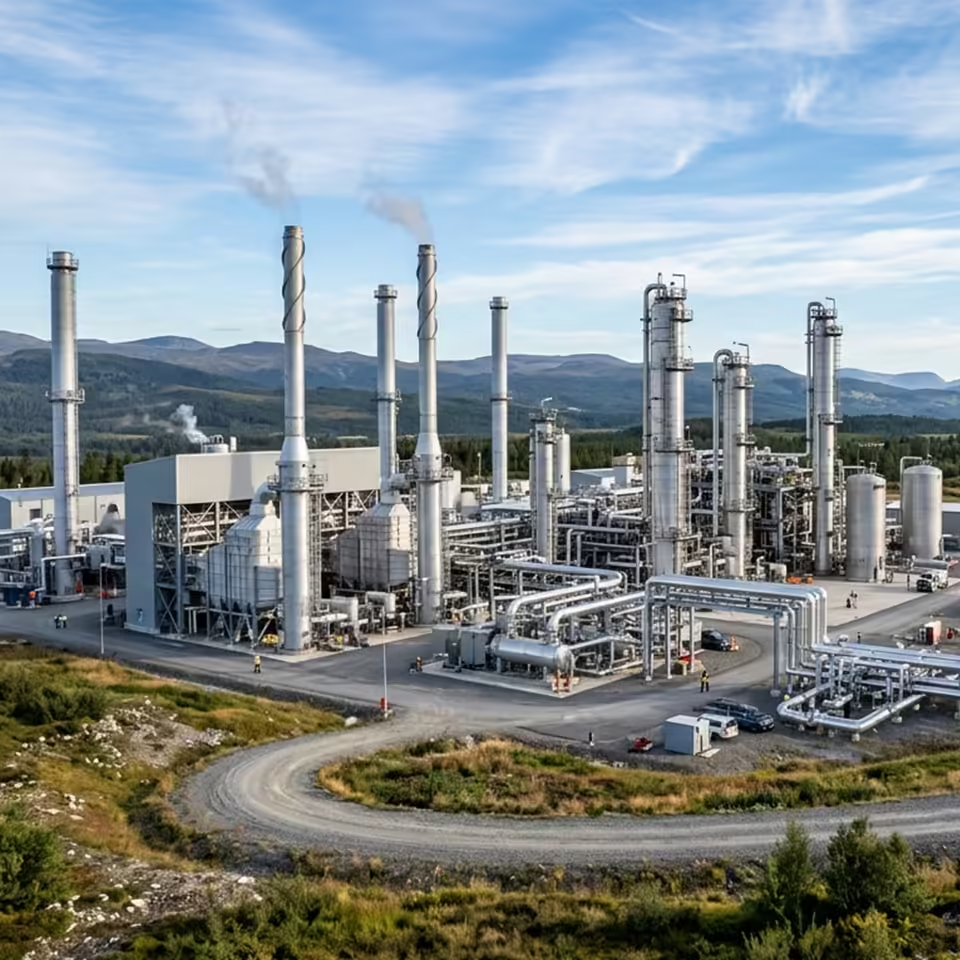

The economics of CCS vary considerably across each step of the value chain, from capture through transport to geological storage10.
Capture consistently represents the largest share of total CCS chain costs and is primarily driven by the concentration of CO2 in the gas stream being treated. For industrial processes generating high-purity CO2 streams (such as ammonia production, natural gas processing or bioethanol fermentation), capture typically costs USD 11–34/t CO2, requiring only compression and drying rather than full separation5. For medium-concentration streams (cement kilns, steel blast furnaces, refineries and waste-to-energy plants), where CO2 typically represents 5–15% of flue gas, costs rise to USD 28–140/t CO2. Cement is at the upper end of this range4, with CCS increasing levelised production costs by 60–130%, while steel plants see cost increases of around 10–20%.
The choice of capture technology also influences costs. Chemical absorption with amine solvents, the most mature approach, remains cost-competitive but carries a significant energy penalty for solvent regeneration. Solid sorbent adsorption is emerging as a cheaper and less energy-intensive alternative for modular applications, while membrane separation promises lower energy use but currently faces higher capital costs at industrial scale6.
For carbon dioxide removal technologies, costs are significantly higher. BECCS ranges from USD 45–85/t CO2 depending on the sector of application. Direct Air Capture (DAC) is currently priced at USD 110–900/t CO2 and is considered unlikely to fall below USD 340/t CO2 even at gigaton scale5, although it is a very debated point and some believe that costs can go below USD 150/t CO211. Looking ahead, cost reductions of 20–40% are anticipated across most industrial capture applications by 2035 as technology matures and supply chains develop.
CO2 transport costs depend heavily on distance, volume, transport mode and degree of infrastructure sharing. Compression and conditioning prior to transport add a further USD 11–28/t CO2 regardless of mode5.
For pipeline transport, economies of scale are dramatic4: costs range from USD 9–11/t CO2 for a small 3 Mt/year line down to USD 2–3/t CO2 for a large 30 Mt/year network over 250 km. In Europe, CATF’s geospatial cost modelling shows that, with only the announced (mostly offshore) storage sites and without pipeline access, transport and storage costs for cement and lime plants range from USD 38 to 240/t CO2 (median USD 120/t CO2). When pipeline access is enabled, 79% of plants achieve combined transport and storage costs below about USD 110/t CO2; if storage is also developed more widely, including onshore, 90% of plants fall below about USD 70/t CO2 (median USD 43/t CO2)12.
For CO2 shipping, current cost estimates range from USD 17–45/t CO2 for dedicated vessel connections, with significant reduction potential as fleet sizes grow13.
Overall, European transport costs are projected to fall by around 18% by 2030 and 37% by 2050 as infrastructure expands3. Transport thus weighs much less than capture for most emitters, but can rival it for sites located far from storage, and it is a more readily actionable lever: shared pipelines and more geographically distributed storage sites would reduce transport distances and open CCS to a broader range of industrial emitters.
Storage costs are the most variable component of the CCS chain, driven primarily by geological conditions. A recent modelling study by the Global CCS Institute identifies boundary conditions as the single most decisive cost driver: closed-boundary systems (where pressure cannot dissipate into surrounding formations) can cost up to four times more than open-boundary equivalents14.
For onshore saline aquifer storage, costs range from USD 2–15/t CO2 under favourable conditions to USD 10–58/t CO2 under the most challenging geological settings but rarely exceed USD 60/t CO2 even in worst-case onshore scenarios. Offshore storage carries a higher base cost due to additional infrastructure complexity, ranging from USD 5–31/t CO2 with open boundary conditions, but up to USD 147/t CO2 in constrained settings (closed boundaries, poor-quality reservoirs). Notably, offshore projects with open boundary conditions can achieve costs comparable to onshore sites and remain the preferred option across much of Europe given geological availability and social acceptance5.
When capture, conditioning, transport and storage costs are aggregated, end-to-end CCS costs currently range from around USD 25–60/t CO2 for the lowest-cost applications (high-purity streams with onshore storage) to USD 120–200/t CO2 or more for harder industrial sources with offshore transport and storage4,9. A presentation to the European Parliament estimated the average end-to-end cost for EU industrial CCS at between USD 170–340/t CO2.
These figures are telling when set against the current EU ETS carbon price, which averaged around USD 90–96/t CO2 (EUR 80–85/t) during the first semester of 2026, well below the full cost of CCS for most industrial applications. This gap explains why most operational CCS projects today still rely on blended public funding, Carbon Contracts for Difference (CCfD) or long-term offtake agreements to bridge the commercial viability gap, and why policy support remains indispensable to scaling the sector in the near term.
Beyond storage, the long-term value of carbon capture may also lie in treating CO2 as a feedstock rather than a waste stream. The most mature route is synthetic chemistry: combined with low-carbon hydrogen, captured CO2 can be converted into platform molecules such as methanol (whose downstream derivatives include formaldehyde, olefins, and synthetic fuels) as well as ethylene, formic acid, and polycarbonates, through thermocatalytic or, increasingly, electrochemical pathways16. Altogether, e-fuels and chemicals are expected to represent the vast majority of CO2 use, although other applications, such as building materials or precision fermentation represent further opportunities. LanzaTech, for instance, already sells protein derived from industrial gases and has set a roadmap toward commercial-scale CO2-to-protein production by 2028. Crucially, the economics of these applications improve markedly when CO₂ is valorised in short loops close to the point of capture: co-locating conversion units with high-purity emitters such as ammonia or ethanol plants cuts transport, compression, and purification costs, and integrated coproduction systems have been shown to lower both emissions and the effective cost of the captured18.
Source: www.enerdata.net