
CCS and FEN UDD sign strategic alliance to study the economic-financial contribution of business sustainability
How much does a sustainability project contribute to the financial balance? Answering that question is today one of the main challenges for Chilean companies. To address it, the Santiago Chamber of Commerce (CCS) and the
Business Sustainability Center (BSC) of the Faculty of Economics and Business (FEN) of the Universidad del Desarrollo signed a collaboration agreement and strategic alliance to promote sustainable business development as an engine of the economy and business.
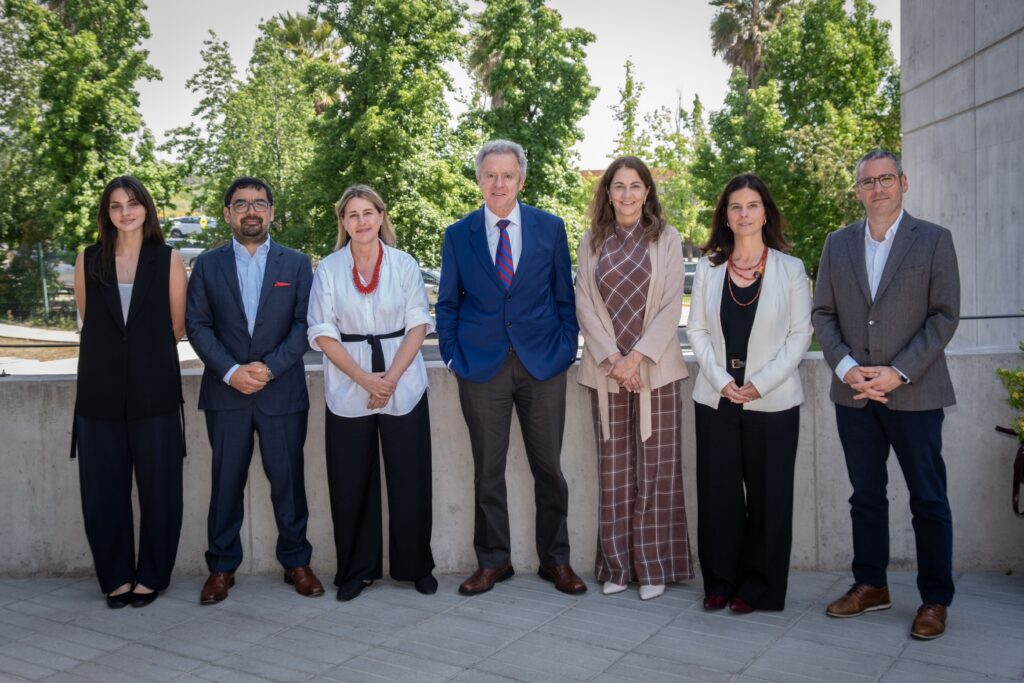
The signing brought together María Teresa Vial, president of the CCS; Federico Valdés Lafontaine, Rector of the UDD; Matías Lira, dean of the FEN UDD; Catalina Braun, Vice Dean of the FEN UDD; Roberto Ponce, director of the BSC; Verónica Torres, CCS Sustainability Manager, and Dana Wagner, CCS Sustainability Coordinator.
CCS president, María Teresa Vial, stated that “we have fully entered the era of ESG accounting, bringing the impact of business sustainability to the heart of the financial strategy is essential to mobilize capital and build the trust that the market today demands of us.”
A gap that the market needs to close
The agreement formalizes work that both institutions have been carrying out for months in the CCS Sustainable Finance Council. Today, this body brings together almost 50 leading companies from different sectors, with a common challenge: translating sustainability management into quantifiable financial results.
The context is demanding. Regulations such as NCG 461/519 of the CMF raise reporting standards, while, according to a diagnosis carried out this year by the CCS to the Council’s companies, more than 65% have not yet adopted methodologies to financially evaluate their socio-environmental projects.
Preliminary results of a survey applied by the CCS and the BSC to companies from the Sustainability Committee illustrate the problem: 26 of 29 respondents assign high importance to the energy savings of a project, but only 13 would incorporate it into their cash flow. In other words, companies recognize the value of sustainability, but they still do not have common criteria to carry it into their financial evaluations.
“From the Faculty we can provide methodologies to evaluate sustainability projects with the same rigor as any other investment. The alliance with the CCS allows us to develop these methods together with companies,” said Matías Lira, dean of the FEN UDD.
A guide to evaluate sustainable projects with financial criteria
The first great fruit of the alliance is the joint development of an Investment Evaluation Guide for sustainability projects. The tool accompanies teams from the initial evaluation of a project to its application in specific cases, and is structured in three parts:
● The evaluation problem: how an investment is decided today and what common errors appear when building the case.
● The conceptual guide: a shared vocabulary between sustainability and finance, a taxonomy of costs and a classification of benefits according to who captures their value, supported by frameworks such as ROSI, Capitals Protocol and the social prices of the State.
● The practical guide: how to build and present the business case with data from a
real project.
The guide is being calibrated with the experience of the companies themselves: both sustainability leaders and the finance teams that decide which projects are financed participated in the information gathering.
“The guide helps build the business case with the data of each project. In addition, it offers criteria to decide what benefits to incorporate into the cash flow and how to separately evaluate the social and environmental effects,” explained Roberto Ponce, director of the BSC UDD.
Next steps
The alliance is part of the roadmap of the CCS Sustainable Finance Council, which works on three pillars: access to capital, through the identification of sustainable financial products and banking eligibility criteria; investment, with the attraction of national and international funds for impact projects; and financial results, with methodologies to quantify ESG management and its effect on investment and operation costs (CAPEX/OPEX).
In the coming weeks, the Council companies will review and discuss the progress of the conceptual guide, and then advance its practical application with real cases. The guide will be officially launched on January 21, 2027 and will be publicly accessible to the entire business ecosystem. In addition, the agreement contemplates lines of joint work in training, research and events.
“Our goal at the Sustainable Finance Council is to build a definitive bridge between the sustainability and finance teams, to measure tangible impacts, mitigate risks and respond to new regulatory demands,” concluded Verónica Torres, CCS Sustainability Manager.
Source: www.ccs.cl