
It was nearly 80 years ago, and Europe was struggling to emerge from the devastation of war. Much of the continent lay in ruins, its economy was on life support and its political future uncertain.
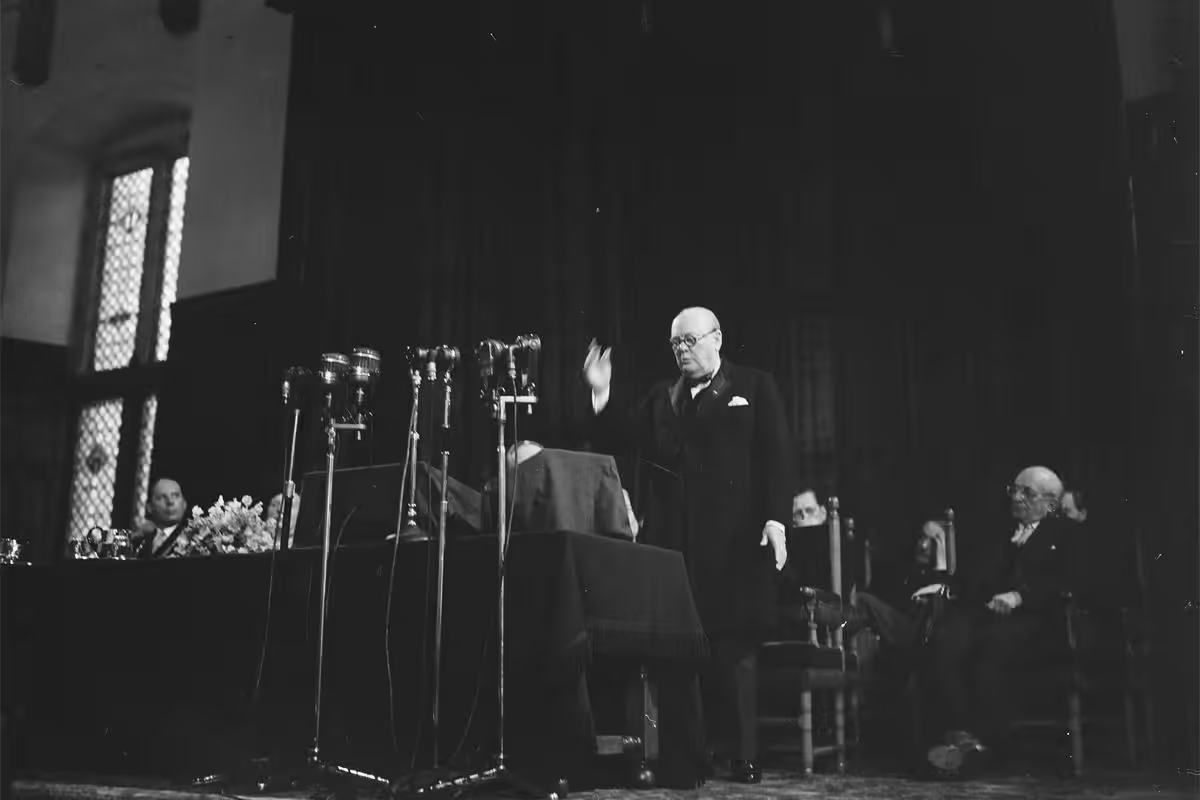
In May 1948 hundreds of delegates from across Europe gathered within the imposing walls of the Ridderzaal in The Hague to hear an Englishman set out a vision for their salvation. His name was Winston Churchill. His answer: a “United States of Europe.”
Fast-forward to today and Commission President Ursula von der Leyen wants another Congress of Europe to reimagine the continent’s future.
The details are different, but the historical echoes are hard to miss. War has returned to the continent. Nuclear arsenals are once again expanding while climate change and artificial intelligence are adding new dimensions to Europe’s existential anxieties. Its economies, meanwhile, are squeezed by mounting global competition, while public trust in institutions are fraying and old alliances are weakening.
A new Congress of Europe, the thinking goes, could supply fresh ideas and new momentum to the European project.
Overhauling the bloc’s institutional architecture could address some of its most persistent weaknesses, like paralysis of foreign policy and the democratic deficit separating European citizens from the officials who shape policy in Brussels.
But for those who have spent decades wrestling with the question of European integration, from federalists to euroskeptics, the real question isn’t whether Europe can dream up a new vision. It’s whether those with power are willing to act — and, ultimately, what kind of Europe they want to build.
Forging Europe’s future
At the Ridderzaal, delegates forged a compromise between federalists and those who favored cooperation among member states. The first Congress birthed the Council of Europe, founded in 1949, and also inspired other European projects such as the College of Europe, European Movement International and the European Convention on Human Rights.
The Congress marked the beginning of a wave of efforts to unite Europe after years of war, from the Schuman Declaration in 1950 that led to the European Coal and Steel Community, to the Treaty of Lisbon that entered into force in 2009.
But the momentum towards a federal Europe slowed as the union expanded beyond economic cooperation into justice and home affairs, all while more countries joined the bloc. The shift brought sensitive questions of identity and sovereignty to the fore, putting governments wary of ceding national powers on the defensive.
“Many people are inclined to say that the only way forward is an ever closer Union,” said Catherine De Vries, political scientist at IE University and author of “How Europe Survives.” “But that’s not true. If you look at the postwar history of the European Union, it’s an organism that has developed in much messier ways.”
She argues that the European Union should be understood as a vehicle to bolster member states’ sovereignty through international cooperation on issues like migration and border security. More federalism per se, then, isn’t necessarily the answer to Europe’s problems, she said, but rather a root cause of member states’ resistance to change.
Visions for Europe have multiplied over the past decade, from the right to the left, yet structural change has stalled. The EU hasn’t undergone a major treaty revision since 2009.
De Vries said the impasse is hardly surprising. Treaty reform requires politically fraught ratification processes, including referendums in some member states. More fundamentally, she said, too few governments have been convinced that reopening the treaties is the right political step — leaving reform stuck in the Council.
But that doesn’t mean Europe’s elite have stopped trying.
‘Broken from the very start’
European leaders have repeatedly sought to break the deadlock over reform. The list read as a who’s who of Brussels policymaking: former Commission president Jean-Claude Juncker’s white paper on the future of Europe, the Conference on the Future of Europe led by Von der Leyen and Emmanuel Macron, and the reports on competitiveness by economists Mario Draghi and Enrico Letta.
But the efforts have largely failed to jumpstart further reforms, with the Conference on the Future of Europe, held across the EU between 2021 and 2022, being the most emblematic example.
More than 700,000 citizens met with civil society groups and EU officials to put forward 49 proposals on how the EU should work. After its conclusion the European Parliament took some of the most ambitious structural proposals and voted in favor of a convention to reform the treaties. Proposed reforms included switching to qualified majority voting within the European Council in areas like foreign policy, giving the Parliament powers to initiate, amend or revoke legislation and for Parliament to nominate the Commission president.
But “the car was broken from the very start,” said Fassoulas, who participated in the conference. “They were driving it down the road as they were building it,” he said. “The organizers didn’t have a clear idea of what they wanted or political buy-in.”
It was a frustrating outcome for those who took part, like Janis Emmanouilidis, deputy chief executive and director of studies at the European Policy Centre.
He said that governments feared the Conference on the Future of Europe would undermine their power and move the EU in a more federal direction. Treaty reform proposals or calls for a new convention must go through the Council, and without at least majority support, they can’t move ahead.
“I’m pointing my fingers at the member states,” said MEP Raquel García Hermida-Van Der Walle (Renew, NL) who chairs the Spinelli Group, the network of federalist-minded lawmakers within the Parliament. “The Council has a responsibility to engage with the European Parliament and give an institutional reaction to our proposal.”
‘We need to make Europe flexible’
Not everyone agrees that Europe needs more federalist reforms. Rising right-wing movements across the EU want to limit the power of Brussels, arguing instead that a strong Europe is built on strong nations.
“Power that moves to Brussels never comes back on its own,” said MEP Charlie Wiemers (SE, ECR). “So any honest debate about Europe’s future must start with returning powers to member states and keeping the veto.”
Wiemers said that democratic accountability rests with member states, not the EU, and that his party would oppose a new Congress as a tool to “manufacture consent for more centralization.”
Rodrigo Ballester, head of European studies for Mathias Corvinus Collegium and author of The Great Reset, a report on reforms that would reinforce the power of member states, said that reforming the EU was inevitable as the EU continues to enlarge, but that “the answer cannot only be federalism.”
Instead, he suggested a “Europe á la carte” approach — differentiated integration that would allow member states to work together on as many, or as few, policy issues as they wished.
“We need to make Europe flexible so it bends instead of breaks,” he said. “It’s not a way to kill the EU, but to make it survive by inserting a huge dose of flexibility.”
De Vries agreed, arguing that smaller, targeted reforms within existing EU law would be more effective. For example, she said that member states could do far more under enhanced cooperation. Under Article 20 of the Treaty on European Union, at least nine member states can come together to act on specific issues.
As more right-wing parties eye power in 2027, the window to further federalize the EU is closing. Parties like Alternative for Germany and National Rally have already unveiled plans to downsize the bloc’s power, including reducing the budget and shrinking the Commission.
But the challenges of reform aren’t limited to only treaty-level change. Even smaller, policy-level EU reform proposals have met similar fates. The European economic competitiveness reports written by Italian economists Mario Draghi and Enrico Letta have had spotty implementation. Only 16% of Draghi’s 383 recommendations have been strictly implemented, according to the Draghi Index, a tracker measuring the uptake of his proposals.
‘This is looking like a fig leaf exercise’
With member states blocking fundamental reforms, pro-European groups — European Movement International, the Union of the European Federalists and the Spinelli Group — are pinning their hopes to a different lever: a truly bottom-up, citizens-led Congress of Europe that could pressure governments to act.
But, there’s growing fear among these same groups that the 2027 Congress will instead be a top-down exercise driven by the 13th floor of the Berlaymont.
“This new proposed Congress of Europe is rather elite-driven,” said Richard Corbett, a former member of the Parliament who represented the Parliament at the Conference on the Future of Europe in 2021 and 2022. “The 1948 Congress was grassroots organizations who brought it together and then brought politicians to it.”
European Movement International sent a concept note for what the next Congress of Europe could look like to Von der Leyen earlier this year. But they’ve yet to receive a response.
Fassoulas said that without engagement from citizens and civil society there was a risk that the next Congress of Europe could “just be lip service” to the idea.
Emmanouilidis put it more bluntly: “This is looking like a fig leaf exercise. I don’t think there’s bad intent, but it’s unclear to me whether the level of ambition is strong enough to make this thing work.”
Manuel Müller, nonresident fellow at the Finnish Institute for International Affairs and editor and founder of the Föderalist, said that political buy-in from member states and a commitment to endorse treaty change would give the Congress more legitimacy. “I don’t see any real political capital invested in this,” he said.
A Commission spokesperson said that the initiative was still planned for the first half of 2027, and will allow Europe’s youth to “write their own chapter in our history.”
The first Congress faced a similar historical test. Speaking before Europeans drawn from all walks of life at The Hague in 1948 — from “trade-unionists” and “statesmen” to “chiefs of industry” and “eminent writers” — Churchill outlined the “high and solemn responsibility” which lay before that generation.
“If we fail in clarity of view or courage in action, a priceless occasion may be cast away forever,” said Churchill. “But if we all pull together … and firmly grasp the larger hopes of humanity, then it may be that we shall move together into a happier, sunlit age …”
Churchill’s words still ring true nearly 80 years later. What remains uncertain is if today’s Europeans can summon the “courage in action” to match the Europe they hope to build.
Follow the developments shaping Europe
Subscribe to The Continental to receive The Parliament’s latest reporting, analysis and opinion to your inbox, delivered every weekday morning. Sign up for free here.
Source: www.theparliamentmagazine.eu