
The Colorado Avalanche announced two serious injuries on Saturday morning. Their top players Nathan MacKinnon and Cale Makar are both out for an extended period. Makar is expected to miss two weeks, while MacKinnon could be gone a month.
The Canadiens faced a weaker Avs club, but they still have a lot of firepower without their two best. Montreal turned in a flat effort. It happens in a long season: Colorado 4 Montreal 1.
Wilde Horses
The first half of the game basically saw the Canadiens playing well enough, but not catching any breaks. This isn’t to say they were scintillating as only Kirby Dach stood out above the crowd. Dach is becoming harder to take off the puck. He uses his reach well, and is increasing his offensive-zone time.
Montreal couldn’t mount any answers until one Nick Suzuki scored one of the prettiest backhand goals you’ll ever see. The pass came from Juraj Slafkovsky in the high slot. Devon Toews was right in front ready to defend, until Suzuki suddenly wasn’t there anymore.
Suzuki did a spin-move that left Toews watching, and in that moment, Suzuki fired a backhand off the joint of the crossbar and post, and into the net. It was exquisite. It reminded one of the days when players had a straight blade that made backhands easier.
This wasn’t a night when anything came together. There’s little to praise. Apart from the Suzuki goal, Canadiens chances weren’t of a high quality, and no one stood out except Dach, and the goal from Suzuki.
Wilde Goats
After 12 games with a point in every contest, what ails the Canadiens finally came to the fore. It’s difficult to believe that the 31st ranked power play in the league was able to take a point in every game considering how vital a power play is to success.

Get breaking National news
Get breaking Canada news delivered to your inbox as it happens so you won’t miss a trending story.
It’s easy to say the club misses Ivan Demidov, and that is true, but this malaise goes much deeper than what changes Demidov could bring. The power play is about talent, but, clearly, talent alone doesn’t get the job done, because the Canadiens have plenty.
The issue is chaos. It sounds simple, but power plays aren’t just about pretty passing. Often, it’s bodies in front of the net, and the Canadiens almost never have anyone where pain meets opportunity. They are reluctant to take it to the net, and they are reluctant to stand in front of the net.
Half of the power play goals come from beautiful passing, and the other half come from the pure chaos of a shot taken with men in front of the net, or charging to the net for rebounds, screens, and deflections.
The shot from 25 feet that a goalie is square to isn’t often going to get the job done, especially when the best shooter Cole Caufield often finds himself in the corner for some reason. That structure has always been confusing why such a great shooter is at the side in the corner.
Slafkovsky is the number one issue on the power play. He doesn’t enjoy life in front of the net taking punishment on the power play. When Slafkovsky gets positioned on the half-wall, then he loses possession with pressure. It’s a hard truth to hear, but Slafkovsky needs to get angry, dirty, and fight for space where space is the hardest fight.
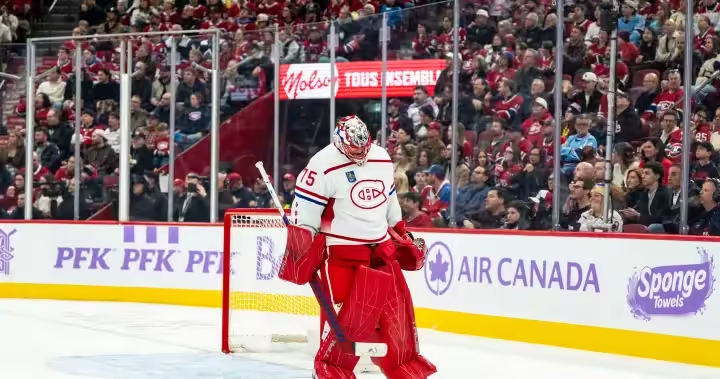
The other negative is Jakub Dobes. He definitely was unlucky, but he also has some weakness in his game. Dobes is overplaying shots laterally leaving him completely out of position for rebounds. Naturally, he wants to track that first shot fully, but in doing that he’s out of the net. He is sliding to Moose Jaw.
Also, when a goaltender is on his back, or on his stomach, something has most definitely gone wrong. It just shouldn’t happen. In the prone position, there’s, at least, three feet of free space above. No goaltender coach teaches any goalie to be on his stomach.
Dobes is 71st of 76 goalies in the league in Goals Saved Above Expected. The statistics are telling a story of a goaltender not playing technically sound. When he was the best goalie in the playoffs last spring, he was technically sound. He was square to the puck, and, in position, ready for rebounds.
One final thought, Florian Xhekaj is fun, but the better hockey player is Owen Beck. Florian made no impact on the game and had difficulty defensively. Beck looks strong every night he’s been given the opportunity.
He’s the more complete player.
Wilde Cards
The Canadiens also announced a serious injury on Saturday as Chris Kreider is gone for six to eight weeks. Kreider suffered the injury in Boston on Thursday night in an awkward hit with Michael Eyssimont.
The Bruins forward fell as he approached Kreider for some reason. He didn’t seem to lose his balance but chose falling as his best chance to make a play against the Canadiens forward. They contacted at Eyssimont’s hip against Kreider’s knee.
Kreider was fitting in nicely with the Canadiens so far. The offence wasn’t stunning, but Kreider plays a good two-way game, and he will be missed.
The Canadiens only said that it was a lower-body injury, but the way the leg bent from the outside-in during the collision usually indicates an MCL injury, and the timeline
to return is correct for that. The six to eight weeks also indicates that the ACL was not implicated, and that’s fortunate for Kreider.
Recovery from an MCL injury is almost 100 per cent successful.
Brian Wilde, a Montreal-based sportswriter, brings you Call of the Wilde on globalnews.ca after each Canadiens game.
© 2026 Global News, a division of Corus Entertainment Inc.
Source: globalnews.ca