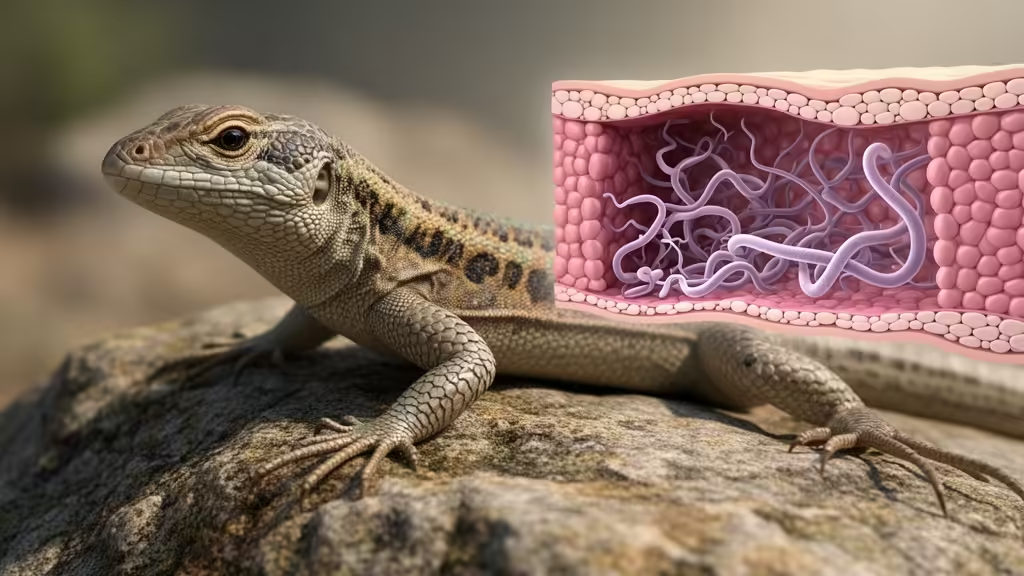

In a broad molecular investigation of wild reptile populations, researchers detected Borrelia DNA in 5.8 percent of individual lizards and across 22.2 percent of sampling sites surveyed throughout the Iberian Peninsula and North Africa. The study examined blood samples collected from eighteen species of lacertid lizards across sixty-three distinct geographic localities, ultimately identifying active Borrelia infection across ten of those species. These findings establish that bacterial presence within lacertid lizards is distributed across multiple species and diverse regional localities rather than being restricted to an isolated host taxon or single geographic pocket.
The bacteria identified belong to the Borrelia burgdorferi sensu lato species complex, which causes Lyme borreliosis, widely recognized as one of the most widespread tick-borne zoonoses affecting the Northern Hemisphere. Although the transmission dynamics of this zoonotic complex have been documented in various wildlife hosts, the occurrence and ecological role of reptile hosts have remained poorly understood. Among the positive blood samples analyzed in this survey, Borrelia lusitaniae emerged as the predominant genospecies. Additionally, the molecular analyses detected Borrelia garinii at a low frequency, representing the first published report of this particular genospecies being detected in lizards.
The research was designed to investigate the occurrence, genetic diversity, and broad-scale ecological correlates of Borrelia infection within reptile populations that have historically received limited surveillance. By sampling blood from 363 individual lizards representing 18 distinct species of the family Lacertidae, the team established a broad geographic baseline spanning 63 localities across both the Iberian Peninsula and North Africa. This broad-scale sampling framework enabled the investigators to evaluate whether regional macroclimatic variables and vertebrate community structures correspond with the presence of Borrelia across varied geographic environments.
To evaluate the factors influencing infection patterns, the researchers constructed logistic models to assess the relationship between environmental conditions and the likelihood of bacterial occurrence. These logistic models demonstrated that the probability of Borrelia occurrence was associated with an interaction between macroclimatic conditions and the composition of local vertebrate communities. Specifically, the statistical models yielded higher predicted probabilities under two contrasting ecological combinations: cold and humid macroclimatic conditions associated with mammal-dominated communities, as well as warm and dry macroclimatic conditions associated with bird-dominated communities.
When the researchers projected these statistical model predictions onto a geographic landscape, the areas of higher predicted probability were largely concentrated in northern Iberia. This spatial projection demonstrated an important ecological reality: the specific combinations of macroclimate and vertebrate community composition associated with Borrelia occurrence do not necessarily occur simultaneously or uniformly across the broader landscape. Consequently, high predicted probability is confined to areas where these specific environmental and community conditions coincide geographically.
The authors emphasized critical limitations that constrain broader ecological inferences from these findings. Most notably, the detection of Borrelia DNA in lizard blood samples indicates bacterial presence but does not by itself demonstrate reservoir competence or confirm that these reptiles can effectively transmit the pathogen to feeding vectors. Furthermore, the overall ecological inferences remain limited by the relatively small total number of positive individuals identified in the survey, as well as the absence of localized data regarding host abundance, tick vector abundance, and microclimatic variations at the individual collection sites.
In their conclusions, the investigators noted that macroclimatic conditions and vertebrate-community composition provide a meaningful broad-scale environmental context for understanding Borrelia occurrence in lacertid lizards. While the investigation successfully expands the documented host range and geographic distribution of Borrelia detection in lacertids, it underscores the need for more comprehensive field evaluations. The authors concluded that future research must integrate host, vector, environmental, and transmission data to clarify the exact ecological contribution of reptiles within Borrelia burgdorferi sensu lato enzootic cycles.
Subject of Research: Borrelia occurrence and broad-scale ecological correlates in lacertid lizards
Article Title: The interplay between macroclimate and vertebrate-community composition is associated with the occurrence of Borrelia spp. in Iberian lizards
Article References: Megía-Palma, R., Sánchez-Díaz-Corralejo, J. M., Martín-Trueba, J., Fitze, P. S., Martínez, J., Beukema, W., Martínez-Solano, I., Cuervo, J. J., Martín, J., Reguera, S., Moreno-Rueda, G., Jiménez-Robles, O., Ortega, J., Belliure, J., Cabido, C., Martín-González-Niño, R. M., & González-Barrio, D. (2026). The interplay between macroclimate and vertebrate-community composition is associated with the occurrence of Borrelia spp. in Iberian lizards. Parasites & Vectors. https://doi.org/10.1186/s13071-026-07774-7
Image Credits: AI Generated
DOI: 10.1186/s13071-026-07774-7
Keywords: Borrelia, Borrelia burgdorferi sensu lato, Borrelia lusitaniae, Borrelia garinii, lacertid lizards, Lyme borreliosis, tick-borne zoonoses, Iberian Peninsula, North Africa, macroclimate, vertebrate community composition, reservoir competence, enzootic cycles, blood samples, logistic models, molecular analyses, host range
Source: bioengineer.org