Black holes are known to collide and combine in monstrously violent merger events, but new research suggests these celestial stalwarts can also fragment into smaller bodies, like a cosmic pair of pants splitting down the middle.
In a paper published Oct. 22 in the journal Physical Review Dresearchers used several mathematical modeling methods to propose a “pair-of-pants” topology for black holes. The hypothesis suggests that under extremely specific conditions, these dark behemoths could fragment into numerous less-massive black holes.
“Understanding precisely what is forbidden, what is merely unlikely, and what becomes possible once the assumptions are relaxed is the central goal of this work,” the researchers wrote in the paper.
Latest Videos FromLive Science
Black hole fragmentation could play into other cosmic mysteries. For example, it could help to explain black holes with masses that are too small to be formed through conventional astrophysical processes. These hypothesized black hole “morsels” would be so small that astronomers could see them evaporating before their eyes on observational timescales.
Do black holes wear pants?
In the new paper, the researchers explored whether black holes’ event horizons — the boundaries beyond which nothing, not even light, can escape — could split under various cosmological conditions. These situations included classical four-dimensional general relativity (Einstein’s description of our large-scale universe as we currently understand it) as well as cosmologically esoteric frameworks such as higher-dimensional space-time and modified gravity scenarios.
But modeling black hole dynamics, especially the split of an event horizon, is messy work. So the researchers simplified it by comparing discrete slices of space-time, effectively condensing the fragmentation process into static snapshots from before and after the split.
In our classical cosmos, it seems mostly impossible for black holes to split, the researchers found, but they did identify a loophole that might allow it to happen.
Get the world’s most fascinating discoveries delivered straight to your inbox.
The “pair-of-pants” topology for the fragmentation of a black hole.
(Image credit: The University of Southern Denmar)
The first impediment is entropy, the possible arrangements of an isolated system’s energy, which cannot spontaneously decrease but only stay the same or increase. This has been theorized by Stephen Hawking and recently demonstrated through detections of ripples in space-time called gravitational waves, suggesting that a black hole’s surface area cannot decrease.
For these reasons, splitting a static Schwarzschild black hole — the simplest type of black hole in our four-dimensional general relativity — would be strictly forbidden because it would violate the second law of thermodynamics.
The second impediment is kinematics, the motion of orbital dynamics, which precludes the possibility of a permanent split because the black hole fragments would recombine into a single body incredibly quickly.
But there is a loophole: A rapidly rotating black hole could literally spin itself apart.
“This is why, in four-dimensional general relativity, an isolated black hole in empty space could only split if it spins very close to the maximum rate the theory allows, what we call a near-extremal black hole,” study co-author Manuel Del Pianoa theoretical physicist at the University of Southern Denmark, told Live Science via email. “Loosely speaking, the equator of the horizon is then dragged around at nearly the speed of light.”
Through this theoretical process, the two resultant black hole fragments could be gravitationally slingshotted away from each other before they could recombine. So under conventional space-time conditions, it seems “black holes do not wear pants.”
Then, the researchers mathematically modeled black hole fragmentation in versions of space-time with more than four dimensions.
In models of higher-dimension space-times, a black hole’s rotational velocity is no longer limited because gravity weakens with increasing dimensionality. Therefore, any such ultrafast spinning black holes could theoretically fragment, the researchers explained in the paper.
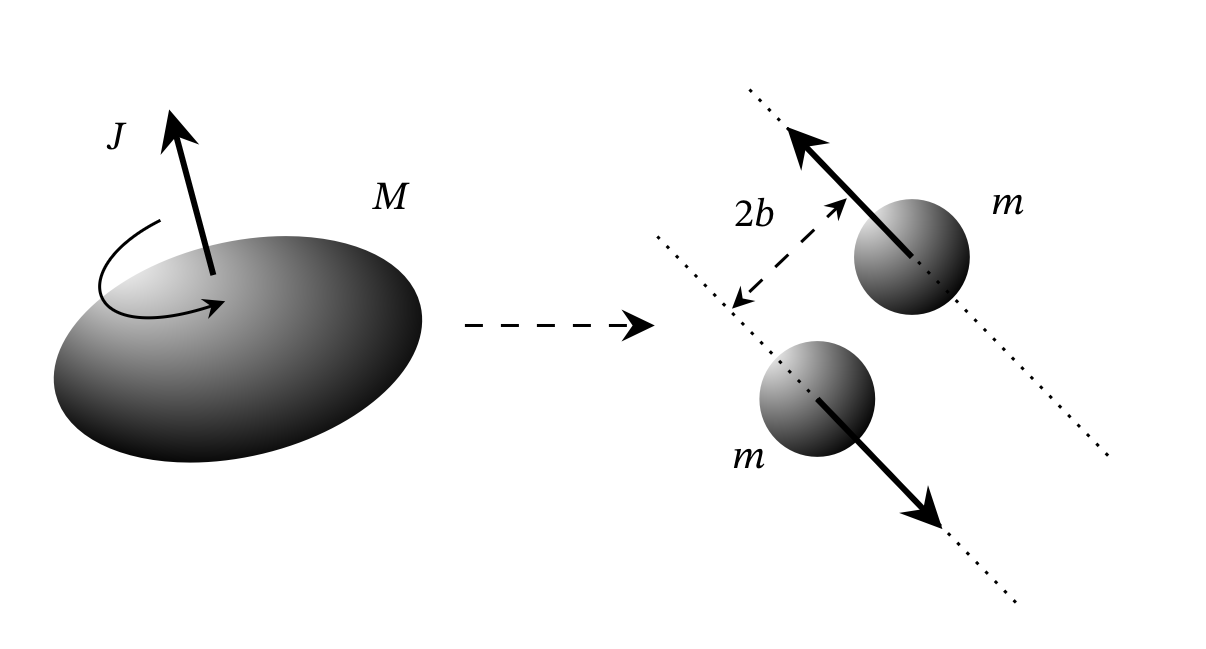
A diagram from the new study illustrating the theoretical pants-splitting method.
(Image credit: Cacciapaglia et al. (2026))
In the “black string” model, a normally spherical black hole would become cylindrical or string-like, stretching across any extra dimensions. It could then pinch off to fragment into multiple smaller bodies, akin to “beads on a string.”
Additionally, the researchers calculated that black hole fragmentation may be entropically favored in space-time models with modified gravity, which alter the gravitational interactions in extremely warped environments near the black hole.
“The fragments are tiny, though: in one of our benchmarks, a black hole of ten solar masses would favour fragments … a few times the mass of the Great Pyramid of Giza squeezed into a region smaller than a proton, and the heavier the parent, the smaller the fragments,” Del Piano explained.
Fragmentation also may be more likely if there is a “bumpy horizon” around black holes, akin to a dense blanket or shroud of exotic matter that acts as a singular-but-gigantic quantum entity. The superfluid qualities of this matter could create strange vortices that eventually cause a black hole to fragment into multiple smaller bodies.
Scientists might see a black hole decrease in size, an actual fragmentation, or simply an indirect gravitational signature, depending on the dimensions and whether it intersects the viewer’s “brane,” or slice of dimensionality.
Smaller relativistic waistlines may be more conducive to wearing pants
The researchers expect that smaller objects — like the hypothesized, miniature primordial back holes that may have formed shortly after the Big Bang — are more likely to split, compared with much more massive astrophysical black holes such as those at the centers of galaxies.
“Overall, we expect small black holes, such as primordial ones from the early universe, to be the most prone to splitting,” Del Piano told Live Science.
Gamma-ray telescopes or gravitational wave observatories may one day offer evidence of a signal associated with the supposed split of a small black hole, but the specifics, including whether this actually occurs, are uncertain.
“One important caveat: our analysis shows when splitting is allowed by entropy and conservation laws, not that it actually happens,” Del Piano noted. “As we put it in the paper, a shattered glass has more entropy than an intact one, yet glasses don’t shatter on their own. Settling the question requires full dynamical simulations, which is the natural next step.”
Cacciapaglia, G., Del Piano, M., Sannino, F., & Vellucci, V. (2026). When black holes admit pair-of-pants topologies. Physical Review. D/Physical Review. D., 114(8). https://doi.org/10.1103/cx69-t466
See how much you know about black holes with our black hole quiz!
Source: www.livescience.com