
Stay up to speed with stories written by drivers, for drivers.
Get automotive news, DIY tips, market trends, in-depth car profiles, and more right in your email inbox.
When the topic of stainless steel cars comes up, most people think of the DeLorean DMC-12 or the Tesla Cybertruck. While they’re the first production vehicles to be completely skinned in stainless, they’re not the first attempts to make passenger car or light truck bodies out of that corrosion-resistant alloy. The original efforts, in fact, took place decades earlier.
Pedantically, one could argue that neither the DMC-12 nor the Cybertruck has a “stainless steel body.” The DeLorean’s stainless-steel panels are affixed to a fiberglass monocoque and are cosmetic, not stress-bearing. The Cybertruck’s outer panels do form a load-bearing exoskeleton and contribute significantly to the vehicle’s torsional stiffness, rigidity, and crash performance, but a substantial structure underneath still consists of aluminum castings, stamped steel and aluminum panels, and high-strength steel components.
Besides DeLorean and Tesla’s use of stainless steel, other manufacturers flirted with the material over the years. The 1957–58 Cadillac Eldorado Brougham had a brushed stainless roof, and some Maserati Boras featured a stainless roof and A-pillars.


Before these examples, though, the Ford Motor Company was involved in the production of fourteen cars whose bodies were indeed completely made of stainless steel starting in 1931. Their purpose was to promote the corrosion-resistant and durable material, and the fact that the majority of those cars still exist and have traveled hundreds of thousands of miles corroborates their objective.
While working at the U.K.’s Brown-Firth Research Laboratories in 1912–13 on corrosion-resistant gun barrels, Harry Brearley formulated a steel alloy that contained 12.8% chromium and 0.24% carbon, which resisted etching by acid and wouldn’t rust like normal carbon steel. The chromium allowed the creation of an oxide layer that resists rust. Brearley called it “rustless steel,” but a local cutler who tested it suggested “stainless steel,” and the name stuck. Simultaneously and independently, Elwood Haynes developed a similar chromium-based alloy in the United States, and he and Brearley eventually joined efforts, pooling their patents. Their form of stainless steel is known as Martensitic, which is used for knives, flatware and cutlery, and surgical instruments. Eduard Maurer and Benno Strauss at Germany’s Krupp patented austenitic stainless steel, which adds nickel to the recipe. This is the most commercially widely used stainless steel, such as grades 304 and 316. There is also Ferritic stainless steel, which is used for appliances, some cookware, and automotive trim.
The first use of stainless steel in the automotive industry was decorative. In 1930, Allegheny Steel (which later merged with Ludlum Steel in 1938 to become Allegheny Ludlum and is today known as Allegheny Technologies Inc., ATI) started supplying Ford with stainless steel for brightwork, including radiator shells, headlamp shells, hub caps, gas caps, radiator caps, and other trim for the Model A and subsequent vehicles. The stainless steel in these instances replaced nickel-plated steel. In 1931, Ford promoted these uses with a brochure titled Rustless Steel, whose cover reproduced the look of that metal and whose text touts, “This bright, lustrous metal will not rust, tarnish or corrode in any kind of weather, and will last the life of the car… It never requires polishing… you merely clean it with a damp cloth as you would a windshield.”

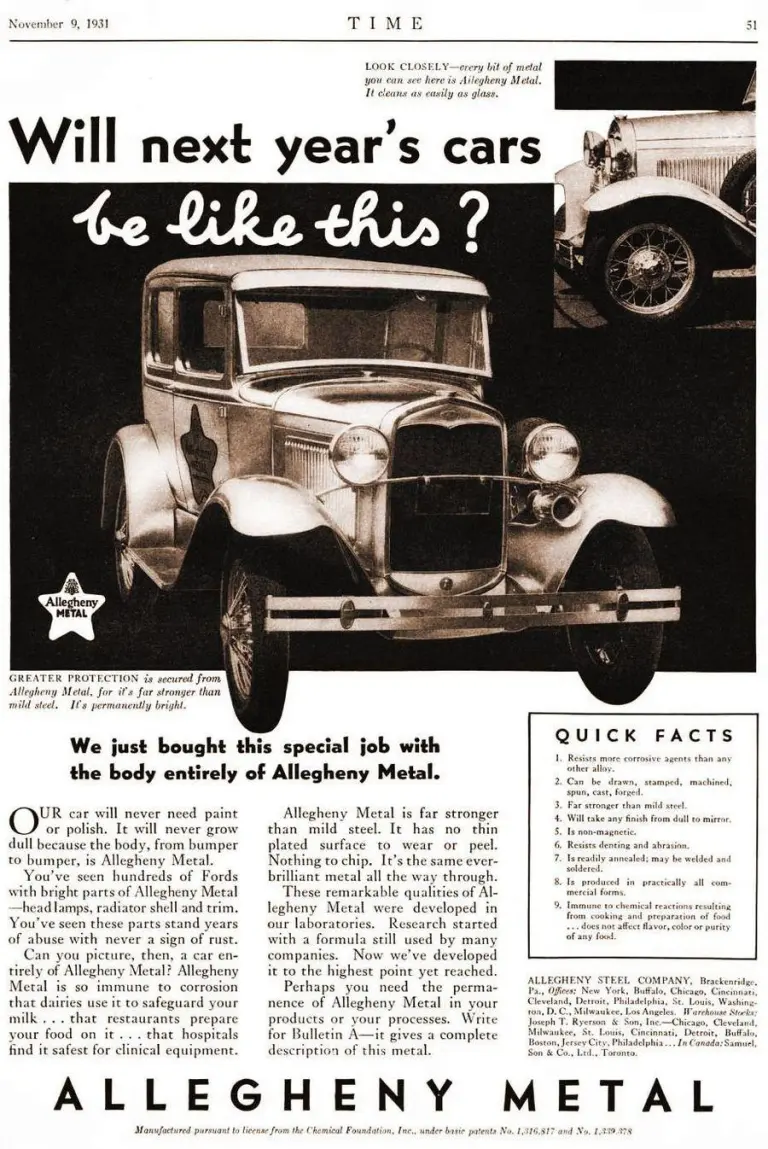
That same year, Ford produced three prototype Model A Tudor sedans with stainless-steel bodies, using sheet metal supplied by Allegheny Steel. The stainless was hung on standard wood framing, and those cars used stock mechanicals and a mild steel floor pan. Sources say they cost Ford about $2000 each, about four times the cost of making a conventional Tudor. Ford kept one for itself, later sectioning it for a cutaway display, and sold a second to Allegheny Steel, which promoted it in a full-page ad in Time magazine. Interestingly, Allegheny didn’t call it “stainless steel;” it branded the material “Allegheny Metal.” That ad says that “every bit of metal you can see” is stainless, so that apparently also included the car’s wire-spoked wheels and fender-mounted horn. Oddly, the third stainless steel Model A ended up with the Universal Steel company, Allegheny’s competitor, which used it as a promotional vehicle. That car still exists, while the Allegheny Steel car ended up in a World War II-era scrap drive.
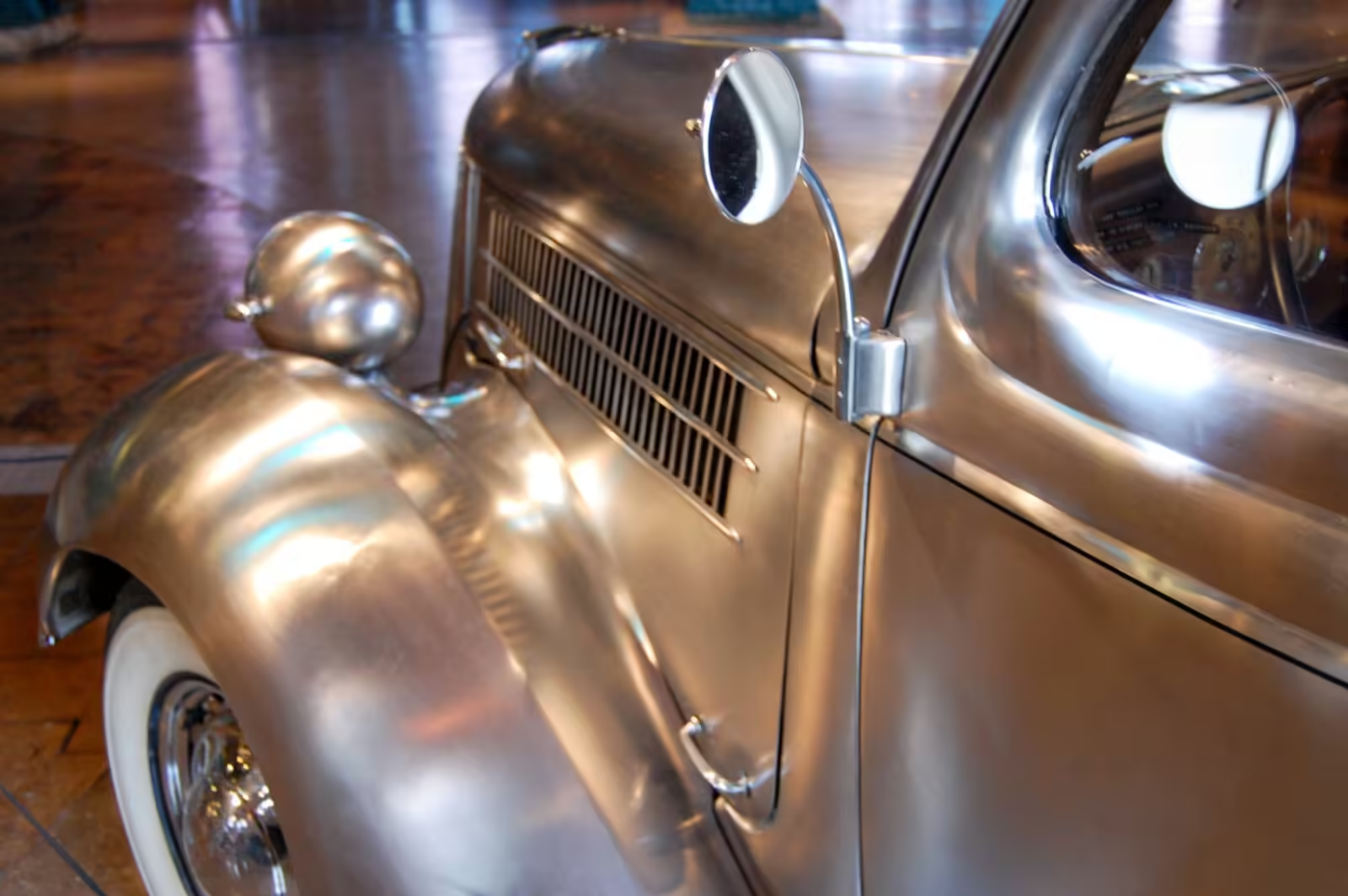
The response to the stainless-bodied Model As must have been worth the effort because in 1935 Allegheny made an even more ambitious proposal to Ford. Allegheny would supply the specialized sheet metal for Ford to make six 1936 Deluxe Tudor Touring Sedans with stainless-steel bodies. Ford agreed to do the stamping of the body panels and assembly of the bodies on conventional flathead V-8–powered chassis. Once assembled, the cars would be used by Allegheny’s regional sales chiefs in New York, Chicago, Cleveland, St. Louis, Philadelphia, and Detroit and also as an incentive. Top salesmen could win the use of one of the stainless cars for a year.

Ford engineers may have regretted the agreement. Compared to conventional mild carbon steel, stainless is significantly harder, has a higher work-hardening rate, and generates more friction against tooling. It turned out that stamping the body panels required 50–100 percent more press force and careful attention to die clearances, surface finish, and lubrication to avoid cracking or galling of the part. Dies meant for carbon steel had to be modified with greater clearances, die surfaces had to be polished or treated with special coatings, and sometimes replacement dies had to be made from harder tool steels. Welding the stainless steel presented its own problems, as gas-welding technology had not advanced enough to cope with the material’s different thermal conductivity and tendency to warp or lose corrosion resistance if heated improperly. Specialized welding techniques had to be developed, along with special body fillers for the bare material.
Both historical accounts from the era and later reports say that the stainless was so hard on the tooling that it could no longer be used for production without extensive repair and rework.
Despite the challenges of making the stainless bodies, once they were completed and put into service by Allegheny, the cars each accumulated well over 200,000 miles within a decade, proving that the stainless steel would remain corrosion-free. While the bodies remained more or less pristine, chassis, drivetrain, and interior components were replaced as needed.

In 1960, Allegheny, then known as Allegheny Ludlum, approached Ford about making two Thunderbird hardtop coupes. Lessons learned from the 1936 cars were applied. Ford’s normal body supplier, the Budd Company, did the stamping, while final assembly was completed at Ford’s Wixom, Michigan plant, which was responsible for Thunderbird and Lincoln Continental production. Regular production tooling was used, but the jobs were scheduled to be stamped at the end of the 1960 model year run, after all the panels needed for production and replacement parts were made. Notwithstanding efforts to protect the tooling, accounts say dies were so heavily damaged that they were effectively destroyed. Fortunately, 1960 was the last model year for the “Squarebird,” and model changeover to the “Bulletbird” meant they needed new tooling anyway.


A variety of stainless grades were used in the project. Body panels, grilles, and bumpers were fabricated from Type 302, while exhaust systems used Type 409 for the mufflers and Type 304 for the exhaust pipes. This was one of the first applications of a stainless steel exhaust system. One problem Ford faced was that the grade of stainless steel needed for the roof was not available in wide enough coils to make the roof in a single stamping, so a seam had to be run down the middle and then the weld was ground down flat. The finished cars weighed pretty much the same as production Thunderbirds: just about two tons.
Both stainless T-Birds tallied over 100,000 miles each in promotional and executive use by Allegheny, and they still used their original corrosion-resistant exhaust systems decades later.

In late 1966, the two companies collaborated once more, this time building three Lincoln Continental convertibles, two of them fitted with ’67 grilles and trim. They were a bit less ambitious than the earlier stainless-bodied cars in that only the exterior body panels were stainless. Other components, like bumpers and trim, were stock. Unlike the ’36 Fords and ’60 Thunderbirds, which were assembled on those models’ regular assembly lines, final assembly of the stainless Continentals was done in a dedicated section of the Wixom assembly plant, not the regular line. Again, curb weight was close to that of the production Contis.
While the stainless-steel Fords and Lincolns were successful in terms of generating publicity for both Ford and Allegheny, the experiments proved that stainless steel was not practical for mass production use, at least for making car bodies. The increased cost of the steel, the wear and tear on tooling, and changes needed in production techniques made that certain. The DeLorean and Cybertruck further confirm this with their use of easily stamped, relatively flat panels without any compound curves. Stainless steel would later find relatively wider use in the automotive industry, in corrosion-resistant exhaust systems, and continue to be used for brightwork, but there are reasons why there is only one vehicle currently on the market (soon to be none, given the Cybertruck’s impending departure) with stainless steel body panels.

Due to financial straits made worse by the Covid-19 pandemic, in 2020 Allegeny Ludlum’s corporate successor, ATI, decided to sell off three of the stainless-bodied cars still in the corporate collection, one ’36 Ford, one ’60 T-Bird, and one ’67 Lincoln Continental convertible, in one lot as a complete set billed as the “Historic Stainless Steel Trifecta,” consigned to Worldwide Auctioneers. In September of that year, the lot was hammered off at $1.045 million, including fees, to an anonymous buyer.

Ten of the fourteen original stainless-steel-bodied cars still exist. One of the 1931 Model A stainless cars remained in private hands and was for sale on eBay a few years ago, reportedly with a half-million-dollar reserve. Four of the 1936 Ford Deluxe Tudor Sedans survive. One is on permanent display at the Senator John Heinz History Center in Pittsburgh, donated by ATI in 1999. One is in the collection of the Early Ford V-8 Foundation Museum in Auburn, Indiana. One is in the Crawford Auto-Aviation Museum in Cleveland, part of the Western Reserve Historical Society’s matched set, and one is part of the set sold in 2020. Both 1960 Thunderbirds still exist, one at the Crawford Museum, and one in the 2020 auction set now in private hands. All three of the Continental convertibles still exist, one in the matched set that ATI sold off six years ago, one that remains in ATI’s hands, and one in the Crawford Museum’s matched set, on public display.


Source: www.hagerty.com