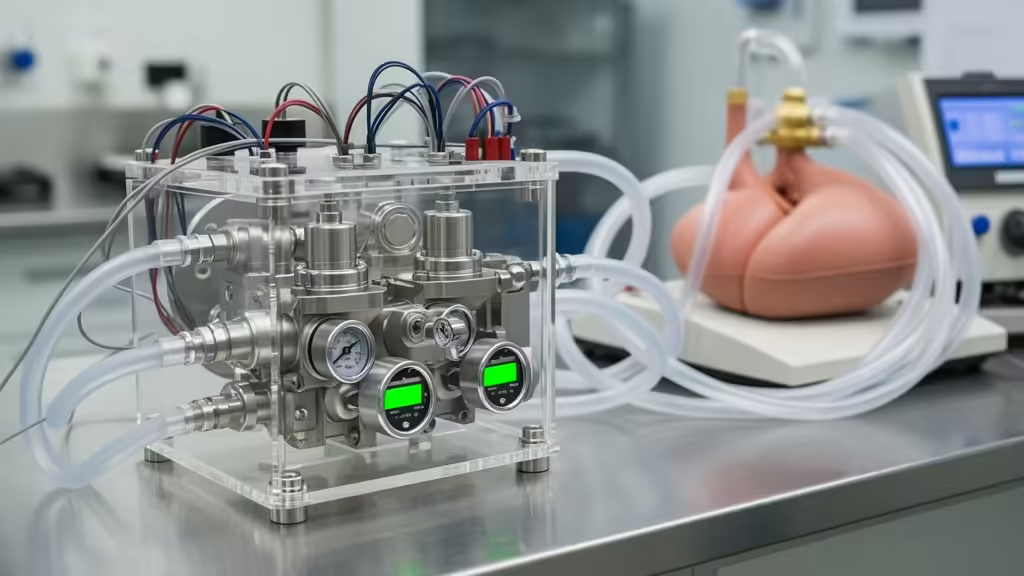

Biomedical researchers and clinical investigators from institutions across Spain, Ireland, France, and the United States have designed and evaluated an open-source, low-cost mechanical ventilator assembled from basic automotive hardware and standard retail materials. Developing scalable and locally manufacturable ventilatory support devices addresses severe critical care supply shortages exposed during global respiratory crises such as the COVID-19 pandemic, where international supply chains for specialized medical components frequently collapse. The primary investigation, published in Frontiers in Public Health within the Disaster and Emergency Medicine section, describes a simplified volume-controlled system engineered intentionally as a last-resort intervention rather than an intensive care unit replacement. Constructed around a conventional automotive windshield wiper motor, dual parallel shaft bellows, passive membrane valves, and an analog water-column monitoring apparatus, the prototype was designed to function independently of centralized compressed gas lines, complex microprocessors, commercialized pneumatic valves, and delicate electronic transducers.
The engineering rationale behind the prototype focuses on extreme mechanical simplicity, decentralized local constructability, and deliberate avoidance of specialized healthcare supply chains. When pandemic conditions overwhelm manufacturing logistics, low- and middle-income regions face critical deficits in life-sustaining respiratory devices, unable to obtain either finished commercial ventilators or specialized replacement parts from foreign suppliers. To circumvent these systemic supply-chain vulnerabilities, the investigators leveraged the ubiquitous presence of motor vehicle replacement components, standard plumbing fittings, and general hardware supplies. The device’s reciprocating motion generator takes advantage of the durable gearboxes, rotary motors, and mechanical linkages already integrated into mass-produced automotive windshield wiper motors, ensuring that emergency technical teams can procure the core drive mechanism almost anywhere vehicle repair parts exist.
Operationally, the ventilator functions as a volume-controlled reciprocating displacement pump driven by a standard 12-volt car windshield wiper motor connected directly to a vehicle battery. Because the motor unit naturally converts rotational movement into reciprocating linear displacement, it reliably cycles back and forth at standard speeds of 40 to 60 strokes per minute under direct battery power. To govern the patient’s respiratory rate across both pediatric and adult clinical ranges spanning 12 to 45 breaths per minute, the team incorporated an inexpensive automotive direct-current motor speed controller originally manufactured for automobile fan regulation. The moving output rod of the wiper motor connects to a dual-chamber air pump consisting of two automotive shaft bellows—components normally manufactured from durable, impermeable synthetic polymers to protect automobile drive shaft joints—mounted in parallel with rigid structural connectors to distribute forces evenly and synchronize compression stroke cycles without causing structural deflection.
To permit bedside adjustments of the volume delivered to the patient, the mechanical linkage connecting the automotive motor to the parallel bellows features an adjustable-length crank system constructed from conventional threaded rods and nuts. By manually rotating this crank mechanism, operators can adjust the physical stroke amplitude of the bellows, thereby modulating the delivered tidal volume continuously without requiring the clinician to interrupt ongoing mechanical ventilation. Because the flexible synthetic bellows behave essentially like rigid pistons moving within a cylinder under typical clinical ventilation pressures below 40 cmH₂O, the stroke displacement scales linearly with air displacement.
Directional gas circulation through the ventilator circuit is governed entirely by passive, differential-pressure-driven membrane valves that eliminate any need for electronic microcontrollers, solenoids, or external computational elements. The primary inspiratory and expiratory components, designated V1 and V2, operate as differential flap valves assembled from rigid polyvinyl chloride pipe fittings, with lightweight closing flaps cut directly from common plastic office folder sheets. When the bellows compress during inspiration, internal positive pressure forces V1 to seal shut while opening V2 toward the patient circuit; conversely, negative pressure during the retraction phase draws ambient or oxygen-enriched gas through V1 while V2 seats securely. A third specialized valve, designated V3, regulates the expiratory limb through an elastic membrane cut from clinical latex or nitrile examination gloves, passively actuated by pressure within the bellows chamber to close during positive-pressure inspiration and reopen during negative-pressure bellows refill.
Airway pressure monitoring and system safety are accomplished without electronic pressure transducers, relying instead on a water-filled transparent U-tube manometer measuring 5 millimeters in internal diameter with 45-centimeter arm lengths. Connected to the inspiratory limb, the manometer provides direct visual tracking of airway pressure excursions, including peak inspiratory pressure, while utilizing a variable resistance derived from an intravenous infusion set roller clamp to dampen dynamic fluid oscillations at higher breathing frequencies. Beyond primary pressure monitoring, the open U-tube operates as an intrinsic safety pop-off relief valve: if an abnormal obstruction or persistent closure occurs in the expiratory circuit, excessive airway pressure rapidly ejects the water column into the environment, immediately venting the inspiratory pathway and preventing progressive pulmonary overdistension or fatal barotrauma.
Bench-top performance testing was conducted across rigorous mechanical simulations of severe adult and pediatric lung pathologies using a calibrated SmartLung physical respiratory model equipped with adjustable resistance and compliance elements. Investigators simulated severe adult obstructive-restrictive lung disease by establishing a resistance of 20 cmH₂O·s/L and a compliance of 15 mL/cmH₂O, while severe pediatric pathology was modeled with a resistance of 50 cmH₂O·s/L and a compliance of 10 mL/cmH₂O. Following more than 400 continuous hours of operational cycling, the prototype demonstrated robust mechanical endurance and delivered tidal volumes up to 600 mL at adult settings—sufficient to supply protective ventilation of 6 mL/kg for an 85-kilogram adult patient—and achieved tidal volumes down to 90 mL at cycling frequencies up to 45 breaths per minute for pediatric configurations modeling patients under 10 kilograms, while generating positive end-expiratory pressures up to 10 cmH₂O via adjustable water-column submersion.
Gas exchange capabilities were comprehensively validated on the bench by infusing continuous carbon dioxide flows between 45 and 350 mL/min into the compliant patient model to simulate metabolic carbon dioxide production across varying patient weights. By adjusting ventilator cycling frequencies between 16 and 26 breaths per minute and tidal volumes between 120 and 500 mL, the apparatus maintained steady normocapnia with end-tidal carbon dioxide locked at 35 mmHg at metabolic production levels reaching 350 mL/min. Furthermore, electrical measurements indicated remarkably low power consumption: adult model ventilation required only 7.3 W without PEEP and 12.0 W at 10 cmH₂O PEEP, while pediatric simulation drew 18.5 W and 20.1 W, respectively. These low power requirements establish that a conventional 80 ampere-hour 12-volt car battery can maintain continuous adult ventilation for approximately 5.5 days without PEEP and 3.4 days with PEEP, or provide 2.2 and 2.0 days of pediatric life support before requiring recharging or connection to alternating-current converters.
Following bench evaluation, preclinical in vivo proof-of-concept testing was performed in four healthy anesthetized domestic pigs weighing between 48 and 52 kilograms under ethical authorization from the University of Barcelona Animal Research Ethics Committee. Across stable 40-minute evaluation periods, the prototype delivered a mean tidal volume of 391 ± 7 mL at 19.3 ± 2.1 breaths per minute, maintaining normal arterial blood gas parameters with an arterial carbon dioxide partial pressure of 38.3 ± 2.1 mmHg, arterial oxygen partial pressure of 188.3 ± 25.0 mmHg, heart rate of 70.7 ± 6.8 beats per minute, and mean peak/trough arterial pressures of 137.7 ± 6.8 and 81.3 ± 3.1 mmHg, with tidal volume coefficients of variation remaining under 1 percent.
The study authors emphasize several vital constraints, limitations, and safety cautions regarding their open-source prototype. Moreover, the lack of electronic sensors prevents closed-loop automation, automated clinical alarms, and quantitative precision monitoring, while U-tube dynamic fidelity decreases at rapid pediatric respiratory rates above 25 breaths per minute. Consequently, the authors explicitly state that this device is not a substitute for standard intensive care equipment, but strictly an extreme last-resort intervention for overwhelmed disaster scenarios where no alternatives exist and untreated patients face imminent mortality. Implementation must remain restricted to qualified physicians and engineers operating under emergency disaster authorities.
Subject of Research: Evaluation of a simplified emergency mechanical ventilator constructed from automotive and hardware components for resource-limited settings
Article Title: Simple and easy to build mechanical ventilator for pandemic health crises in resource-limited areas
Article References: Farré, R., Salama, R., Rodríguez-Lázaro, M. A., Kiarostami, K., Fernández-Barat, L., Oliveira, V. D. C., Torres, A., Farré, N., Dinh-Xuan, A. T., Gozal, D., & Otero, J. (2026). Simple and easy to build mechanical ventilator for pandemic health crises in resource-limited areas. Frontiers in Public Health, 14, Article 1855214. https://doi.org/10.3389/fpubh.2026.1855214
Image Credits: AI Generated
DOI: 10.3389/fpubh.2026.1855214
Keywords: mechanical ventilation, emergency medicine, disaster medicine, windshield wiper motor, shaft bellows, low-resource settings, open-source medical hardware, respiratory support, positive end-expiratory pressure, bench testing, porcine models, tidal volume, passive membrane valves, water-column manometer, pandemic preparedness, gas exchange, normocapnia, biomedical engineering
Source: bioengineer.org