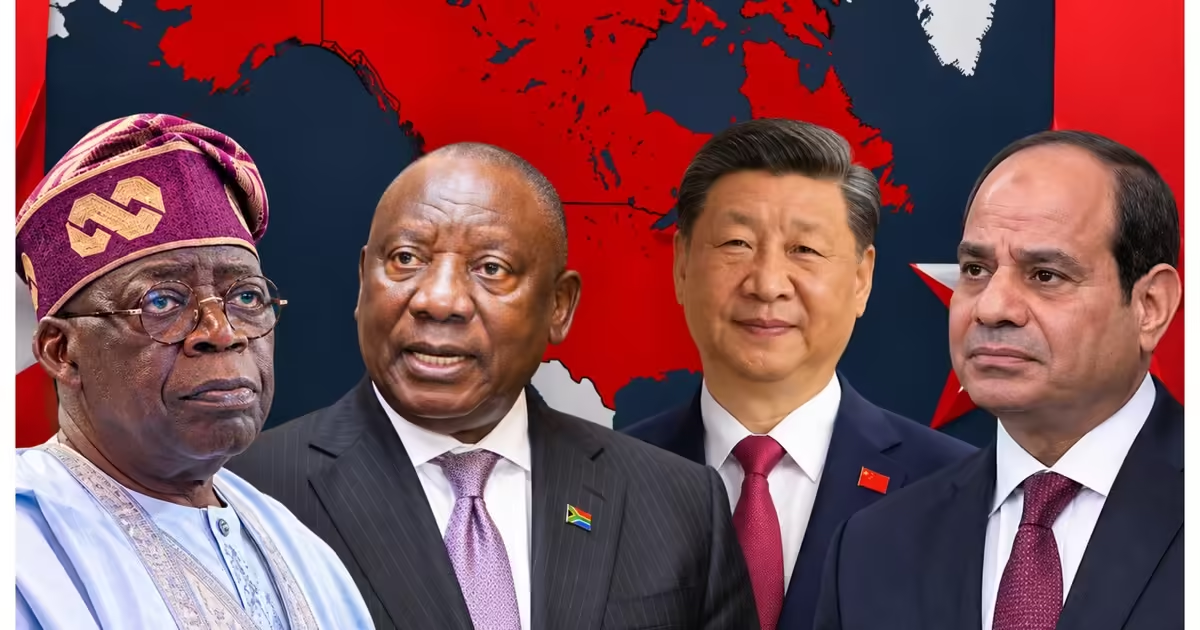

Figures from the World Bank and the Central Bank of Egypt reveal varying levels of reliance on Chinese financing, with all three countries facing pressure to manage debt repayments, fund infrastructure and improve living standards.
While Chinese loans have supported major infrastructure projects, the three countries continue to grapple with economic challenges, reflecting the difficulties of translating large-scale investments into broader economic benefits.
According to the World Bank’s International Debt Report 2026, Nigeria owed China $5.67 billion at the end of 2025, while South Africa’s debt stood at $1.93 billion.
Egypt’s central bank separately reported $9.6 billion as of June 2025, bringing the combined reported figure to $17.2 billion, although the balances cover different reporting periods and debt categories.
Nigeria’s reliance on Chinese loans continues to grow
Nigeria’s debt to China increased from $5.32 billion in 2024 to $5.67 billion in 2025, extending an upward trend from $3.63 billion in 2021.
China accounts for nearly 85% of Nigeria’s $6.68 billion bilateral external debt, making Beijing its largest government creditor.
Much of the borrowing relationship has centred on infrastructure financing, particularly railways and transport networks designed to improve connectivity, facilitate trade and reduce the cost of moving goods across Africa’s most populous country.
However, these investments have coincided with mounting fiscal pressures and deteriorating household purchasing power.
The World Bank estimated that more than 60% of Nigerians lived below the national poverty line in 2025, while rising food prices continued to strain household budgets.
Beyond Chinese financing, Nigeria’s total external debt reached $145.02 billion in 2025, with multilateral lenders holding $31.37 billion of its public and publicly guaranteed external debt.
Egypt carries the largest reported Chinese debt
The country also relies on financing from Gulf governments, international institutions and private investors to support infrastructure development and economic reforms.
Saudi Arabia accounted for $13.5 billion of Egypt’s external debt, followed by the United Arab Emirates with $11.7 billion and Kuwait with $6 billion, reflecting its broad creditor base.
Egypt’s external debt-service payments reached $38.7 billion during the 2024/2025 financial year, placing pressure on public finances and increasing demand for foreign currency.
Despite these financial obligations, Egypt recorded stronger economic growth, with the World Bank reporting a 5.1% expansion during the 2025/2026 financial year. The unemployment rate also fell to 5.8% in the second quarter of 2026.
However, inflation continued to weaken household purchasing power and constrain poverty reduction, leaving many Egyptians facing financial pressures despite improvements in economic growth and employment.
South Africa’s borrowing reflects greater reliance on financial markets
South Africa, the continent’s largest economy by nominal GDP, owed China $1.93 billion at the end of 2025, the lowest Chinese debt balance among the three economies.
China accounted for nearly 47% of South Africa’s $4.13 billion bilateral external debt, followed by Germany with $1.33 billion. Unlike Nigeria, South Africa relies more heavily on private creditors and international financial markets to meet its financing needs.
Its total external debt reached $206.34 billion in 2025, reflecting a larger foreign debt portfolio despite its lower exposure to Chinese lending.
South Africa also faces a more severe unemployment challenge than Egypt. According to Statistics South Africa, the official unemployment rate reached 33.6% in the second quarter of 2026, leaving 8.5 million people without jobs, compared with Egypt’s 5.8% unemployment rate during the same period.
Rising repayments put development spending under pressure
The financial pressures facing Africa’s three largest economies form part of a wider debt challenge across developing countries, where governments must balance growing repayment obligations with spending on infrastructure and essential public services.
According to the World Bank, developing countries’ external debt reached a record $9.4 trillion in 2025, while low- and middle-income economies paid $1.4 trillion in principal and interest.
Between 2022 and 2025, these countries paid $436 billion more in debt service than they received in new financing, reducing the resources available for long-term development.
“The return of private lending to low- and middle-income countries is welcome, but these countries are borrowing more, paying more, and in many cases leaving less for long-term development,” World Bank official Haishan Fu warned.
Source: africa.businessinsider.com