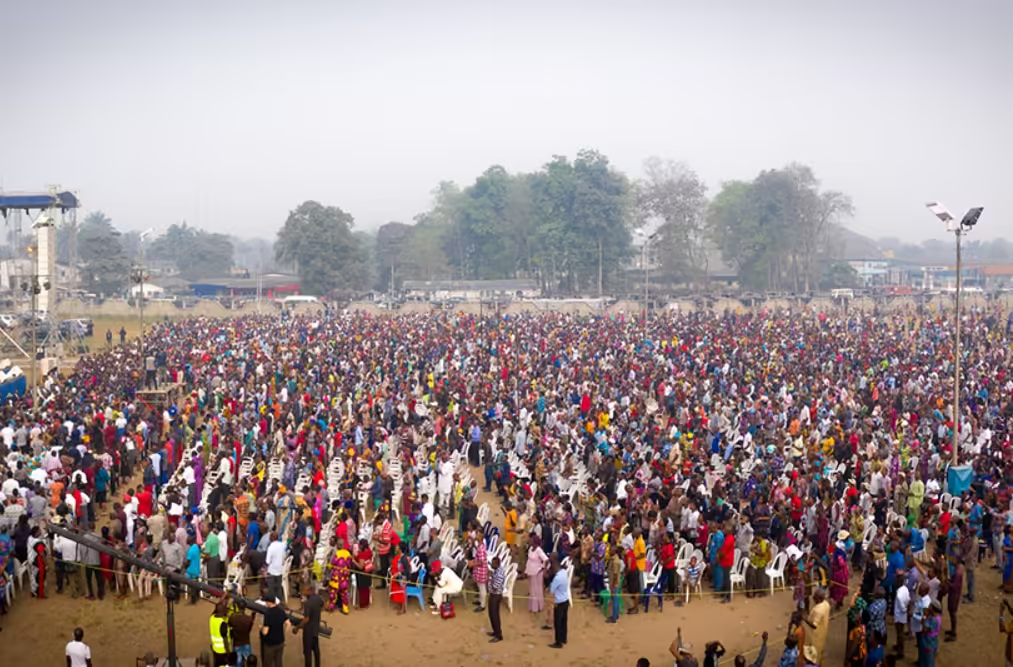

Sub-Saharan Africa is projected to become the home of more than half (54%) of the world’s Christian population by 2070, but the continent’s growing religious influence comes against a backdrop of persistent persecution and the rapid expansion of Islam, according to new research.
A report published Nov. 18 by the Pew Research Center estimates that the number of Christians in sub-Saharan Africa will more than double from approximately 700 million in 2020 to 1.6 billion by 2070.
The region, which accounted for 31% of the world’s Christians in 2020, is expected to host 54% of the global Christian population within the next five decades, marking a significant shift in the geographical center of Christianity.
However, the projections also point to a changing religious landscape within Africa, with Muslims expected to increase their share of the region’s population as both religious groups experience substantial growth.
Pew estimates that the Muslim population in sub-Saharan Africa will increase from 369 million in 2020 to approximately 980 million in 2070, representing growth of more than 2.5 times.
Muslims are projected to account for 36% of the region’s population by 2070, up from 33% in 2020. The Christian share, meanwhile, is expected to decline from 62% to 59%, although Christians will remain the largest religious group.
The projections suggest that the continent will play an increasingly important role in shaping the future of both Christianity and Islam.
Christian populations face widespread persecution
The projected growth of Christianity in Africa contrasts sharply with the levels of violence and discrimination experienced by Christians in several parts of the continent.
According to Open Doors International’s 2026 World Watch List, sub-Saharan Africa accounted for 4,491 of the 4,849 Christians recorded as killed worldwide for their faith during the reporting period. This represents approximately 93% of the global total.
Nigeria alone accounted for 3,490 of those deaths, representing about 72% of all recorded killings worldwide.
The figures reflect a continuing pattern of violence against Christian communities, particularly in countries affected by armed conflict, Islamist militancy and weak government institutions.
Open Doors identified Sudan, Nigeria and Mali as the three countries in its 2026 rankings that received the maximum possible score for violence against Christians. Four sub-Saharan African countries also featured among the 10 countries where Christians face the most severe persecution.
The organization estimates that more than 388 million Christians worldwide face high levels of persecution and discrimination because of their faith. In Africa, approximately one in five Christians experiences such conditions.
Beyond killings, Christian communities across the region face abductions, displacement, attacks on churches and restrictions on religious activities.
In Nigeria, Christian communities in states including Benue and Plateau have experienced repeated attacks, with thousands of people killed or forced from their homes. Open Doors has also highlighted the activities of armed groups, including Boko Haram, Islamic State West Africa Province and other militant organizations.
Sudan has also emerged as a major concern, with the country’s ongoing conflict contributing to insecurity and making religious minorities increasingly vulnerable.
The persecution figures highlight a difficult reality for the African Church. While its population is projected to grow considerably, millions of Christians continue to live in environments where practicing their faith can expose them to violence and discrimination.
Islam’s growing presence across the continent
The Pew projections also point to the increasing influence of Islam in sub-Saharan Africa, where the Muslim population is expected to grow considerably faster than the Christian population in relative terms.
The projected increase to close to a billion in 2070 means the region will be home to a substantially larger Muslim population over the coming decades.
Pew expects the number of countries with Muslim majorities in sub-Saharan Africa to increase from 16 in 2020 to 17 by 2070. Meanwhile, the number of countries with Christian majorities is projected to decline from 32 to 30.
Benin, Ivory Coast and Togo are expected to experience changes in their religious majorities during the projection period.
In Ivory Coast, for example, Muslims are projected to account for 51% of the population by 2070, up from 46% in 2020. The Christian share is expected to decline from 45% to 38%.
In Ethiopia, Christians are projected to account for 54% of the population in 2070, down from 62% in 2020, while the Muslim population is expected to increase to 46%.
The changing religious balance does not necessarily indicate a decline in the absolute number of Christians. Rather, it reflects the faster growth of other religious populations within countries experiencing rapid overall population expansion.
Pew’s projections are based on demographic factors including fertility rates, age distribution, mortality, migration and religious switching. They assume that recent patterns in these areas will continue over the projection period.
The researchers also project that Muslims will overtake Christians as the world’s largest religious group by 2035, reflecting the faster growth of the global Muslim population.
A changing future for the African Church
The demographic projections raise important questions about the future role of African churches in global Christianity.
However, the projected growth also comes with considerable challenges, including the need for stronger church institutions, leadership development, theological education and greater efforts to protect vulnerable Christian communities.
The scale of persecution in sub-Saharan Africa also highlights the need for greater international attention to religious freedom and the protection of Christian minorities.
Pew cautions that its projections are not predictions of what will definitely happen. Wars, economic changes, natural disasters and other unforeseen developments could alter religious population patterns over the next five decades.
Nevertheless, the findings point to a major shift in the global religious landscape, with Africa increasingly positioned at the center of Christianity while also experiencing significant growth in Islam.
Source: www.christiandaily.com