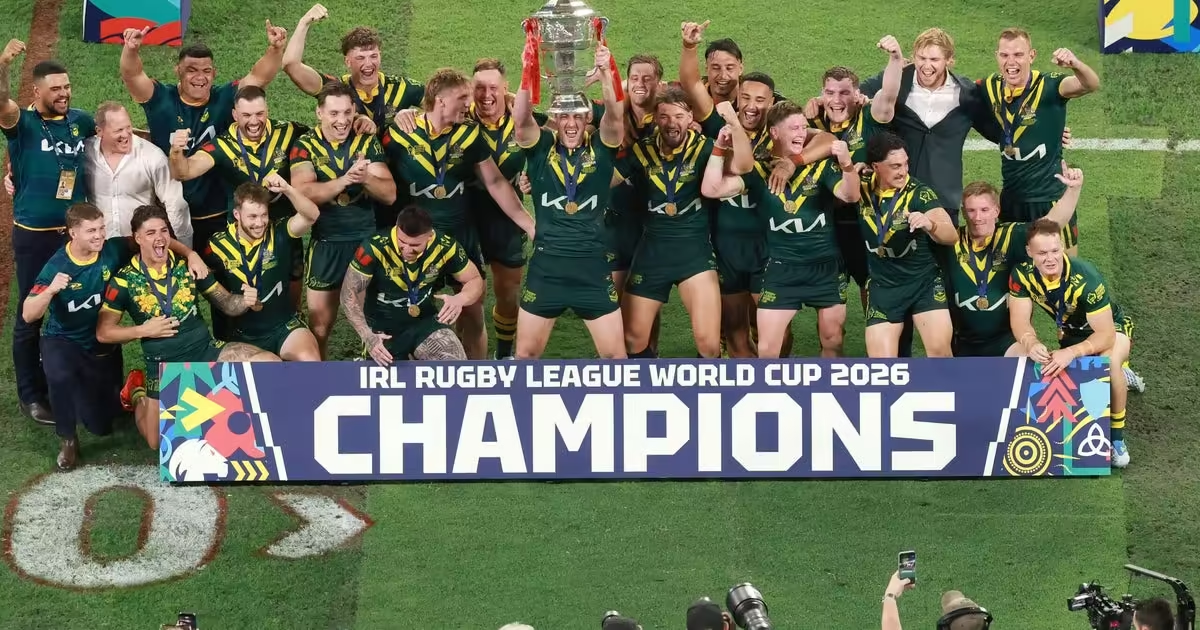

There was passion, power, personality and some viral moments. In many ways, the Rugby League World Cup contained plenty of the elements required to help grow the sport for a wider audience.
But the men’s and women’s tournament had something less compelling in common too: their outcomes were utterly predictable.
As night follows day, so Australia won. The Kangaroos, as the men’s team are known, and Jillaroos, the women’s nickname, went unbeaten throughout, and each thumped neighbours New Zealand in their respective finals 32-12 and 34-10.
The numbers make for bleak reading, if you’re not Australian. The men’s and women’s teams have now won each of the last four World Cups; the Kangaroos have claimed 10 of the last 11, and never not reached the final in that time, while the Jillaroos have contested the last five women’s events since it began in 2000.
For a sport craving global growth, new eyeballs and a slice of the lucrative North American market before staging the next finals across the United States and Pacificit begs a difficult question: is this the least competitive of all the World Cups in major team sports? And, if so, what does it say about rugby league?
Australia’s Olivia Kernick and Millie Elliott show off the Women’s Rugby League World Cup (Cameron Spencer/Getty Images)
Australia’s full back Reece Walsh, adrenaline coursing through him after helping Australia to victory at Brisbane’s Suncorp Stadium on Sunday, responded to those who doubted whether his team’s hegemony would persist before the tournament.
“Everyone wrote us off, talking about how good the other teams are, how good their cultures are,” he said, during his on-field interview. “I just feel we got disrespected. Seeing all the Aussie fans come out — how’s that for culture, baby?”
Cue laughter and delight among the home supporters in the 52,461 sell-out and plenty of social media traction. Walsh is just one of the stars with X factor on and off the pitch that marketeers can leverage to grow the sport.
But the reality is that any dismissal of Australia’s prospects was largely limited to local media after they only just edged out New Zealand in their opening fixture. In the end, it was more a case of ‘monoculture, baby’. The Kangaroos stomped all contenders, and Walsh was ably supported by the brilliance of Cameron Munster and Harry Grant along the way. None of Australia’s rivals could compete.
Big tournaments are boosted by jeopardy and variety, and there was never much prospect of that.
It would be unfair to suggest that it is only rugby league in this situation. Australia have won five of the last seven 50-over cricket World Cups, while in the 11 iterations of the men’s Rugby Union World Cup since 1987, South Africa and New Zealand have four and three wins respectively. In the women’s equivalent, New Zealand have triumphed in six of the 10 finals.

Nobody could live with Reece Walsh, right, and Australia (Cameron Spencer/Getty Images)
Rugby union will bring its flagship world tournament to the U.S. in 2031, the year after rugby league’s finals in the nation.
“This is a strategy to maximise the interest of broadcasters, government partners and fans in the current World Cup, which has regularly broken records for crowds and the number of television viewers,” Troy Grant, chairman of International Rugby League (IRL), said at the board’s annual general meeting this month.
“At the same time, we want to take advantage of opportunities that are opening up in new frontiers where the Rugby League World Cup hasn’t previously been played.”
Predictability is a pressing consideration for rugby league because it has so many other attributes that might ignite U.S. interest. The sport is arguably the easier of the two rugby codes for newcomers to grasp; in terms of rules and the flow of contests. League has less of the attritional set pieces than union, with no line-outs at all and scrums barely contested. Teams have 13 players rather than 15, with the added space often producing more direct, fast-moving action and more tries.
Australia’s dominant domestic top flight, the NRL (National Rugby League), and England’s Super League have put feelers into the American market by playing annual fixtures in Las Vegas since 2023. Last year, Australia women played England women in the city, winning 90-4.
In broadcast terms, the NRL steams ahead. Over the summer, it agreed a record $5.3bn ($3.5bn U.S, £2.78bn) TV deal to run over seven years. By contrast, the European Super League’s previous contract with UK broadcaster Sky Sports was for £21.5m ($28.3m) a year. That ended in the summer and a replacement deal is yet to be finalised, but the NRL is in final-stage talks about investing in it themselves.
For all its forward thinking, rugby league was criticised for not helping itself with the format of this year’s World Cup. The men’s tournament only featured 10 teams, cut from 16, and the format left observers baffled. The group stage featured one pool of four teams and another with six. Two teams qualified from each but, in the six-team pool, not all the sides faced one another.
Still, on the whole attendances were strong, especially for the Southern Hemisphere giants, and the emergence of Samoa and Tonga as competitive teams, with their passionate supporters, was another bonus. Both will be elevated to tier 1 nation status for 2030, and each provided highlights of the tournament with spine-tingling renditions of their traditional calls to battle, Tonga’s Sipi Tau and Samoa’s Siva Tau, before games.
A mention also for the wheelchair format, which took place at the same time with thrilling games and a break from Aussie dominance as England retained their crown.

The pre-match rituals of Samoa (pictured) and Tonga were thrilling spectacles (Mark Metcalfe/Getty Images)
So rugby league’s potential is there. Last month, boxing and snooker promoter Eddie Hearn told The Athletic that he believes in the sport, even as he plays an influential part in union’s expansion plan by promoting England’s breakthrough star Henry Pollock.
“I feel a big shift in momentum with rugby,” he said. “We (his Matchroom promotions company) are stuck in a little bit of an interesting place, because we’ve had very interesting talks with rugby league.
“Our move into rugby was always centered around league. We had an approach five years ago from Ralph Rimmer (the former Rugby Football League CEO) and the guys there, and I like the tribalism of league, the passion, the inherited fan value. It’s a family thing, too. I thought that was the one which had the potential and I kind of stumbled into union, quite honestly thinking that it was dead.”
The challenge for the sport and its backers is to find a way to inject greater competition into its big showcase event. Otherwise, the barrier to really capturing the attention of the world may never be overcome.
Source: www.nytimes.com