
Gulf Arab countries, already battered by months of conflict, are scrambling to avert a new round of U.S.-Israeli strikes on Iran and Tehran’s expected retaliation — conflict that would further cripple energy infrastructure, disrupt global trade and plunge the region into a wider war.
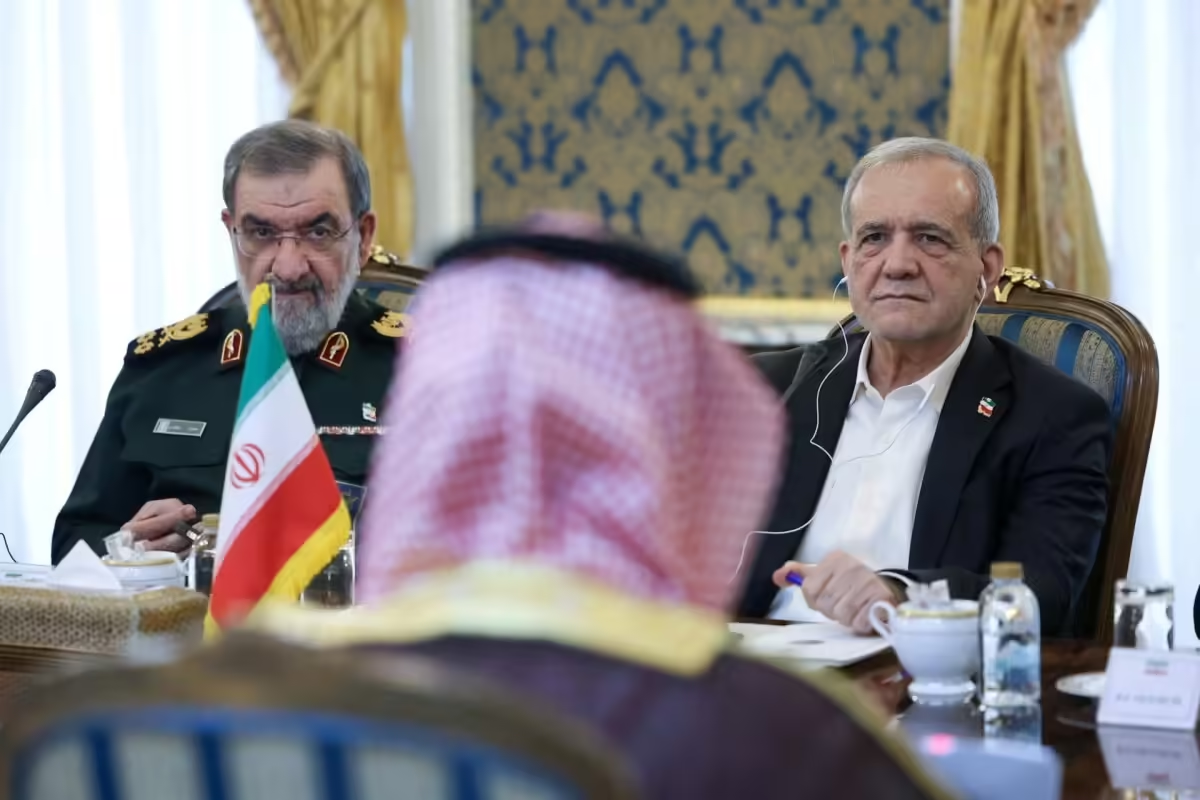
On Oct. 26, the senior security leaders of Saudi Arabia, Turkey and Pakistan met with Iranian leaders in Tehran amid reports of possible fresh U.S. and Israeli strikes after the Nov. 3 midterm elections. On Oct. 30, Qatari mediators followed, seeking to calm tensions.
“The region is at a very dangerous moment,” said Anna Jacobs, a nonresident fellow at the Arab Gulf States Institute in Washington. “There are acute concerns in regional capitals that war will resume after the U.S. midterm elections and that it will be worse than before.”
Washington has reportedly briefed regional allies on potential short, intense attacks on Iran and its possible retaliation against neighbors. On Oct. 29, the top U.S. military commander in the Middle East briefed President Donald Trump on options for renewed military strikes on Iran. No final decision has been announced, but Trump told supporters last week, “We may do another little Epic Fury, or they’ll agree. If they’re smart, they’ll just say, ‘let’s get down to business.’”
Across the Middle East, the U.S. and Israel are deploying more troops, munitions, supplies, aircraft and warships in demonstrable preparation for new strikes. On Oct. 29, 10 U.S. military cargo planes landed at Israel’s Ovda and Nevatim air bases. More aircraft landed in Saudi Arabia, Jordan and Qatar, according to the Israeli public broadcaster Kan. Earlier this month, Washington deployed a third aircraft carrier and 9,000 more troops to the region.
“The amount of U.S. military hardware moving around and the extent of the planning makes me think another round of conflict is likely,” said Jacobs.
Any new round of fighting is expected to be far deadlier than the earlier conflict.
There are indications that Tehran is preparing for a broader and more destructive response.
Drawing lessons from the Russia-Ukraine war, Iran could deploy more advanced drones to target energy and transportation infrastructure, desalination plants and power grids. Iran-backed militant groups in the so-called Axis of Resistance could expand the conflict to other countries in the region. Terrorist attacks in the West are also a possibility.
Jacobs stressed the importance of the Oct. 26 meeting in Tehran between Iranian leaders and senior security officials of the three countries that signed the Mecca Joint Defense Agreement. Saudi Defense Minister Prince Khalid bin Salman led a delegation that included Turkish intelligence chief Ibrahim Kalın and Pakistani military chief Field Marshal Asim Munir to Tehran to meet Iranian President Masoud Pezeshkian, national security chief Mohsen Rezaei and Foreign Minister Abbas Araghchi.
Speaking after the meeting, Rezaei said the four nations agreed that “West Asia’s security must be based on the countries of the region, and any external interference must be prevented.”
The Mecca Pact, as the agreement is widely known, declares an attack on any one of Saudi Arabia, Pakistan and Turkey to be an attack on all three. Their leaders signed it in the Saudi holy city on Aug. 7. Shortly after the signing, the Iranian-backed Houthis, which the U.S. State Department has designated a foreign terrorist organization, launched an offensive that has included attacks on Saudi Arabia. Earlier this month, the three members agreed under the pact to deploy forces to the kingdom to counter those attacks.
“This meeting came at a critical moment and shows a region-wide effort to prevent another deadly round of the U.S.-Israel war with Iran,” Jacobs said, adding that the countries also wanted to underscore their support for mediation efforts by Doha and Islamabad, which brokered a short-lived truce between Washington and Tehran in June.
“The subtext is also clear,” she said. “These countries know they need to find a modus operandi with Iran.”
Mecca Pact members are trying to prevent the escalation of hostilities despite signals by the Trump administration, said Gregory Gause, a Gulf expert at Washington’s Middle East Institute.
“The Saudis are very concerned about the promised Iranian reactions against them and the other Gulf states,” he said, adding, “This is directed at the immediate threat of a new round of damaging attacks across the Gulf.”
At the same time, Gause said Riyadh is seeking Tehran’s help in extending any agreement in the Gulf to the Houthis in Yemen, whose territorial grab along the country’s Red Sea coast and attacks on the Saudi energy industry and infrastructure have rattled the kingdom.
Since September, Houthi missile and drone attacks have killed at least 17 people in Saudi Arabia, wounded hundreds and damaged airports, military facilities and energy infrastructure. These attacks have also severely disrupted aviation by forcing the cancellation of thousands of flights this month.
But Gause said Pakistan and Turkey, Iran’s eastern and western neighbors, respectively, have little influence over Tehran.
“Neither is willing to bring military or economic pressure on Iran, so their independent influence on Tehran is not great,” he told MBN. “Neither Turkey nor Pakistan can either by themselves or jointly pressure or persuade Iran to change its regional policies or rein in the Houthis.”
Both countries are interested in preventing an escalation in the short term, Gause said. Renewed conflict would be very harmful to Saudi Arabia and hinder its ability to invest in Turkey’s and Pakistan’s military industries, the main reason each of those countries joined the Mecca Pact.
The six members of the Gulf Cooperation Council have suffered extensive losses since the U.S. and Israel attacked Iran on Feb. 28. A Reuters probe established that Iran has launched at least 135 drone and missile strikes on 84 infrastructure sites since the outbreak of the war. These and other attacks on airports and military sites have killed scores and injured hundreds.
The countries also suffered from the disruption of traffic in the Strait of Hormuz. One-fifth of the world’s oil and gas supplies pass through the narrow waterway. In a sign of escalating tensionsseveral oil tankers were reported to have struck mines in the strait on Oct. 29, and a British maritime monitor said a vessel was seen on fire north of Khasab, Oman.
Gonul Tol, a regional expert at Washington’s Middle East Institute, said the three Mecca Pact members have little influence over the U.S. or Iran. If the U.S. and Israel attack Iranian civilian infrastructure, Tehran might retaliate in a far deadlier manner than it has so far.
“Ultimately, it comes down to whether Washington and Tehran can reach an agreement to prevent further escalation,” she said.
Source: alhurra.com