
A butterfly commonly seen throughout Central and South America has been concealing a remarkable secret. For more than two centuries, scientists believed that the genus Colobura contained just one widespread species. Now, researchers have identified a third species that looks almost identical to its relatives, raising new questions about how these butterflies evolved and continue to live alongside one another.
The newly identified species, named Colobura cryptica, was described in the journal Zootaxa by researchers led by Anisha Sapkota, a doctoral student at the Florida Museum of Natural History. By combining DNA analysis with subtle differences in wing patterns and ultraviolet light reflection, the team uncovered distinctions that had remained largely invisible to scientists.
Even more surprising, the three species occupy overlapping regions and can be found in the same places at the same time. Yet genetic evidence suggests they remain separate, with no detectable signs of interbreeding.
A Familiar Butterfly With a Hidden Identity
Central and South America’s tropical rainforests contain some of the greatest concentrations of biodiversity on the planet. Costa Rica alone supports approximately half a million species, roughly five times the number found across Canada, even though Canada’s land area is about 200 times larger.
Despite this extraordinary diversity, certain plants and animals are especially recognizable throughout the region. In Canada’s boreal forests, balsam firs are a familiar feature of the landscape. In tropical America, trees belonging to the genus Cecropia play a similarly prominent role.
In 1888, German botanist Andreas Schimper described their importance, writing, “Every naturalist who has been in tropical America will remember Cecropia, belonging to the most conspicuous trees of those countries.”
The butterflies of the genus Colobura are just as recognizable, according to Sapkota.
“If you go to the neotropics, Colobura is one of the first butterflies you see,” she said.
These butterflies and Cecropia trees share a close ecological relationship because Cecropia leaves provide food for Colobura caterpillars. Both groups occur across an enormous geographic area, from portions of the Andes Mountains and the Brazilian Amazon to the Atlantic Rainforest in Brazil and Paraguay. They are also widespread throughout Central America and the Caribbean Islands.
Such broad distributions are not particularly unusual in tropical ecosystems. However, the diversity within these groups presents an interesting contrast.
Scientists recognize 61 species of Cecropia, many of which occupy relatively small geographic areas. Some grow only in the Andes, while others are confined to the Caribbean.
For Colobura butterflies, the situation appeared very different. After Carl Linnaeus formally described Colobura dirce in 1758, scientists spent more than 200 years treating the genus as a single species, despite its extensive range.
That understanding began to change in 2001, when researchers formally recognized a second species. Now, an unexpected discovery in Venezuela has led to the identification of a third, described by Sapkota and her colleagues in Zootaxa.
Rather than providing a simple explanation for the group’s evolutionary history, the discovery has introduced an even greater puzzle.
“It’s crazy to think about. These butterflies look almost exactly the same and are found in the exact same place at the same time.”
A Butterfly Mystery Dating Back More Than 150 Years
Distinguishing adult Colobura butterflies is exceptionally difficult. Their wings are nearly identical, with only slight variations in a gray stripe on the underside of the front wings. In some butterflies, this stripe becomes a little wider. In others, it stays the same width. It may also extend far enough to meet a yellow band running across the wing, or stop short of it.
Their caterpillars offer somewhat clearer clues.
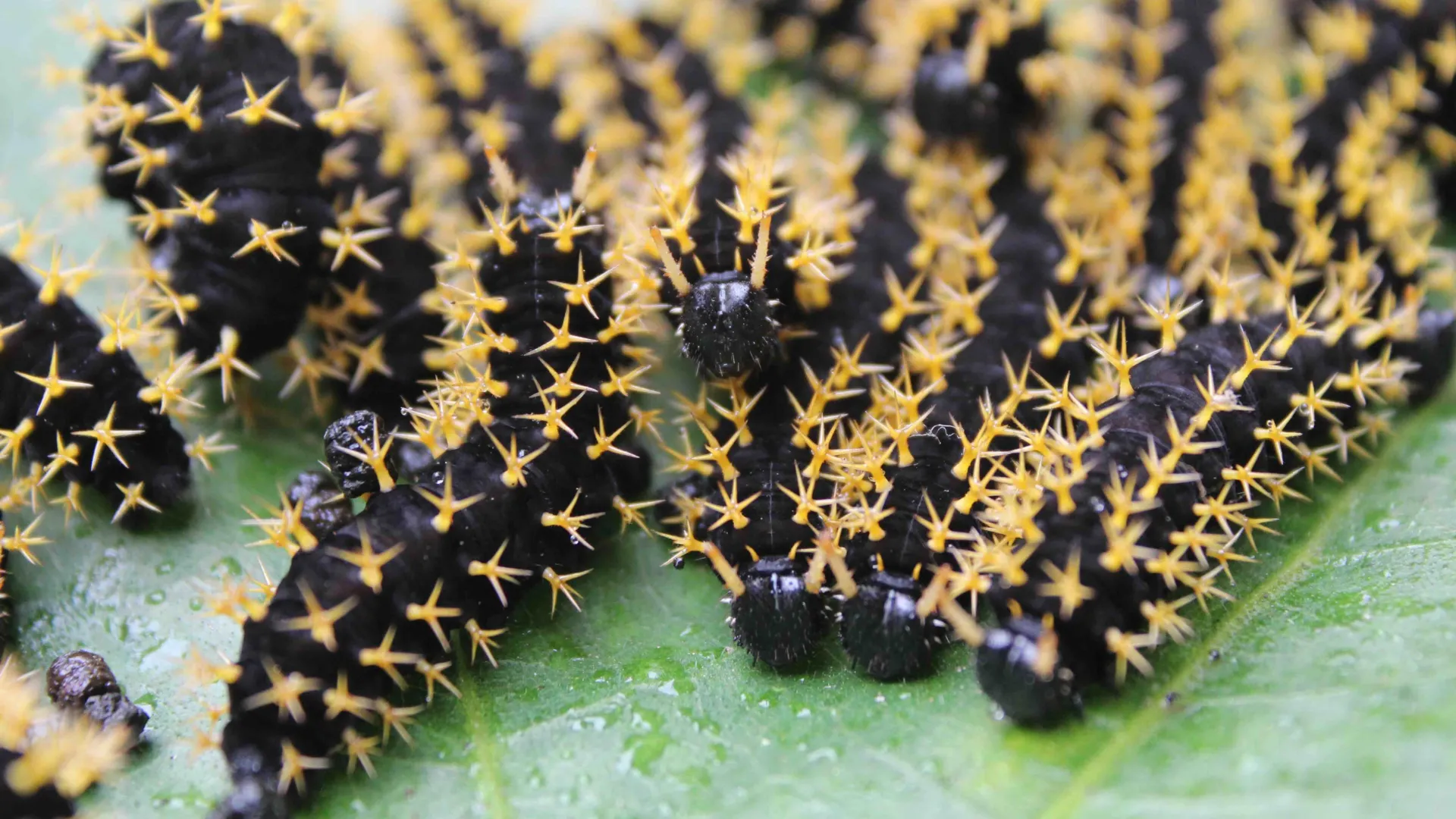
Colobura caterpillars have velvety black bodies covered with prominent yellow projections that end in sharply angled barbs. These defensive structures send a warning to potential predators that could be interpreted as “leave me alone, or there will be unpleasant consequences.”
Beneath those conspicuous spines are much smaller cream-colored markings. Depending on the species, these markings may resemble teardrops or rings, or they may be missing entirely.
The importance of these differences was recognized surprisingly early.
In 1852, Dutch entomologist Jan Sepp proposed that caterpillars with different cream-colored patterns represented two separate species. Other researchers rejected his interpretation, arguing that the variations could reflect differences between males and females or simply natural variation within a single species.
That view remained dominant for approximately 150 years.
In 2001, Keith Willmott and several colleagues revisited Sepp’s observations and formally described a second species, Colobura annulata. Willmott is now a curator at the Florida Museum’s McGuire Center for Lepidoptera and Biodiversity.
“We assumed that was the problem solved,” Willmott said.
He moved on to other research, believing the longstanding classification problem had been resolved. However, occasional observations continued to suggest that something was missing.
“I had a few indications that there was a third species, but I thought it was too implausible.”
At the time, even the existence of two nearly indistinguishable species seemed remarkable.
“It’s a very distinctive butterfly. It’s hard to imagine there being two species in the same area that look alike because they’re so different from anything else.”
An Unexpected Discovery in Venezuela
Roughly 25 years later, fresh evidence emerged when Willmott’s colleague Andrés Orellana encountered a group of hungry Colobura caterpillars feeding on a young Cecropia tree in Venezuela.
The caterpillars were rapidly stripping leaves from the sapling. They possessed the familiar black body segments near the head and yellow spines characteristic of the genus, but one feature stood out.
Unlike the two recognized species, these caterpillars had no cream-colored markings at all.
Orellana photographed the unusual insects and shared the images with Willmott. The discovery provided a compelling reason to investigate whether a third species had been overlooked.
Sapkota had recently joined the Shirey lab at the Florida Museum and was eager to lead the investigation.
Working with her colleagues, she designed a study that combined genetic evidence with careful examinations of butterfly anatomy.
First, she studied DNA barcodes, short and highly variable genetic sequences that help researchers distinguish species. These sequences came from a long-running survey of butterflies and moths in Costa Rica led by study co-authors Daniel Janzen and Winnie Hallwachs.
The investigation then expanded to older butterfly specimens collected across tropical Central and South America. Sapkota sent these museum samples to Nick Grishin at the University of Texas Southwestern Medical Center, where researchers sequenced both their mitochondrial and nuclear genomes.
The genetic results provided a way to test whether the butterflies represented genuinely different evolutionary groups rather than ordinary variations within a single species.
But the researchers also wanted to know whether there were physical differences that previous scientists had failed to notice.
An Invisible Clue Hidden in Butterfly Wings
Sapkota spent hours examining preserved butterflies in museum collections, searching for consistent traits that might distinguish the suspected species.
At first, the effort produced few answers. Other than the slight differences in the gray wing stripe, the butterflies appeared remarkably similar.
Eventually, she noticed something unusual.
The undersides of some wings appeared to have a faint violet shimmer, and the intensity of that sheen seemed to vary between specimens.
This observation suggested that the insects might reflect ultraviolet light, which falls outside the range of human vision but can be detected by many butterflies.
“I checked it with a spectrometer and found that even though the butterflies didn’t look violet to me, it reflected UV light,” she said.
The measurements revealed a striking pattern. All three species reflected ultraviolet light, but the wavelengths differed.
The researchers named the newly identified species Colobura cryptica, reflecting its previously concealed identity.
Although the visible differences were extremely subtle, the ultraviolet measurements, caterpillar markings, and DNA results told a consistent story.
The three species could be distinguished by the following features:
| Species | Adult wing characteristics | Average UV reflectance | Caterpillar markings |
|---|---|---|---|
| Colobura dirce | Gray band widens slightly and does not reach the yellow crossband | 376 nm | Cream-colored teardrops on abdominal segments |
| Colobura annulata | Gray band stays uniform in width and meets the yellow crossband | 370 nm | Cream-colored rings on abdominal segments |
| Colobura cryptica | Gray band stays uniform in width but does not meet the yellow crossband | 344 nm | No cream-colored markings |
There is an additional complication with Colobura dirce. It includes two subspecies with different ultraviolet reflectance values. Colobura dirce dirce reflects light at 362.2 nm, while Colobura dirce wolcotti reflects light at 390.6 nm. The 376 nm value represents the average for the species.
Beyond these minor wing differences, Sapkota could not identify any other consistent anatomical distinctions. Even the male genitalia, which often provide some of the most reliable features for separating butterfly and moth species, appeared indistinguishable.
Nevertheless, the genetic findings were decisive.
DNA analysis identified three distinct evolutionary lineages, and those divisions matched the physical differences the team had documented. Together, the evidence confirmed that Colobura contains three species rather than two.
Three Butterfly Species Living Side by Side
Identifying a previously unknown butterfly species is significant on its own, but the geographic distributions of these three species make the finding particularly intriguing.
All three occur in overlapping portions of Central and South America.
Colobura dirce has the widest distribution, extending from Mexico to southeastern Brazil. It occurs on both sides of the Andes Mountains and throughout the Caribbean archipelago.
Colobura annulata also occupies a large geographic area, although it is absent from the Greater Antilles.
The newly described Colobura cryptica has the smallest known range, stretching from southern Mexico to the foothills of the Andes.
These overlapping distributions raise an important evolutionary question. How did three species become genetically distinct while continuing to occupy many of the same regions?
Species often emerge when populations become isolated from one another. A mountain range, for example, might divide a population and prevent individuals on opposite sides from mating.
Over many generations, the separated groups can accumulate different genetic and physical traits. If those differences become great enough, the populations may eventually lose the ability to interbreed, even if they come into contact again.
But geographic separation is not the only mechanism that can drive the formation of new species.
Researchers suspect that the Colobura butterflies might have developed different ways of using their shared forest habitats.
“There could be vertical stratification between these butterflies,” Sapkota said. “Colobura dirce is typically found in the undergrowth and C. cryptica and C. annulata are usually found in the canopy, but we do not know for sure because there have been mixed signals coming from different studies.”
In other words, one species may spend more time near the forest floor while the others favor the upper branches.
This kind of habitat separation could potentially help maintain differences between species living in the same geographic area.
However, previous research has produced inconsistent observations. One reason may be that even experienced butterfly specialists have difficulty telling the three species apart.
How Do Nearly Identical Butterflies Recognize Each Other?
An even more puzzling question concerns how the butterflies identify suitable mates.
Many moths and some butterflies use special scent glands to release pheromones, chemical signals that help individuals recognize members of their own species.
Colobura butterflies lack those glands.
That suggests visual information may play an important role in mate selection. Yet their nearly identical appearance makes it difficult to understand how they distinguish one species from another.
The newly discovered ultraviolet differences offer a possible explanation.
Although humans cannot see ultraviolet light, many butterflies can. Sapkota suspects that the different ultraviolet reflections from their wings might provide visual signals that help them identify members of their own species.
Similar mechanisms are known or suspected in other butterflies and moths. Garden whites, sulfur butterflies, and wood tiger moths possess ultraviolet-reflecting wing scales that researchers believe may contribute to mate selection.
Sapkota is investigating whether Colobura butterflies use comparable signals, but the results have not yet provided a clear answer.
Whatever mechanism they use, the butterflies appear remarkably successful at maintaining their separate identities.
Analysis of nuclear DNA found no evidence of hybridization among the three species, despite their overlapping ranges.
The findings suggest that the species have followed separate evolutionary paths without detectable genetic mixing.
A Familiar Butterfly Still Holds Many Secrets
The discovery of Colobura cryptica demonstrates how much remains unknown about even widespread, conspicuous animals.
For generations, naturalists studied these butterflies without recognizing the full diversity hidden within the group. Only by combining detailed observations with modern genetic testing and ultraviolet measurements were researchers able to uncover the third species.
Yet some of the most important questions remain unanswered, including how the butterflies choose mates, whether they occupy different parts of the forest, and what originally caused their evolutionary separation.
For Sapkota, answering those questions will require observing the insects in their natural habitats.
“Someone has to go the field to find it out themselves.”
Those interested in another unusual aspect of Colobura biology can explore the Biodiversity Heritage Library, which contains a whimsical account published in 1952 describing the poop perches that young Colobura caterpillars construct during their earliest developmental stages.
Study Authors and Funding
Additional study co-authors include Andrés Orellana of the Universidad Nacional Experimental del Táchira; Nick Grishin and Leina Song of the University of Texas Southwestern Medical Center; Isidro Chacón of the Museo Nacional Santo Domingo de Heredia; Daniel Janzen and Winnie Hallwachs of the University of Pennsylvania; and Sajan KC of the Florida Museum of Natural History.
The research received partial funding from the National Institutes of Health, the Welch Foundation, Canada’s New Frontiers in Research Fund (NFRFt-2020- 00073), the Canada Foundation for Innovation’s Major Science Infrastructure program (MSI 42450), BioAlfa, and Project UNET (Universidad Nacional Experimental del Táchira).
Source: www.sciencedaily.com