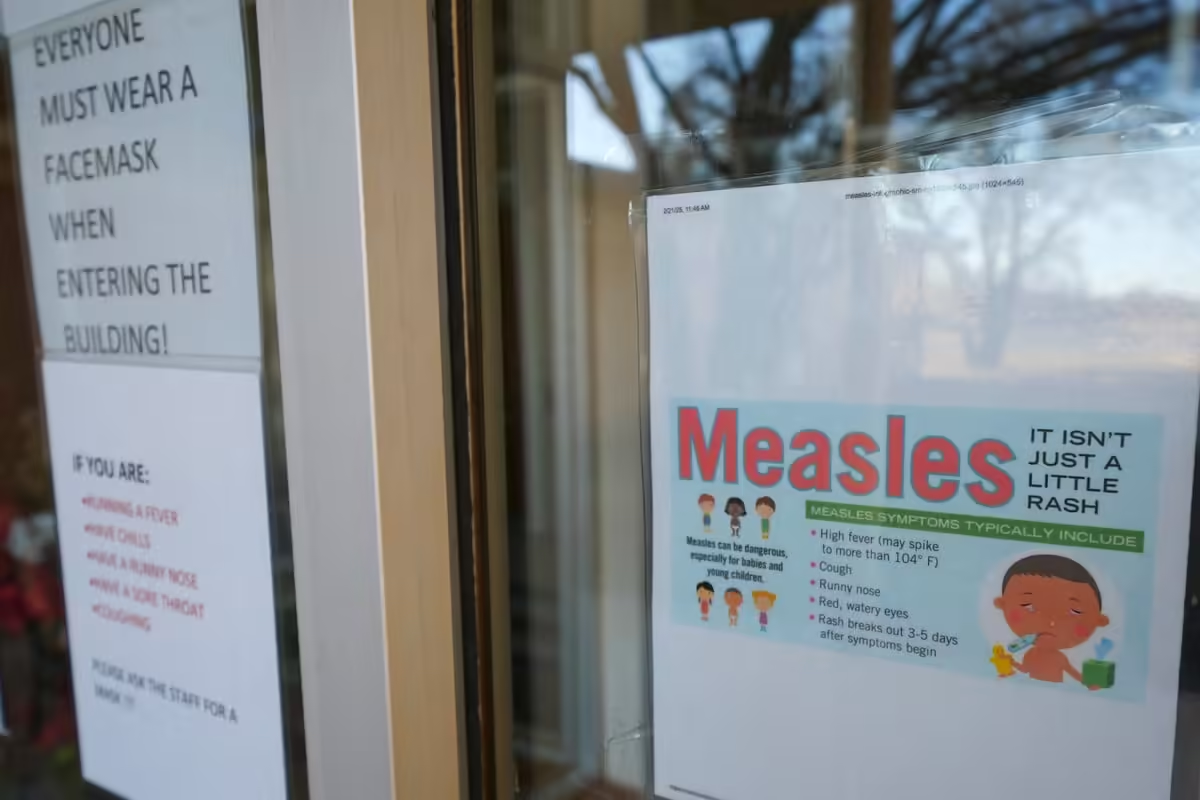

Dr. Jim Conway remembers when measles was declared eliminated in the United States in 2000.
He said federal investments in making sure every child had access to the vaccine against measles, mumps and rubella, or MMR, and record levels of vaccination led to what was once inconceivable.
“It was one of those things that for those of us in the public health world that gave us real hope that while we can do almost anything,” said Conway, the medical director of UW Health Immunization Programs. “We actually can eliminate diseases.”
Understanding Wisconsin, Together.
WPR’s “Wisconsin Today” newsletter keeps you connected to the state you love without feeling overwhelmed. No paywall. No agenda. No corporate filter.
But after years of declining vaccination rates, the U.S. is no longer considered a measles-free country.
The Pan American Health Organization is expected to announce Tuesday that the U.S. no longer qualifies for measles elimination status.
KFF Health News reported on Saturday that researchers with direct knowledge of the decision reached the conclusion that the highly contagious virus is now regularly transmitted from person-to-person in the country.
The news comes as a major measles outbreak continues to rapidly grow in southwestern Wisconsin and new outbreaks are emerging across the state from people contracting the disease while traveling.
The state Department of Health Services has reported 651 cases this year, one of the highest totals in the country. Fourteen people have been hospitalized and two children have died from measles in the last two weeks.
Dr. Ryan Westergaard, state epidemiologist and chief medical officer for the Bureau of Communicable Diseases at the state Department of Health Services, told PBS Wisconsin’s Here & Now on Friday that the expected status change is at this point “a formality.”
“It’s a sobering reminder of how much we’ve lost,” Westergaard said. “It was a tremendous accomplishment, a public health triumph, to eliminate a disease that’s as infectious as measles from a whole population for so many years.”
Conway worries measles could once again be showing public health leaders what’s to come, this time with the rise of other vaccine-preventable diseases.
“Measles is sort of the canary in the coal mine,” he said. “I do worry that we’re going to start to see the whole panoply of different diseases start to reemerge, and what that does to society, and what that does to schools.”
State data show just under 80 percent of 2-year-olds had at least one dose of the MMR shot last year, well below the 95 percent vaccine coverage needed to stop a measles outbreak. DHS data also show vaccination rates have been declining for over a decade.
For Wisconsinites who support vaccines, the reemergence of measles has brought new urgency to the issue of declining vaccination rates.
Hannah Sorensen is director of Wisconsin Families for Vaccines, a nonpartisan group that formed earlier this year to combat anti-vaccine rhetoric and advocate for science-based policies.
“This isn’t that we don’t know how to prevent measles anymore, and it’s just that we have allowed the conditions that let it spread,” Sorensen said. “So we know that this is going to unfortunately continue spreading unless we get our vaccination rates up.”
State health officials have said the last three and half months have had the highest number of measles cases and the first deaths in more than 35 years.
The relative rarity of measles in the U.S. before last year has likely contributed to the complacency about the disease, according to Conway.
He said about 10 percent of children who are infected are hospitalized with complications, and the virus kills one to two people for every 1,000 cases.
“When people are looking at those numbers, they’re like, ‘Oh well, it doesn’t kill a lot of kids.’ But having lived through caring for patients in multiple outbreaks of measles in my career, everybody that gets measles is miserable,” Conway said. “It’s high fevers, everything hurts. You know, it’s a miserable couple of weeks of recovery, and unfortunately, 10 percent or 15 percent of people are going to end up in the hospital, many of them with long-term problems.”
He said the impacts range from the inability to fight off other diseases due to a weakened immune system to hearing loss and neurodevelopmental problems in more severe cases.
Wisconsin Public Radio, © Copyright 2026, Board of Regents of the University of Wisconsin System and Wisconsin Educational Communications Board.
Source: www.wpr.org