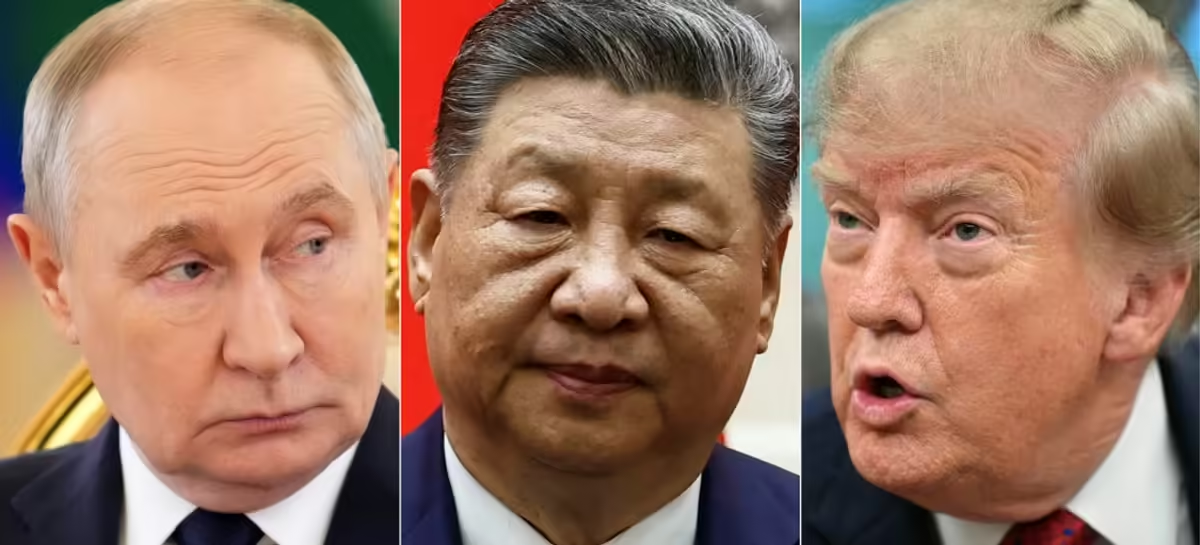

US President Donald Trump said Monday, Nov. 16, that he would discuss Russia’s war against Ukraine with Russian President Vladimir Putin and Chinese leader Xi Jinping at a trilateral summit in China this week, reversing an earlier White House position that the conflict would be left off the agenda.
The three leaders are scheduled to meet Thursday, Nov. 19, in Shenzhen on the sidelines of the Asia-Pacific Economic Cooperation (APEC) summit, without Ukrainian or European representatives present.
JOIN US ON TELEGRAM
Follow our coverage of the war on the @Kyivpost_official.
“We’ll talk about my favorite subject, Ukraine,” Trump told reporters before departing Washington, adding that both sides are suffering heavy casualties. He also suggested Putin was “backing down a little bit” and wanted to see the conflict end.
His remarks abruptly reversed guidance from senior US officials on Friday, Nov. 13, who had stated Trump would focus on nuclear disarmament and the war in Iran rather than Russia’s invasion of Ukraine. At the time, officials said separate US-led peace negotiations meant China was not part of the Ukraine diplomatic track.
Beijing has said the first-of-its-kind meeting among the three leaders will focus on “safeguarding world peace” and strategic stability, without specifying Ukraine.
For Putin, the summit offers a chance to project Russia as a global power while discussing its war against Ukraine as part of a broader deal between Washington, Moscow and Beijing – without Kyiv or its European allies at the table.
Other Topics of Interest
Kyiv advances key economic reforms despite Russia’s intensified attacks, as the IMF warns Ukraine faces a $34 billion funding gap in 2027.
Europe warns against elevating Putin
Polish Foreign Minister Radosław Sikorski sharply criticized the Shenzhen summit’s format, arguing that it grants Moscow an international standing it no longer deserves.
“I think that’s an unnecessary elevation of Russia to the position of a global superpower, which Russia hasn’t been for a long time,” Sikorski said.
“It should be a meeting in the triangle of China, US and EU.”
Sikorski also warned against placing pressure on Kyiv rather than Moscow.
“The focus should be on the aggressor, not the victim of aggression,” he said.
German Chancellor Friedrich Merz issued his own warning ahead of the summit, urging Washington to avoid unexpected agreements resembling the uncertainty that followed Trump’s earlier meeting with Putin in Anchorage, Alaska.
“Please, no surprises. Continue to play as part of ‘Team Europe’ and ‘Team Ukraine,’” Merz said Friday.
European governments have repeatedly insisted that Ukraine must determine its own territorial future and that Russia cannot dictate Europe’s security arrangements.
Ukrainian Foreign Minister Andrii Sybiha has similarly warned that a US-China-Russia summit could encourage Putin to prolong the war.
“Putin is not a global leader, he is a war criminal. And Russia is not a global power, it is a global problem,” he said.
Two summits, two competing diplomatic priorities
Thursday, Nov. 19, will see two parallel diplomatic summits – one in China, the other in Berlin.
While Trump meets Putin and Xi in Shenzhen, accompanied by Secretary of State Marco Rubio and Treasury Secretary Scott Bessent, German Chancellor Friedrich Merz will host a Coalition of the Willing summit alongside French President Emmanuel Macron and British Prime Minister Andy Burnham.
The Berlin gathering, expected to draw more than 20 heads of state and government, will focus on Ukraine’s defense, post-war security guarantees and continued military support, with Merz prioritizing funding for Kyiv’s defense in 2027.
US envoys Steve Witkoff and Jared Kushner are expected to join the Berlin talks. According to Axios, a US official described the parallel meetings as a “coordinated diplomatic effort.”
Yet their simultaneous timing highlights different priorities.
The question is whether the two tracks will reinforce each other or create competing expectations.
Zelensky: ‘Difficult talks’ bring Europe into peace process
On Monday, President Volodymyr Zelensky confirmed that Ukrainian, US and European negotiating teams had held difficult discussions.
“We need a dignified end to the war and guaranteed security for Ukraine,” Zelensky said in his evening address.
For the first time, Europe participated with its full negotiating group, including France, Germany, Britain, Italy, Poland, the European Commission, European Council and NATO.
“The discussion was difficult, but there is a result,” Zelensky said, announcing follow-up talks in Berlin to agree on concrete steps.
Kushner outlines security guarantees for Ukraine
Kushner said Monday that Washington had made progress toward a settlement, emphasizing that the goal was a “sovereign, secure, and prosperous” Ukraine, free to determine its own future.
He outlined three priorities: credible security guarantees against renewed Russian aggression, a path to EU membership and a post-war reconstruction plan.
“NATO will remain a critical pillar of European security,” he wrote on X.
Kushner stressed that any final agreement must be accepted by both Ukraine and Russia, adding that negotiations were helping “narrow the remaining gaps.”
According to Reuters, Kushner and Witkoff spoke with Kremlin foreign policy aide Yuri Ushakov before holding talks with Ukrainian and European representatives.
US envoys have reportedly pushed for direct talks between Moscow and European governments, but Ushakov said Russia had not agreed to European participation in the next round of peace negotiations.
Ultimately, the real test will not be Thursday’s summits, but whether either diplomatic track can compel the Kremlin to end the war it started.
Source: www.kyivpost.com