
Officials in Nova Scotia are warning that the unregulated drug supply is becoming more toxic as it’s commonly laced with unknown ingredients, including strong veterinary sedatives.
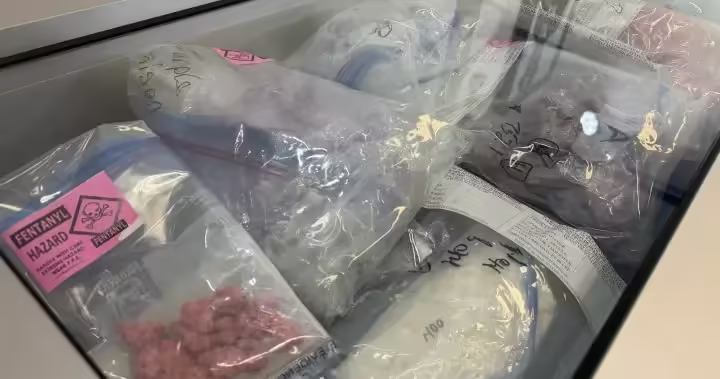
Halifax Regional Police confirmed that as recently as Sept. 4, a search at a home in Dartmouth included a sample of fentanyl that tested positive for medetomidine — a potent sedative used primarily by veterinarians.
As part of that investigation, police seized 6.2 kg of fentanyl, an additional 1,400 fentanyl pills and 10.5 litres of GHB — commonly known as the date rape drug. The case is believed to be the largest ever seizure of fentanyl and GHB in Atlantic Canada.
As well, Nova Scotia Health said last week that a drug sample that was seized by police in Pictou County and sent to Health Canada’s drug analysis lab tested positive for a variety of substances including medetomidine or its salts, fluorofentanyl, ketamine, methylfentanyl, phenacetin, caffeine, diphenhydramine and nefopam.
According to Nova Scotia Health, the drug was described as being a “sticky brownish soft resinous substance.”

Officials in British Columbia, Ontario and New Brunswick have raised growing concerns about the detection of medetomidine in the drug supply, which can be mixed with opioids like fentanyl.

Get daily National news
Get daily Canada news delivered to your inbox so you’ll never miss the day’s top stories.
Nova Scotia RCMP confirmed to Global News that medetomidine has been found in the province but the force could not say how many times the drug has been identified in their jurisdiction.
“There is always a risk that unregulated drugs may contain unexpected, stronger than expected, or potentially harmful ingredients,” said spokesperson Cpl. Carlie McCann in a statement.
“An overdose is a medical emergency. Under the Good Samaritan Drug Overdose Act, people who experience or witness an overdose and call 911 are protected from being charged with possession of a controlled substance and breach of conditions regarding simple possession of controlled substances.”
Dr. Ryan Sommers, senior regional medical officer of health and senior medical director population and public health, said the unregulated drug supply is “becoming more dangerous” because it can contain not only strong opioids, but veterinary sedatives as well.
“These substances are often mixed with other opioids and benzodiazepines, which can cause deep sedation, slow or stopped breathing, low blood pressure, and a very slow heart rate,” he said in a statement.
“Naloxone reverses the effects of opioids and helps restore breathing, but it does not work on tranquillizers or benzodiazepines. As a result, a person may stay unconscious even after receiving naloxone.”
He said naloxone should be given in a suspected overdose because it can restore breathing when opioids are involved, “and they almost always are.”
Users should also assume that any unregulated drug taken may contain fentanyl and medetomidine.
Anyone who sees a suspected overdose should call 911 immediately.
“Naloxone may not wake someone up when drugs like medetomidine are involved, but it can restore breathing. Call 911, prioritize breathing, and do not leave them alone,” he added.
© 2026 Global News, a division of Corus Entertainment Inc.
Source: globalnews.ca