
Your laptop runs on hidden software developed over decades to handle tasks from boot sequences to memory management, along with countless other low-level services. We forget how amazing it is that you only need to press a button, and you’re ready to run basically anything you desire.
There’s no reason for quantum computers to be any different, but today they are. Until now, there hasn’t been any software available to automatically execute the many processes required to take a quantum processor from power-on to workload-ready. Instead, a long list of independent, human-driven processes are executed by teams of PhD-level researchers and engineers before any workload can ever be run, creating a huge impediment to broad deployment. The machines have mostly been closer to science experiments than useful computers.
Today, we are closing that gap.
We’re thrilled to announce the unification of two core Q-CTRL products into a single fully autonomous process to operate quantum computers. Boulder Opal delivers autonomous hardware calibration and bootup, and Fire Opal enables performance-managed and virtualized algorithm execution on real quantum hardware. Now users can go from bare chips with raw, untuned qubits to optimized algorithm execution in hours instead of months, all in a single, autonomous workflow.
This announcement puts into practice the integrated, end-to-end approach we outlined in “A focus on the quantum computing stack is holding commercialization back”: combining the products our customers already rely on into a single workflow that handles complex quantum tasks for them.
Here’s what you get:
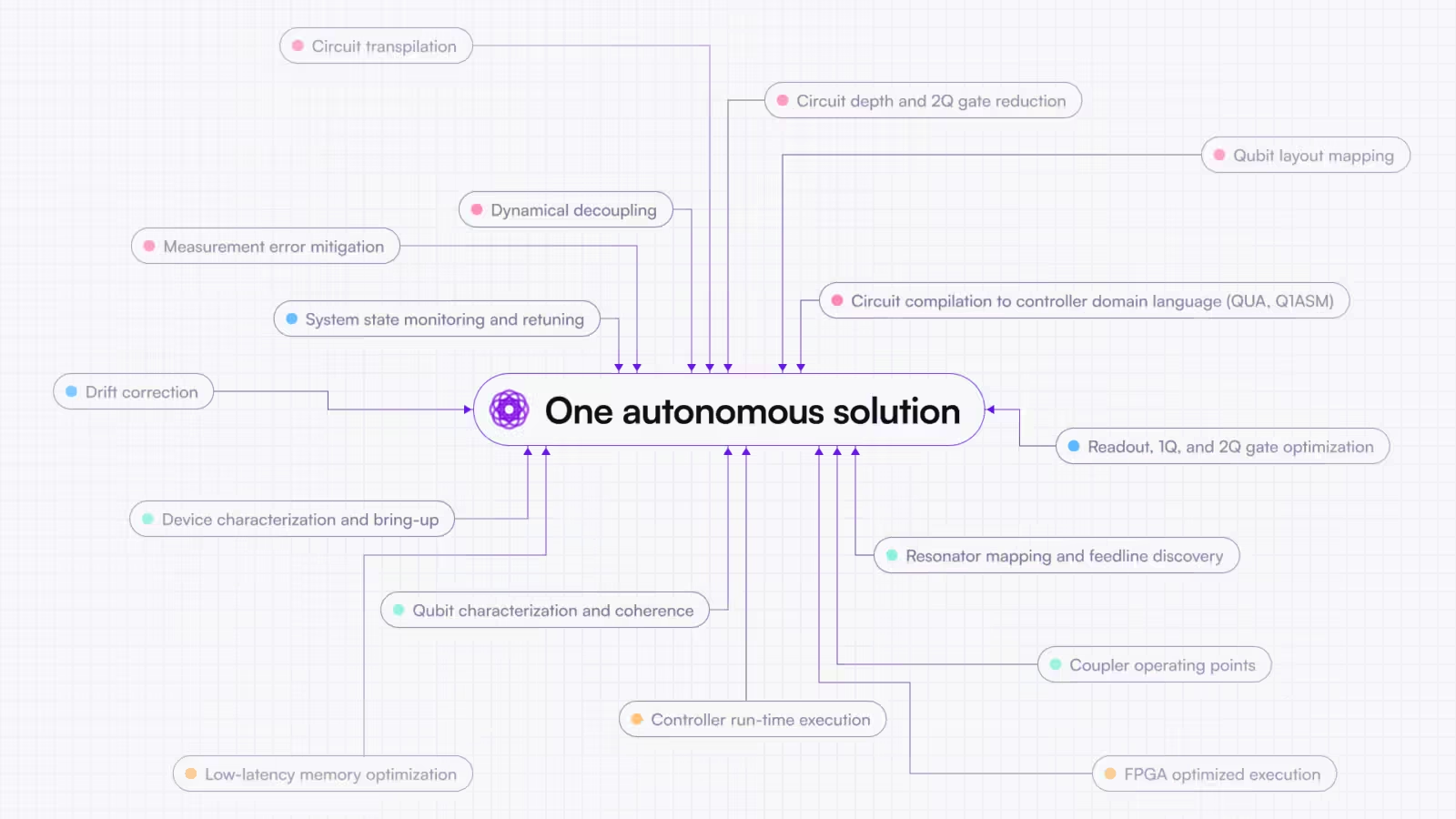
- One workflow: A single abstraction layer automatically manages all aspects of calibration, compilation, error suppression, and execution, replacing disconnected tools, handoffs, and expert-driven steps through the integration of Q-CTRL’s validated products: Boulder Opal and Fire Opal.
- Faster deployment, less downtime: Autonomously tune up and maintain your quantum processor, achieving performance and gate fidelity that beat leading research teams, all with zero human intervention.
- Stronger algorithm results: Execute workloads with automated error suppression to deliver the correct answer with thousands of times higher likelihood: no need to understand any details of error reduction technology, compilation, or the like.
- A platform for growth: Q-CTRL’s software will keep evolving as quantum computers scale, including quantum error correction integrated directly with calibration and compilation.
With this release, Q-CTRL takes another step toward delivering quantum computers that simply work.
Other approaches expose low-level hardware access, which still leaves users writing their own scripts and stitching together bespoke, fragmented workflows. Access isn’t the same as outcomes.
Q-CTRL’s autonomous workflow handles those low-level tasks for you, delivering better performance, and a far a simpler user experience. That’s the stable infrastructure baseline the next wave of quantum innovation needs to build on.
Uncover the hidden burden behind every quantum workload
Picture a new quantum processor arriving at a facility. It’s installed, wired, and cooled down, but it can’t run a single algorithm—it can’t even turn on yet! Specialists first have to characterize every quantum element and calibrate every gate, followed by critical ongoing maintenance. Then another team has to translate a user’s algorithm into a compiled and optimized set of hardware instructions for that specific quantum device.
Achieving a functional processor in this way is no mean feat. Initial calibration alone typically takes three to four weeks of manual work by expert teams; achieving reasonable performance is all but impossible for a novice team purchasing a third-party system. Then every workload to be executed needs a user to build and integrate a complex toolchain of compilers, transpilers, and error-reduction technologies. Making it worse, the right set of techniques and solutions may not translate from one user problem to another.
The true barrier to widespread adoption of quantum computing is turning all of this into a repeatable process that runs every task autonomously, recovers from anomalies, and works fast enough to keep the system ready for real workloads all the time.
We have to be able to operate QPUs without a team of PhDs in tow.
For teams looking to adopt and integrate quantum computers, this burden is huge and often isn’t visible until you face the barrier of receiving a bare QPU by FedEx, plugging it into a fridge, and asking, “now what?”
Build it in-house? You need a dedicated team of specialists and years of development time. Do it suboptimally? You undermine the algorithmic potential of the system you bought. Build something too slow? Process overhead consumes most of the system time and erodes the return on an expensive asset.
Bridge device physics and algorithm performance in one workflow
With Q-CTRL’s fully integrated quantum infrastructure software, your team can boot up a quantum computer and start running workloads without expert intervention, just like a standard CPU. Calibration, maintenance, compilation, and error suppression all run invisibly in the background. And because Boulder Opal and Fire Opal share the same view of your hardware, every improvement made during calibration carries straight through to improved performance for your algorithms. No need to update gate definition databases, it’s all autonomous and seamless.
With both products combined in one workflow, quantum computing fits into the infrastructure you already run. QPU vendors can ship deployment-ready systems. Data center and HPC operators can deploy quantum processors alongside their CPUs and GPUs. National laboratories and research hubs get dependable systems their scientists can use from day one.
Work with the tools and hardware you already use
Our integrated quantum infrastructure-software solution extends across hardware platforms and software ecosystems at both ends of the workflow. Writing circuits in Qiskit? QASM? CUDA-Q? Using Qblox or Quantum Machines controllers? No problem, all supported!
Here are the integrations we support today. And we are working across the industry to add
| Supported integration category | Supported providers | What the integration does | What it means for you |
|---|---|---|---|
| Intermediate representation | Qiskit, QASM, CUDA-Q | Consumes abstract circuit definitions prior to optimization for execution on real hardware. | Keep working in the frameworks your users already know, no rewrites or translation between languages. |
| Controller hardware | Quantum Machines, Qblox | Cross-compiles optimized circuits into each controller’s low-level domain language. | Swap between supported controllers without any need to rewrite low-level compilers. |
| QPUs | Superconducting: QuantWare, Rigetti, Anyon Computing, Qolab Silicon spin: Equal1 | Delivers the complete autonomous calibration and maintenance flows for the supported QPU. | No need to test and design custom calibration or error-reduction procedures; bring up and operate different QPUs through the same workflow without any burden on you. |
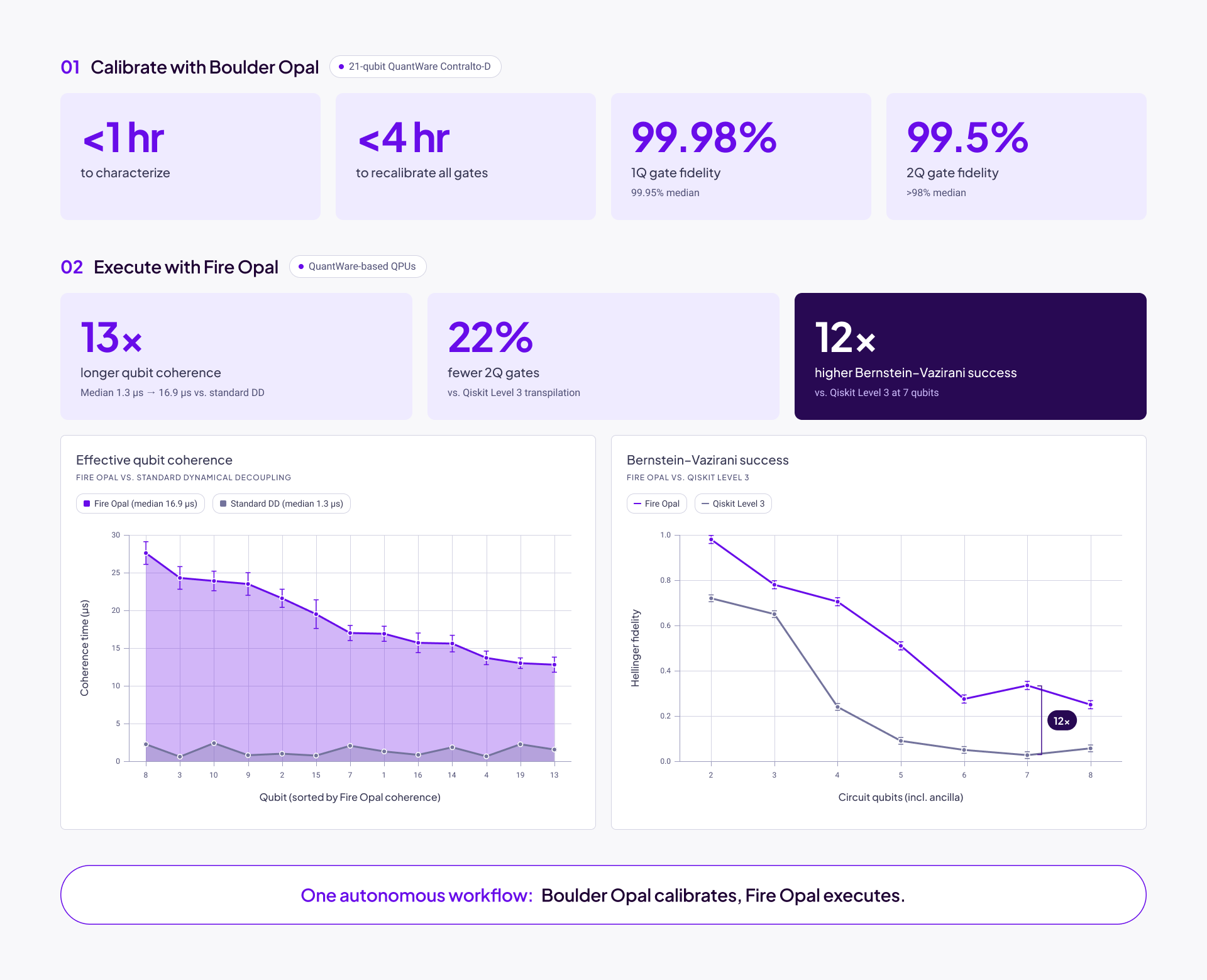
We demonstrated the complete workflow using a 21-qubit QuantWare Contralto-D QPU. Boulder Opal characterized the newly cooled device in under one hour and recalibrated every gate in under four hours, reaching fidelities of 99.98% for single-qubit gates (99.95% median) and up to 99.5% for two-qubit gates (above 98% median).
Fire Opal’s performance advantages are well established on today’s leading quantum computers. With this integrated workflow, those advantages now extend to the calibrated processor, delivering longer coherence times and higher algorithm success probabilities. Using Fire Opal’s advanced crosstalk suppression, qubits stayed coherent 13x longer than with a standard decoupling sequence, raising the median coherence time from 1.3 µs to 16.9 µs. On a shallow Bernstein-Vazirani circuit, Fire Opal used up to 22% fewer two-qubit gates than Level 3 Qiskit compilation, resulting in up to a 12x higher success probability than the standard Qiskit pipeline.
Elevate Quantum’s Q-PAC system is the first to run this brand new integrated quantum infrastructure-software stack live, delivering complete autonomy and virtualization of the QuantWare QPU to end users. Users can access the system through the Open Quantum platform by Quantum Rings from December 2026.
The end-to-end integrated software from Q-CTRL strengthens the Elevate Quantum ecosystem, accelerates commercial velocity, and reinforces Colorado and the Mountain West as a global hub for quantum infrastructure deployment. Rather than wasting cycles battling the system, we can focus on customer enablement and project progress. Jessi Olsen, CEO of Elevate Quantum
The best quantum systems pair maximum uptime with effortless access. While it only takes days to onboard a QPU onto Open Quantum, it’s generally weeks or months before the qubits are sufficiently calibrated for end users. Integrating Q-CTRL’s automated calibration helps close that gap, putting these systems in customers’ hands much faster. Bob Wold, CEO of Quantum Rings
Quantum computing is here and ready to run!
We believe the commercial quantum computing sector needs to shift its focus from the technology stack to delivering customer value.
That value is realized when capability, deployability, and usability come together. The integrated quantum infrastructure software solution we’ve announced today delivers all three, giving you a system that deploys quickly, runs with minimal operating overhead, routinely enables peak performance on real workloads, and brings it all together in a single, easy-to-use workflow.
Ready to find out what it can do for your deployment? Get in touch with our team to see the workflow in action.
Source: q-ctrl.com