

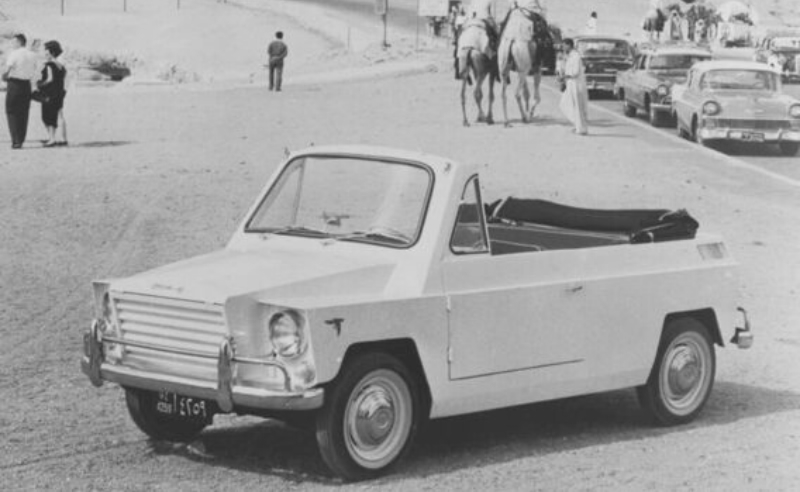
The Ramses, one of Egypt’s earliest locally produced cars, disappeared from production more than five decades ago.
This November, Cairo Design Week (CDW) is bringing it back into view, using the car to ask what an Egyptian vehicle could look like now and what it would take to actually build one.
Reimagining Ramses forms part of inMotion, CDW’s programme dedicated to mobility, industrial design and engineering.
The wider exhibition runs from November 19 to 28 at Sultan Hussein Kamel Palace in Heliopolis, bringing designers, engineers, researchers and students into the same space.
The original Ramses entered production around the turn of the 1960s through state-owned Al Nasr Automotive. Based on the German NSU Prinz, it relied heavily on imported components, with its body produced locally, and was discontinued in 1972.
Its unfinished promise is part of what drew Mohamed Fares, co-founder of Alchemy Design Studio and a designer with more than 25 years in the creative industry, to the project.
Fares found the exhibition almost by chance. He spotted an automotive listing in the Cairo Design Week programme, contacted co-founder Hisham Mahdy and joined once he understood the brief.
The Ramses already carried a personal association. Fares’s first car was a Fiat 128, assembled by the same Egyptian company that had produced the Ramses.
“I’m Egyptian and I want Egypt to be on top of everything,” he says.
One design quickly became two. Fares developed the Grand Tourer and Jameela 2, a compact convertible he nicknames the Little Ramses. Both keep what he sees as the Ramses’s visual DNA: its grille, headlamps and rear.
Inside, vintage leather, chrome and a classic steering wheel pull from the craftsmanship of the period. Fares also looks to cars whose identities have survived generations of redesign, including the Mercedes-Benz G-Class, better known as the G-Wagon.
“My approach is 80 per cent heritage and 20 per cent design for the future,” he says.
The designs are still concepts, and that distinction is central to inMotion. A convincing car needs a path from drawing to engineering, simulation, prototyping, testing and eventually manufacture.
Youssef Elaraby leads the Product Design Centre at PHOTONX, an Egyptian research and development company working across industrial design, engineering, prototyping and product testing.
For Elaraby, the exhibition brings together disciplines that too often operate separately.
“The idea is to bridge the gap between technology and design through innovation,” he says.
Visitors will see scale mock-ups of the Ramses concepts at roughly one-fifth of full size. Elaraby hopes they point towards something larger than the models themselves: an ecosystem capable of responding to a local need and carrying an idea all the way through production.
That chain is where the exhibition’s stakes sit. Egypt has designers, engineering graduates, manufacturers and research centres. inMotion brings pieces of that infrastructure into one exhibition and asks what happens when they begin working around the same problem.
The Ramses becomes one case study inside a much wider look at movement.
A motorcycle prototype developed with designer Ali Hossam Ali sits at the centre of the exhibition, combining design experimentation with engineering to explore what a contemporary Egyptian vehicle might look like.
PHOTONX will also show visitors how product development moves from an early idea through design, engineering and testing.
“We’ll show some of the things PHOTONX is working on, so people know that R&D exists here and that it can help us a lot,” Elaraby says.
The next generation enters through Coventry University’s Egypt branch at The Knowledge Hub Universities, whose School of Design and Media and School of Engineering are contributing projects developed with industry partners.
Dr. Ebtissam Farid, who heads the design school, says students work with briefs drawn from existing market problems.
“We get real briefs from the market, and we try to solve problems that are present in the market in collaboration with industry partners,” she says.
One student lab looks at Egypt’s electric vehicle ecosystem. Its projects include Pebble, a cable-management system for home EV charging designed to resemble natural stone.
Another lab, developed with technology company Solis Technologies, focuses on smart-home products including a door-access unit, a presence sensor and a bin sensor called Iris. A third examines how products can be designed with manufacturing in mind from the beginning.
Student work elsewhere in the exhibition includes Trike, a foldable three-wheeled electric scooter with airless tyres, and a phone-controlled miniature submarine equipped with a claw designed to retrieve plastic from beaches and pools.
“It’s all about the experiences and engaging people in the projects, the concepts, the challenges and the stories around why we’re doing this,” Farid says.
Seen together, the projects move Reimagining Ramses away from a simple exercise in reviving an old car. The exhibition follows the much harder question of what has to exist around a design before an Egyptian product can leave the drawing board.
Fares hopes younger designers leave believing that possibility still exists.
“It’s a message of hope that we can recreate what has been lost over the past 50 years,” he says.
Source: cairoscene.com