
November 15, 2026
UPDATE
Apple launches research study to explore the use of AI for health
The Apple Health AI Usage Study, conducted in collaboration with OpenEvidence, will evaluate trust, comprehension, and real-world health AI engagement
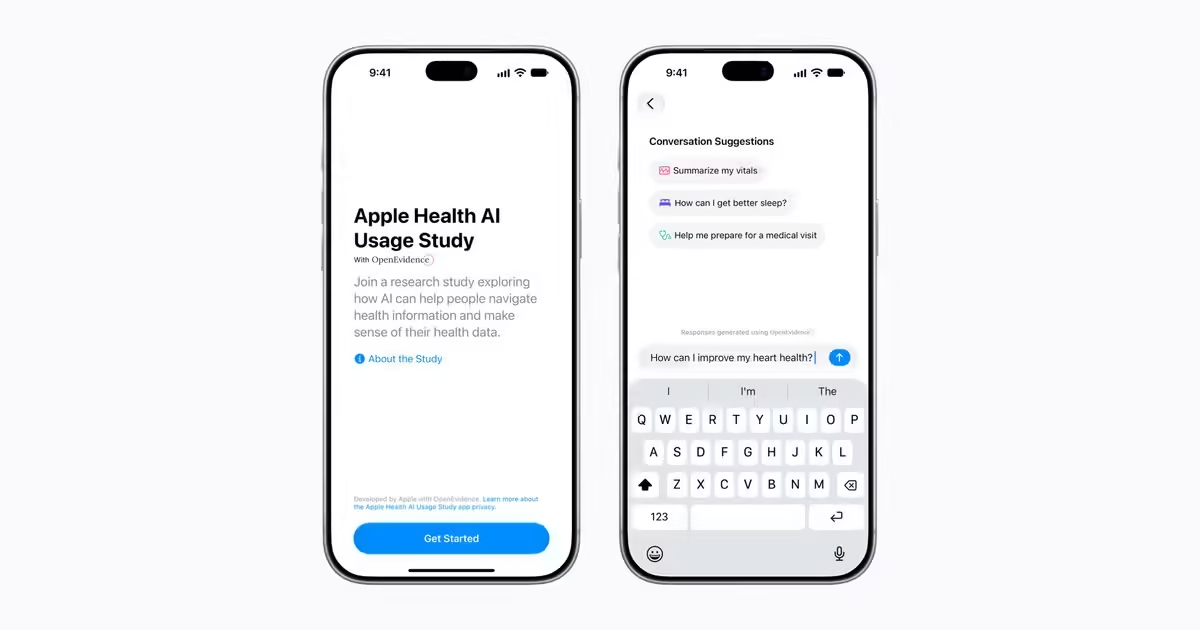
Apple today announced the launch of the Apple Health AI Usage Study in the United States, a virtual research study and associated app designed to advance the understanding of how people interact with conversational health AI tools.1 By examining what drives user trust, the quality of responses, comprehension, and everyday health actions, the study aims to inform the responsible design of health AI experiences for Apple and the industry.
“At Apple, we believe responsible innovation starts with scientific rigor and clinical grounding. Health is deeply personal, and conducting a dedicated research study is the most thoughtful way to understand how people engage with, comprehend, and evaluate health AI in everyday life,” said Sumbul Desai, M.D., Apple’s vice president of Health and Fitness. “Insights from this study will help advance the broader scientific conversation and ensure that as technology evolves, we continue building trusted tools that genuinely support people wherever they are on their health journey.”
The study is conducted in collaboration with OpenEvidence, a leading clinical AI platform widely used by healthcare professionals that generates answers using medical information from established sources such as The New England Journal of Medicine, Journal of the American Medical Association, and Nature. The study brings together medically grounded AI technology developed by OpenEvidence with an Apple-designed research experience. Participants will be able to ask the study app everyday health questions; explore complex medical information communicated with approachable language; and see linked, peer-reviewed clinical citations that ground each response. Participants can also choose to share HealthKit data types — such as resting heart rate, activity, sleep, or lab results — to explore how personal data integration impacts relevance and understanding. Consumer health technologies powered by LLMs may at times offer responses that are incomplete or unclear, which is why research is critical to presenting health information to users with greater clarity. The study will also explore how health AI can potentially help participants better prepare for clinical visits with their own doctors.
“Patients and clinicians are both turning to AI, but the tools they use are being built and tested in separate worlds,” said Robert M. Wachter, M.D., UCSF’s professor and chair of the Department of Medicine. “When patients and doctors draw on versions of the same trustworthy tools, patients arrive prepared, conversations improve, and next steps happen seamlessly. Connecting these tools, and rigorously studying what works, is how we’ll get there.”
The study is designed from the ground up with privacy protections, transparency, and clinical guardrails, and study data will not be used to train AI models. Participants retain control over whether to share any HealthKit metrics or survey responses, and Apple has implemented security measures to protect the study data it maintains, as well as the confidentiality of participants’ information. The study app features safety guardrails that are intended to detect certain concerning questions and suggest that a participant follow up with a provider or other resources if needed.
Study Details and Availability
The Apple Health AI Usage Study is open to up to 200,000 eligible participants age 21 and older across the United States. To join, participants must have an Apple Intelligence-enabled iPhone (iPhone 15 Pro or later) running iOS 26 or later. Download the study app to learn more about the study and choose to enroll.
- The study app is not meant to diagnose or treat any condition, or replace the advice of medical professionals. Participants should consult a doctor or clinician to address health concerns or verify medical information.
Press Contacts
Zaina Khachadourian
Apple
Lance Lin
Apple
Apple Media Helpline
Source: www.apple.com