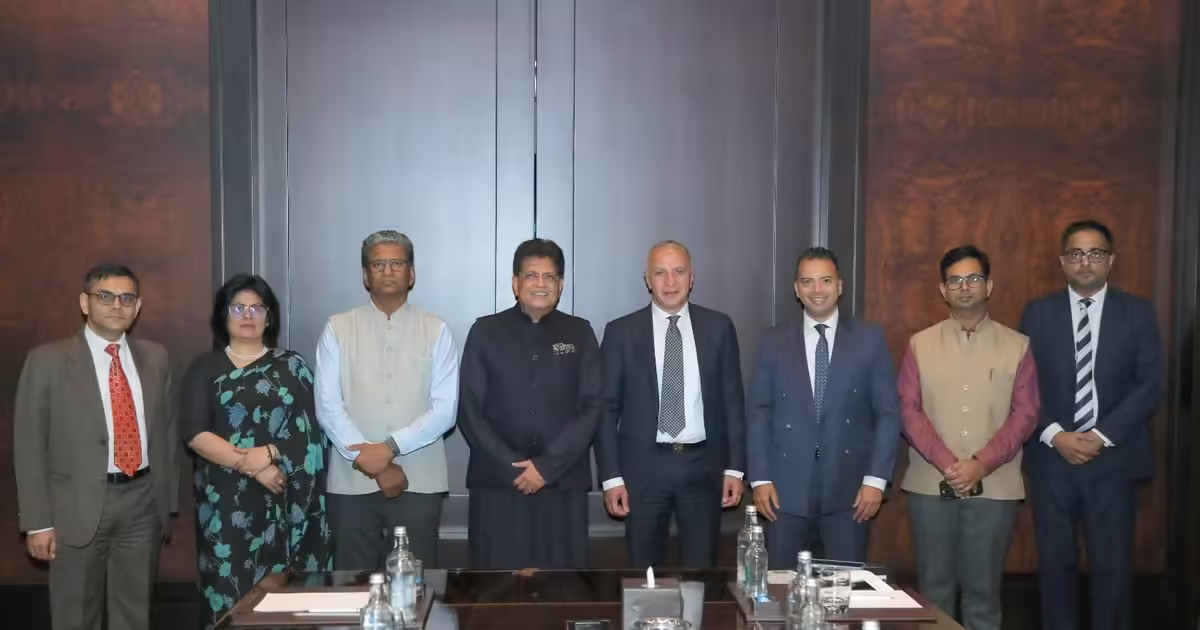

Indian Commerce and Industry Minister Piyush Goyal met Ahmed ElSewedy, president and chief executive of Elsewedy Electric, during an official visit to Egypt accompanied by a 132-member business delegation.
The talks place an African multinational with more than $5.7 billion in annual revenue at the centre of India’s drive to attract additional capital into its fast-growing digital and energy infrastructure markets.
“We discussed strategies to strengthen collaboration across several key sectors, including electrical equipment, smart meters and data centres,” Goyal said after the meeting.
Details of the meeting were disclosed by Goyal and reported by the Press Trust of India. The Indian government separately confirmed that the delegation included more than 130 business leaders and startup representatives.
No investment deal has been announced
The meeting represents an invitation to explore investment rather than a completed transaction.
Neither Elsewedy Electric nor the Indian government has announced an investment value, project location, joint-venture partner or construction timetable. No binding agreement was disclosed following the discussions.
Elsewedy also already lists an office in India as part of its international network. The latest talks should therefore be understood as an effort to deepen the Egyptian company’s involvement in the country, rather than its first entry into the Indian market.
The company operates across electrical manufacturing, engineering, construction, digital services and infrastructure investment. It employs more than 21,000 people and has over 34 production facilities across Africa and Asia, according to its official corporate profile.
Elsewedy says it has a presence in 60 countries and exports products to more than 100 markets. Its reported revenue exceeded $5.7 billion in 2025.
India is targeting experience, not merely capital
Elsewedy’s smart-metering and data-centre experience helps explain India’s interest.
Through its subsidiary Iskraemeco, the Egyptian group says it has installed more than 100 million electricity meters. The business manufactures meters in Egypt, Slovenia and Malaysia and provides smart-grid and energy-management systems.
Elsewedy’s digital division also designs and builds data-centre infrastructure, covering electrical and mechanical systems, security, cabling, testing and long-term maintenance.
In Egypt, the company is part of a consortium developing Africa Data Centres Egypt alongside Vodafone Business and Cassava Technologies.
The Egyptian facility is designed to begin with 20 megawatts of capacity and eventually scale to 200 megawatts. Its first phase is expected to attract approximately $200 million in foreign investmentwhile total investment could reach $1 billion at full capacity.
That $1 billion relates exclusively to the Egyptian project. It is not an investment commitment to India.
The project gives Elsewedy relevant experience as India expands the infrastructure required to support cloud computing, digital public services and artificial intelligence.
A $6.5 billion partnership gathers pace
Goyal’s meeting with ElSewedy formed part of a wider attempt to expand trade and investment between India and Egypt.
Bilateral merchandise trade stood at approximately $6.5 billion during India’s 2025–2026 financial year. India exported goods worth $3.87 billion to Egypt and imported $2.60 billion.
Trade has since accelerated. Merchandise exchanged between the two countries reached $5.04 billion between April and September 2026, representing a 64% increase from the same period a year earlier, according to India’s commerce ministry.
Nearly 70 Indian companies already operate in Egypt, with combined investments exceeding $5 billion. Indian officials view Egypt’s Suez Canal Economic Zone and trade agreements as potential gateways to markets across Africa, the Middle East and Europe.
The two governments have also discussed removing non-tariff barriers, improving market access and expanding cooperation in renewable energygreen hydrogen, pharmaceuticals, engineering and logistics.
Separate discussions have examined the possibility of settling some bilateral trade in local currencies and pursuing a preferential trade arrangement.
India offers Elsewedy a large market for power equipment, digital infrastructure and energy-management systems. The Egyptian group, in turn, brings manufacturing capacity in Africa and experience delivering major infrastructure projects across emerging markets to its Indian partners.
The next meaningful development would be a formal investment agreement, joint venture or named project. Until then, the Cairo meeting remains an early-stage investment discussion rather than a completed deal.
Source: africa.businessinsider.com