
Americans are in a civic literacy crisis. According to the U.S. Chamber of Commerce Foundation, some can’t identify the number of branches of government, let alone name the branch where bills become laws.
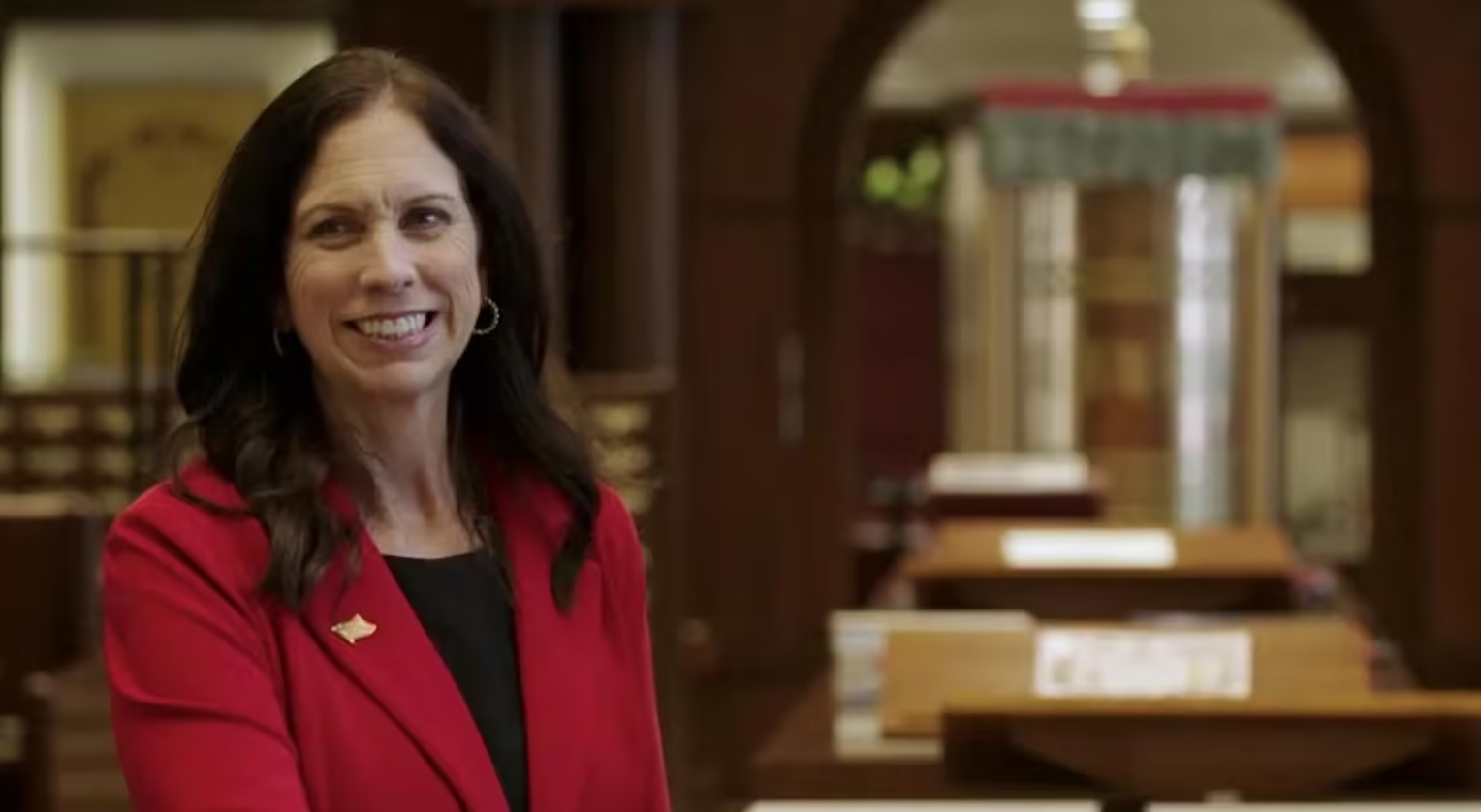
Colleen Shogan, BC ’97, has built her career of public service around this very issue: Americans don’t know their government’s history, and no one is working to inform them.
“Those things are concerning to me because if we don’t understand the basic rules of the game, then we can’t participate in it,” Shogan said.
In 2023, Shogan was sworn in as the 11th archivist of the United States, serving as the head of the National Archives and Records Administration (NARA) until President Donald Trump removed her from office in February 2025.
Since her dismissal, Shogan has continued to pursue service that puts history in the hands of the American people. She serves as the CEO of In Pursuit, a national historical initiative that aims to surface lessons from the 250 years of American history through weekly essays, videos, and events.
The program is part of More Perfect, an alliance that seeks to engage institutions and citizens in protecting American democracy through partnerships with over 100 academic and historical institutions, including 43 Presidential Centers.
“A Version of Service”: Shogan’s Mission To Inform Americans
Shogan’s mission of service comes from a deep admiration of history, and an awareness that only educated citizens can effect change in government.
“If we are concerned about the direction our government is heading, the reason is we haven’t invested in teaching people about it,” Shogan said.
For Shogan, a commitment to serving others began well before her career did—and she remembers her time at Boston College as formative in shaping values.
At the time, BC’s focus on shaping students into “men and women for others” seemed to Shogan like a peripheral aspect of the Jesuit environment. It was only later that she realized how much the maxim had impacted her perspective.
“When I was eventually done with my education after graduate school, and after I had worked as a faculty member and I had the opportunity to actually engage in public service for the first time, I realized how much it resonated with me,” Shogan said.
After earning her doctorate in American politics at Yale, Shogan taught undergraduates at George Mason University—a position she has never fully left. Now an adjunct lecturer at Georgetown, Shogan also dedicates her time to speaking at colleges and universities across the United States, hoping to interest young people in a career of public service.
“I think that it is a version of service, particularly trying to do what we’re doing today—having, you know, really frank discussions about the strength of American democracy,” Shogan said.
Shogan continued to pursue service in her roles at the Library of Congress and the White House Historical Association. In both, she oversaw programs related to K-12 education.
Part of Shogan’s work was making archival materials available to teachers across the country.
“I think we did really important work there, and it was always exciting to actually interact with the teachers in person when we could, and actually learn about how they were going to use our resources in the classroom,” said Shogan. “You can see a really direct impact when you work with teachers.”
“It’s Still Happening to You As A Person”: Becoming National Archivist
When former President Joe Biden’s administration began considering Shogan for the head archivist role, she informed them that she wasn’t a trained archivist or librarian.
“I’m not trained in either of those professions—of course, when I spent over a decade at the Library of Congress, I had the benefit of working alongside archivists who helped me find materials for my various research projects,” said Shogan. “But those aren’t my specific profession, not where my career training is.”
Ultimately, though, Shogan’s outsider perspective was a benefit to NARA.
“The idea is that you’re trying to provide access to as many Americans as possible,” said Shogan. “When you bring that user perspective, then you try to figure out ways in which you can make that user experience as frictionless as possible.”
The Biden administration was confident Shogan would be a skilled leader, but she faced unexpected hurdles in her confirmation process.
The year before, NARA was thrust into the political spotlight when it became aware that presidential documents from the Trump administration had not been transferred to the agency. Efforts began to retrieve the documents—which were found to contain classified national security information—from President Trump’s Mar-a-Lago estate.
As a Biden appointee, Shogan’s hearing became contentious.
“When the FBI announced that they had conducted a search at Mar-a-Lago … for these records from the Trump administration, I knew this was going to politicize what otherwise, historically, has been a very smooth and seamless process for the nomination of the archivist of the United States,” Shogan said.
Those circumstances affected Shogan personally throughout her confirmation process.
“As much as you can be educated in these processes and procedures and politics, it’s still happening to you as a person,” said Shogan. “But I had to try to remind myself as much as possible that it actually wasn’t about me as a person or as an individual. This was a political situation of circumstances that were 100 percent beyond my control.”
Shogan said she relied on her credentials to demonstrate her ability as a leader in nonpartisan settings. She was confirmed on May 10, 2023.
“Ready To Make Her Mark”: Serving as National Archivist
Once in office, Shogan wasted no time in getting to work. During her time as archivist, she cleared a backlog of 350,000 veterans’ records and added the 19th Amendment and the Emancipation Proclamation to the rotunda in Washington, D.C.—the first major documents to be added since former President Harry Truman incorporated the founding documents in 1952.
Shogan also worked on The American Story exhibit, which debuted at the National Archives Museum last year. Former Deputy Archivist William “Jay” Bosanko worked on the exhibit before, during, and after Shogan’s time, and he witnessed the energy that Shogan brought into the project.
“[Shogan] came in and was ready to make her mark and to assess things and figure out where she felt changes needed to be made, and then it was sort of, ‘buckle up,’” Bosanko said.
Bosanko said the exhibit had been in its final stages when Shogan became the archivist but that she identified several changes she wanted to make.
Her decisions caused some frustration among staff that believed parts of the exhibit had already been finalized, Bosanko said, but it ultimately led to an exhibition better suited to its time.
“We also have to be savvy about the world around us and what’s happening around us,” said Bosanko. “And so, the changes she made definitely better positioned the agency and the exhibit for that moment in time.”
Before Shogan could see the final product of the exhibition, she was removed from office by President Trump. No reason was cited for her removal.
“[The American Story exhibit]you know, I had worked really hard on for my entire tenure,” said Shogan. “I never missed a meeting about it. I reviewed every single word, every description and document in that exhibit, and so yes, it was very disappointing to realize that I wouldn’t be there for its opening, and certainly the same thing for the Emancipation Proclamation, the 19th Amendment.”
“Americans Want That Type of Learning”: The In Pursuit Project
It didn’t take Shogan long to pivot to a new role—one that equally suited her historical and service interests.
The In Pursuit project celebrated the 250th anniversary of the Declaration of Independence with collections of essays, podcasts, and videos about various presidents and first ladies. Shogan recruited historians and politicians alike—including former Presidents George W. Bush, Bill Clinton, and Barack Obama—to write the evidence-based essays.
“I realized that everything that I wanted to do as archivist of the United States, I could do in this other role—and in some ways I could do it even better, because I wasn’t in the federal government, and I wasn’t going to be hindered by any bureaucracy,” said Shogan. “We could really move very quickly, and I could have the same principles in mind.”
John Bridgeland, CEO of More Perfect and former director of the White House Domestic Policy Council to former President George W. Bush, said it was Shogan’s leadership that brought presidential history to over 10 million Americans.
“Archives by their nature can be a little sleepy, and she just seems so adept at being so creative at getting to that shared history, which is so important for people to understand in a democracy,” Bridgeland said.
The project utilized new forms of media like Substack and podcasting platforms, and featured writing contributions from three former presidents, three first ladies, Chief Justice John Roberts, documentarian Ken Burns, and six Pulitzer Prize–winning historians, among others.
“We tapped [Shogan] to be the CEO of In Pursuit, and it was one of the best things we ever did,” said Bridgeland. “I was just really impressed with how she brought the archives into the modern age.”
To Shogan, In Pursuit’s success is evidence that despite gaps in civic knowledge, Americans do want to know more about their country’s past—they just need an entry point.
“It matters how we engage with history, and if we do it in a way that is not dictated by ideology, not dictated by partisanship, if we do it in a way that is honest and is inclusive, it tells the full story of American history, not whitewashing our past, because certainly we’ve had successes and failures—then Americans want that type of learning,” Shogan said.
Though she faced obstacles in the pursuit of her mission, Shogan has remained committed to serving Americans through education.
“I think that’s a really important lesson,” said Shogan. “When one door closes in your life, that doesn’t mean that you need to, you know, give up on your dreams or give up on what you want to do. You just need to find another path, and I was able to find that other path.”
Source: bcheights.com