
The 11th of the 11th has just passed, Singles’ Day, the great Chinese online shopping campaign. This year there was something new at customs. For the first time, what platforms like AliExpress, Temu or Shein send to the European Union from outside pays a toll. Three euros of fee from July and, as of November 1, two more euros of management fee.
From the economics of logistics, the relevant question is not whether five euros makes a t-shirt more expensive, but whether such a small rate can alter the geography of electronic commerce. The first data suggest yes, although not in the direction that one might assume.
A FRANCHISE CONVERTED INTO A BUSINESS MODEL
First, the scale. According to the European Commission, they will enter the Union in 2025 5.8 billion low value packages26% more than the previous year. Almost 16 million a day. And the origin is very concentrated: of the 4.6 billion that arrived in 2024, 91% came from Chinaaccording to the Council of the EU.
And until this summer, shipments of less than 150 euros were exempt from tariffs. This is what is known in international trade as de minimis franchisea rule designed to not tax what is not worth managing. Such a threshold creates incentives. If the small package does not pay and the container does, the rational strategy is to fragment the flow, and the large Asian platforms built their model on it. Direct sale to the European consumer, package by package.
WHAT HAS CHANGED AT CUSTOMS
The Council of the EU abolished this exemption and established a provisional tariff of three euroseffective from July 1, 2026 to July 1, 2028, extendable. You do not pay per package or per unit, but rather per product category. Five identical t-shirts are one category and pay three euros; three t-shirts and a watch are two categories and pay six.
Since November 1, a second piece has been added. The Union management fee, two euros per article categoryes independent and additional to the tariff. So we have five euros per category, VAT apart.
Here it is convenient to distinguish between who pays a tax and who bears it, which in economics is known as tax incidence. The party obliged to pay is the commercial importer, not the consumer. The European consumer organization BEUC warned that charging it by surprise on delivery would be illegal because the EU requires reporting the full price before purchase. Another thing is the economic impact. As he remembers Ministry of Consumer Affairsthe platform can impact the cost on the final price, and it is expected to do so.
WHAT THE CUSTOMS OF BELGIUM AND THE NETHERLANDS SAY
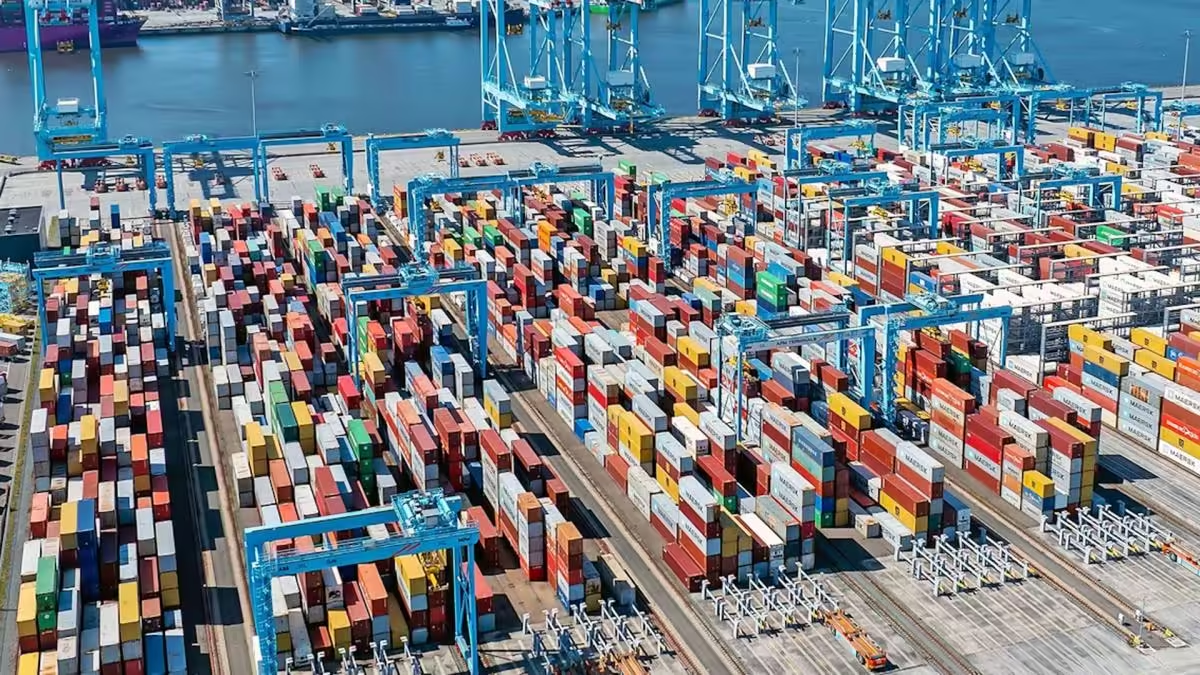
The best way to know if a rate is working is to look at the front door. Belgium and the Netherlands concentrate, according to Euronewsalmost half of the low-value shipments arriving in the Union.
Belgian customs registered between July and September 2026 65% fewer low value shipping declarations than in the same months of 2025. The monthly series published by the Belgian association of SMEs UNIZO shows, with official data, the speed of adjustment. About 166 million in June, 55 million in July, 39.5 in August and 29.5 in September. Almost two out of every three packages have disappeared from the border.
In the Netherlands, customs put the drop at around 70% in August and September compared to 2025. But the same balance provides the data that explains it. Declarations through the ordinary import system rose by 43%. The interpretation of customs itself, translated, is that “these companies are not withdrawing, but rather changing their business model.” Instead of shipping package by package, they import in consolidated containers, store in vessels within the Union and sell from there.
THE BUSINESS DOES NOT DISAPPEAR: IT CHANGES ROUTE
This is the most interesting result. Merchandise that enters in bulk is not exempt from customs. Pay the regular fee. But, once inside a European warehouse, the shipment to the customer’s home no longer crosses any border and does not pay either the three euros or the two for management. The toll taxes a logistics model, that of the loose package, not a specific seller.
Business evidence points in the same direction. On November 4, Shein announced 500 million euros to expand its logistics center in Wrocławin Poland, adding 25% more capacity (up to around one million square metres), with the stated aim of storing more stock close to European customers. That it responds to the rates is reading the press, not a statement from the company; but it matches what Dutch customs describes.
From research in urban logistics, three implications are observed.
For the consumer, the loose package becomes more expensive or delivery times change, but the offer begins to be served closer. For the territory, each warehouse that replaces millions of individual packages is logistical land, employment and truck traffic in some European corridor. For the regulator, a rate designed to equalize the conditions between those who import in containers and those who import by package ends up reorganizing the geography of distribution, and it does so in months.
What we do not know, because customs points out the change but does not quantify it, is how many of the packages missing at the border now arrive in containers. That will be the figure that turns intuition into evidence.
In short, 11/11/2026 was the first with a toll, and confirms a regularity in logistics. When the norm changes, the business does not disappear, it changes its route. The underlying question is not whether we will pay five euros more for an order, but rather where the warehouses from which they will send it to us will be. Are we preparing our cities and our logistics corridors to receive them?
Cristian Castillo GutierrezProfessor of Logistics and Operations, UOC – Open University of Catalonia
This article was originally published in The Conversation. Read the original.
Source: www.diariodenavarra.es