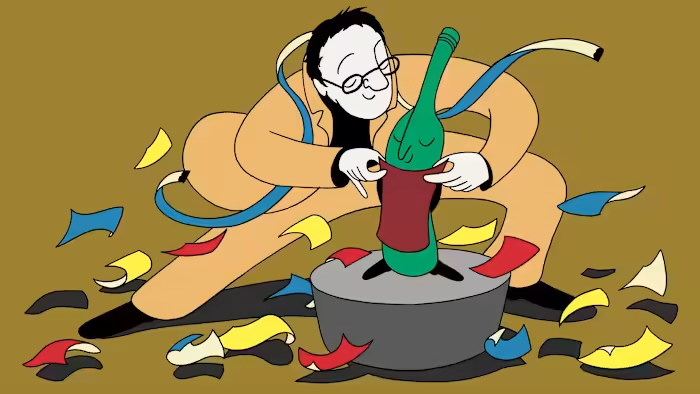

It all began in 2009 when Eben Sadie, now arguably South Africa’s most celebrated wine producer, thought he had sold 200 cases of surplus wine to the local Woolworths. But when the Sadie Family Wines founder saw how many administrative forms had to be filled in, he pulled back, and a British Master of Wine stepped in to take the wine off his hands with a simple handshake.
Thus was born Richard Kelley’s series of bottlings of surplus wine, now up to its 49th “episode”, each labelled The Liberator, with quirky names and comic book illustrations on the bottles. Episode 1, an energetic 2009 white blend still going strong, is called The Bureaucrat, and, as suggested by Sadie, is illustrated with a cartoon of a villain in a suit chasing a winemaker clutching bottles. The latest incarnation, Episode 49, called Pomelo, is touted as “an antidote to orange wine”, with the pink-fleshed fruit pictured on the label. The citrusy 2026 Colombard was more copious than the Bruwer brothers wanted to bottle under their Quando label.
The world is currently awash with surplus wine, which makes me wonder why no one else has had Kelley’s idea of creating a brand that takes advantage of it — not least because so little capital is required to get it off the ground, and it allows the new owner to bypass exclusive distribution agreements.
Perhaps it’s unlikely that anyone else would create such a playful brand as The Liberator. Kelley styles himself “Rick, the Cape Crusader” and clearly enjoys giving each bottling a kooky name, and a fanciful label designed by his South African pal Eddie Haumann. I asked him, at a surprisingly impressive showing of all 49 episodes in London in September, whether the exercise was essentially just for fun. He said it was a commercially useful adjunct to his mainstream wine import business but added, “I’m a Gemini. Half of me runs the business in a businesslike fashion but this is creative: sourcing, coming up with the names (some of which dictate themselves) and the labels.”
Yes, those names. There is Episode 8, An Arrogance of Sommeliers, 200 cases of a 2015 Semillon that Vergelegen’s winemaker André van Rensburg was about to blend into something much less interesting, until Kelley offered to take it off his hands. The arrogance bit was Rick’s proposed collective noun for wine waiters then rising in prominence. Although according to The Liberator website (which explains in detail the background to each wine and reproduces front and back labels), the cartoon on the front of five snooty somms “takes its inspiration from one of Rick’s fellow Master of Wine colleagues, who appears to take a perverse pleasure in photographing every bottle of wine and even the most banal plates of food placed in front of him, only then to punish his ‘followers’ by publishing them on social media”. I’m not sure I can spot the connection between the somms and the MW here, but The Liberator clearly allows Kelley a chance to get strong feelings off his chest.
It was his MW dissertation that took Kelley to South Africa in the first place, in 1993. The topic was the role of temperature in red winemaking and his idea was to contrast the practices current then in New and Old Worlds. Three years after Nelson Mandela had been released from prison, there was clearly so much happening in South Africa that Kelley was intrigued.
He worked the 1995 harvest there in the same year he became an MW, the only one in South Africa, which gave him a certain celebrity in wine circles on the Cape. That same year he went to a trade fair in Bordeaux and met Tim Rands of Vinimark, then the biggest independent wine wholesaler in South Africa. Rands offered Kelley a job and introduced him to the young winemaker of a Franschhoek winery he and partners were then restoring. Marc Kent of Boekenhoutskloof became a self-confessed mentee of Kelley’s, a life-long friend, and host of Kelley’s wedding to an Englishwoman who wanted to return home.
The energetic Kent, who now runs many more wine operations in addition to Boekenhoutskloof, describes Kelley as “an absolute workaholic. In the early days of SA exports post ’94, as Vinimark export manager, he opened up many markets, including the complex monopolies of Canada and the Nordics, for the greater SA industry.”
Kelley puts it more modestly: “I was in the right place at the right time. My role was to find new talent, such as Eben.” The Cape wine industry of the mid-1990s was completely different from the swashbucklingly collaborative community that it is today. When Kelley was researching his MW dissertation, he says that every winemaker he interviewed was convinced that his own wine was the best wine in the world (Norma Ratcliffe of Warwick Estate was the sole woman who could claim to be a winemaker in the South Africa of the mid-1990s), not least because they had hardly tasted any non-South African wines due to the country’s isolation in the apartheid era. Then the whole industry revolved around Stellenbosch and Paarl.
Today, exciting new wines are coming out of many more regions, thanks to the work of a growing cohort of ambitious younger wine producers who have travelled, observed, tasted and learnt. But according to Kelley it took 10 years or so for the industry to catch up with the rest of the world. “The turning point was the new wave tasting in London in 2015,” he says, referring to a seminal, and rowdy, event in the basement of a Soho record shop that was as unlike the manicured lawns of a traditional Stellenbosch winery as you could imagine.
Settled back in the UK, Kelley became a champion of this new breed of Cape winemakers and today two-thirds of the wine imported by his company Dreyfus Ashby (now unrelated to the US company of the same name) comes from South Africa, with The Wine Society his most important customer. He goes to South Africa two or three times a year and is always on the lookout for new talent. “I don’t want to be like Decca and turn down The Beatles,” he says.
But his other concern on these visits is to look out for ingredients for The Liberator bottlings. He sees these surplus wines as “orphans looking for a home. Rescuing them is something that’s worthy. Otherwise they’d just be blended away.” Even the most admired winemakers can find themselves with more wine than they can deal with. The revered Chris and Suzaan Alheit, for example, had way too much 2022 Chenin Blanc from fashionable Skurfberg because they agreed to buy by the hectare not the tonne, and the stupendously wet winter resulted in a seriously swollen crop. “On the bulk market he would have got no money at all,” says Kelley, who called this Episode 42 Midnight Bakkie Rides Again, again for reasons more whimsical than 100 per cent clear. Episode 29 was also made up of 2019 Chenin surplus to the Alheits’ needs.
Kelley usually comes across candidates for The Liberator in either tank or barrel in wineries he’s visiting, and always ensures the wine is bottled in South Africa to keep as much of the profit as possible in the troubled country. But during lockdown he was unable to travel to the Cape and a prohibition on sales of alcohol was in place in South Africa for 165 days. Wine producers were left with a whole, unsaleable vintage in their cellars so he was swamped with offers, and ended up blending one of the early 30s Episodes in his back garden in Newark.
A total of 27 wine producers have featured in The Liberator bottlings, several more than once and by no means only those in Dreyfus Ashby’s portfolio (now available to London restaurants and online for consumers via Flint Wines).
Kelley’s other great interest is the wines of the Loire, particularly those made from Chenin Blanc. According to Marc Kent, “his obsession with the Loire led him to become singularly the biggest champion and voice of SA Chenin, long before it was fashionable”. Of the 49 episodes of The Liberator only five are or contain Chenin Blanc, so popular has this white-wine grape from the Loire become in South Africa.
The recent tasting of them all in London suggested that they are far from disappointing offcuts. There were wines from 2009 and 2011 still in great shape and I was sprinkling scores of 17 and above out of 20. Of course many are now sold out, but in my recommendations here I include my favourites from those still commercially available in the UK, together with my favourites from a tasting of more mainstream wines imported by Kelley that was recently hosted by Flint.
As Kelley says, “South Africa offers some of the best value in the world”. The Liberator bottlings certainly bear this out.
South African gems
THE LIBERATOR
Episode 42, Midnight Bakkie Rides Again Chenin Blanc 2022 Western Cape from Alheit (13%)
£13.18 Lay & Wheeler, £18.89 reduced from £20.99 Harrogate Wine Co, £21.95 Vino GustoEpisode 45, RPM Telegram Sam red Cape blend 2023 Cape South Coast from Minimalist with additions from De Morgenzon and Miles Mossop (13%)
£17.50 Broadway Cellars, £17.95 Vino Gusto, £17.99 Harrogate Wine CoEpisode 48, The Three Graces red Cape blend 2024 Voor Paardeberg from The Foundry (13.5%)
£19.95 Vino GustoEpisode 44, Mudlarking flor-influenced Chenin Blanc 2023 Piekenierskloof from Tierhoek (13.5%)
£25.50 Broadway Cellars, £25.95 Vino Gusto
DREYFUS ASHBY/FLINT WHITES
Tierhoek, Sauvignon Blanc 2024 Piekenierskloof (13%)
£18.58Newton Johnson, Albariño 2024 Upper Hemel-en-Aarde Valley (13.5%)
£20.52Klein Amoskuil, Amos Block Sauvignon Blanc 2023 Swartland (12.5%)
£23.24Tierhoek, Chardonnay 2024 Piekenierskloof (13%)
£25.18Geographica, Bonsai Chenin Blanc 2022 Stellenbosch (13%)
£29.99Alheit, Hereafter Here 2025 Western Cape (13%)
£32.39Beaumont, Hope Marguerite Chenin 2024 Bot River (13%)
£32.39Lukas van Loggerenberg, Kameraderie Chenin 2024 Swartland (13%)
£37.18Tesselaarsdal Chardonnay 2025 Hemel-en-Aarde Ridge (14%)
£37.42Collectible Vintage, Aurelia Chardonnay 2023 Cape South Coast (13.5%)
£38.52Alheit, Cartology 2025 Western Cape (13%)
£39.59
REDS
Minimalist, Perruche Syrah 2025 Cape South Coast (13%)
£19.78Minimalist, Connect the Dots Syrah 2023 Western Cape (13%)
£21.58Miles Mossop, Chapters Cinsault 2023 Swartland (12%)
£22.50Lukas van Loggerenberg, High Hopes Syrah 2025 Swartland (13.5%)
£26.52Minimalist, Stars in the Dark Syrah 2024 Cape Agulhas (13%)
£32.39Minimalist, No Place Like Home Syrah 2024 Elgin (13.5%)
£33.12Lukas van Loggerenberg, Lotter Cinsault 2023 Franschhoek (13.5%)
£34.92Newton Johnson, Seadragon Pinot Noir 2024 Upper Hemel-en-Aarde Valley (14%)
£41.65Lukas van Loggerenberg, Graft Syrah 2025 Stellenbosch (13%)
£42.12
Tasting notes, scores and suggested drink dates on Purple Pages of JancisRobinson.com. International stockists on Wine-searcher.com
Find out about our latest stories first — follow FT Weekend Magazine on X and FT Weekend on Instagram
Source: www.ft.com