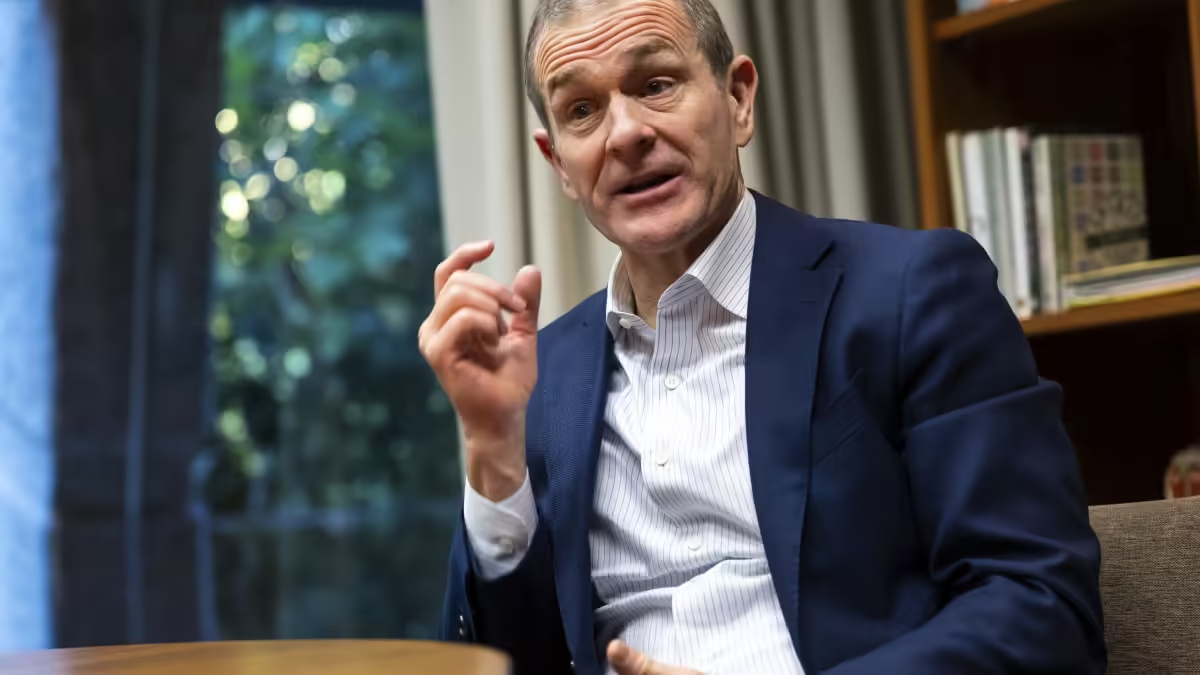

In his more than 30 years of career -20 of them in JPMorgan-, Kevin Foley (1971, Boston), co-head of Investment Banking at the largest financial group in the US, has closely experienced the main turbulences of the global economy, from the great crisis of 2008 to the most recent Covid-19 crisis. believe that Uncertainty has become a constant in financial markets and investors have learned to live with it, although they never let their guard down.
In an interview with EXPANSIÓN during a visit to Madrid to meet with the local team and Spanish clients, Foley acknowledges that he has the tension around the French debt under his magnifying glass. He admits that whatever happens in France “it can have a domino effect” and that the market is already wondering where there could be similar problems.
ASK. The global mergers and acquisitions (M&A) market suffered a decline in the third quarter. Is this a temporary setback or is there less appetite?
ANSWER. It’s too early to tell. However, I believe this is temporary as the market adjusts to the uncertainty around the impact of artificial intelligence (AI). There is also concern about inflation and the evolution of interest rates. The market is assimilating all this. If there’s one thing CEOs have learned in the last five years, it’s how to make decisions without the luxury of certainty. That capability is now more important than ever, because complexity is the operating environment in which we live. We continue to see a lot of activity, and we expect an uptick in M&A.
Q. Both in the US and in Europe?
R. Yes. We expect cross-border activity to increase as investors look for growth and attractive valuations. Strategic logic and relative value put Europe in a good position, and it is well prepared for a stronger M&A landscape.
Q. It seems that investment banking is getting used to managing large operations in greater uncertainty.
R. A large part of this year’s activity has consisted of so-called “megatransactions” – those that exceed $10 billion – and we are seeing all-time highs in volume in that segment. These transactions are, by nature, more complex, involve more stakeholders, and take longer to execute. Added to this is the macroeconomic context.
Q. Do you think this is going to be the short-term trend?
R. As long as uncertainty persists – AI, interest rate developments, the Middle East – deals will take longer to close. But the large ones are here to stay. Companies are making important strategic decisions as they consider how AI will transform their businesses and how to position themselves in an ever-changing world. And, in addition, a good number of family businesses will have to face generational transitions in the near future, which should boost activity.
Q. Operations in equity markets are driving investment banking revenues. Is it a sustainable pace?
R. Yes, the interest is there. There has been a lot of attention this year on big IPOs – SpaceX is a good example – and there is a lot of hype around other big IPOs planned. Investors are looking for diversification and want more securities in their portfolios, which attracts more issuers to the market.
Q. Do you see any country in Europe with more growth potential?
R. Spain continues to outperform in terms of GDP compared to other neighboring countries that are still facing difficulties, and this stronger context translates into a stronger M&A portfolio. In Eastern Europe, Poland stands out, benefiting from both technological development and high defense spending.
Q. If interest rates stay high longer than expected due to inflation, which companies will be most affected?
R. We must analyze the sectoral panorama and evaluate the impact on a case-by-case basis. The inflationary effect of the price of oil spreads throughout the economy and all sectors. It depends on the resources of each company to deal with these circumstances: some will manage it better than others, whether due to their pricing power, their ability to adjust supply chains or other tools they have.
Q. The yield on 10-year French Treasury bonds recently hit 5%. Is there a risk of contagion?
R. Financial markets are interconnected, so anything that happens in France can have a domino effect. It’s not the only country facing deficit problems, leaving investors wondering where those same pressures might arise next.
Q. Could tensions in the sovereign debt market become a problem for European banks?
R. It is a challenge for markets and companies. Corporate debt is valued at a differential compared to sovereign debt yields, so if those yields rise – and France may not be the only country where this happens – the cost of capital increases across the board. You also have to take into account supply and demand. One of the unknowns around AI is how much capital will have to be raised to finance it. If we add to this that governments resort more to debt to finance their deficits, there is a substantial increase in the supply of debt in the market. That combination could widen spreads.
Q. Do you think that private credit healthily complements the traditional banking business or are some less visible risks accumulating?
R. Private credit is here to stay. It is marking the way in which some operations are closed. At JPMorgan we have a division dedicated to private credit and in this sector we have clients. We have oriented our business to encourage greater convergence between large-scale syndicated loans and private credit, because we believe that the market is moving in that direction.
“The biggest unknown is how AI will affect each business”
The IPO market has become increasingly selective and one of the main concerns of investors is how AI will change the way of doing business. According to Foley, certain business models, such as that of software companies, generate more concern: “Can AI simply replace them?” he asks.
In other models, its impact can be just as transformative, but it is more predictable and does not threaten the very existence of the business. “A food company, for example, should be able to use AI to manage its activity more efficiently. But, whether we adopt it or not, we still have to eat,” he explains. These examples illustrate the big question that investors face: “If I am not clear about how AI is going to affect a company’s business, it will be more difficult to invest in it,” he concludes.
The investor appetite for AI is still there, although Foley notes greater caution amid doubts about the speed of its adoption. “The market is debating how it will finance all this growth and how long it will take to recover the investment. I don’t think anyone has an answer,” he says. The banker believes that AI will transform our lives, but warns that its impact will probably take longer than expected because “it is not as simple as flipping a switch.”
Along with AI, Foley places inflation and geopolitical uncertainty among the markets’ top three concerns. “It depends on each sector and each company which of them occupies first place,” he points out. Regarding the impact of Donald Trump’s policy on M&A activity, he states that the president returned to the White House with a “favorable program” for companies and that his approach to regulation has generated more confidence when closing large deals.
Source: www.expansion.com