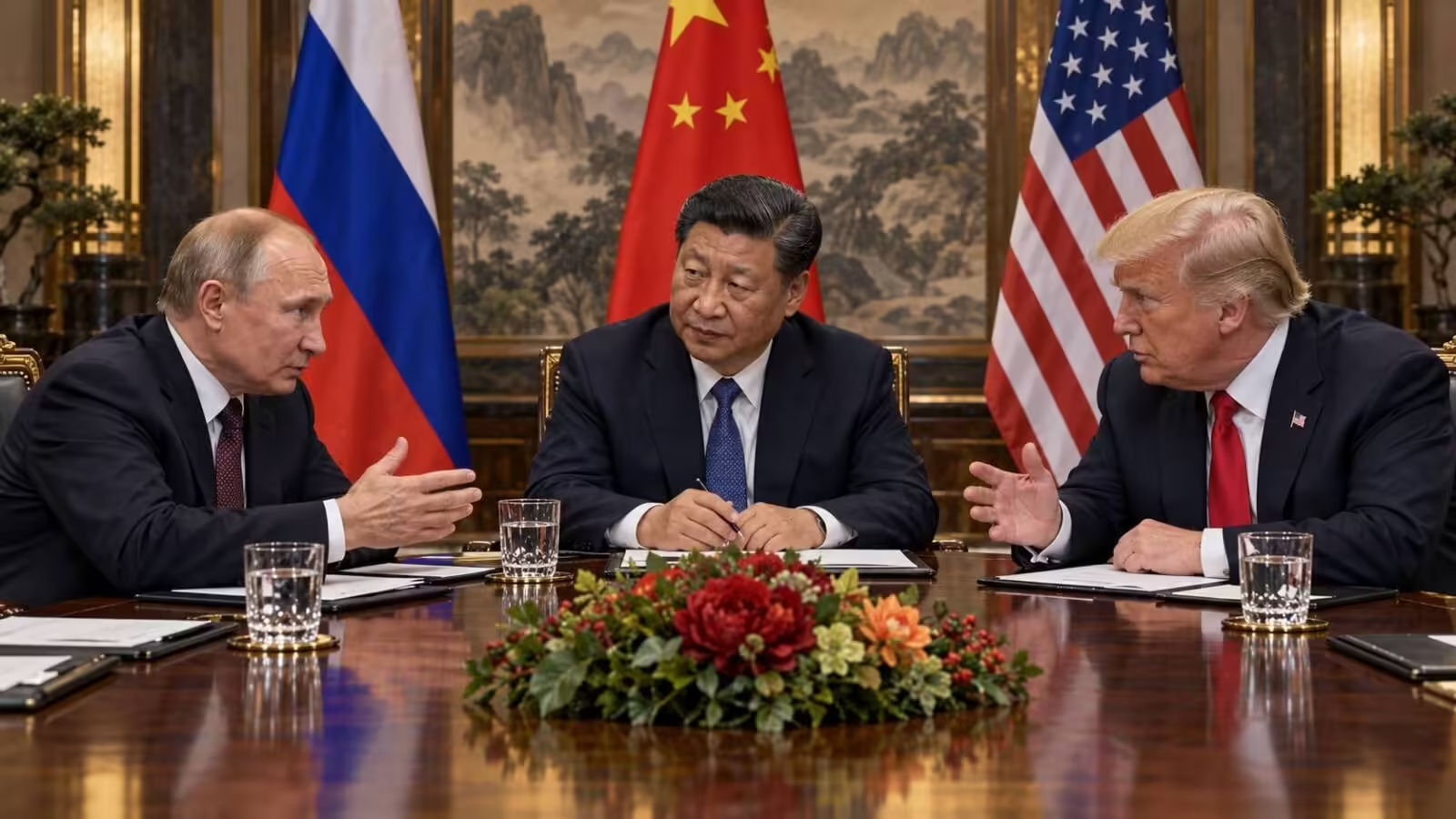

Donald Trump, Xi Jinping and Vladimir Putin are preparing to hold an unprecedented trilateral meeting in China next week, reviving concerns that the world’s major powers could seek to negotiate a new international order without the participation of the countries most directly affected.
When Winston Churchill, Franklin D Roosevelt and Joseph Stalin met in Yalta in February 1945, their armies were approaching victory over Nazi Germany. Their negotiations helped determine the political geography of post-war Europe for decades.
Eighty-one years later, the prospect of another gathering of three major powers has revived memories of that conference, particularly in countries whose sovereignty was compromised by the arrangements that followed the Second World War.
The leaders of the United States, China and Russia are expected to meet on 19 November on the sidelines of the Asia-Pacific Economic Cooperation (APEC) summit in Shenzhen.
The Chinese Foreign Ministry has confirmed that Xi will chair the economic forum on 18–19 November. The Kremlin subsequently confirmed the date of the trilateral meeting.
Yet behind the diplomatic spectacle lie three substantially different national agendas.
Putin’s pursuit of a new international order
For the Russian president, the meeting represents an opportunity to demonstrate that Western efforts to isolate Moscow have failed.
Russia’s ambitions extend beyond securing territorial concessions from Ukraine. Moscow has repeatedly challenged the post-Cold War European security architecture, including NATO’s enlargement and the freedom of neighbouring countries to determine their own strategic alliances.
As EU Today reported following the Abu Dhabi negotiations, Russia has sought to marginalise European representatives while advancing demands that directly affect European security.
A meeting involving Trump and Xi offers Putin something that negotiations with Ukrainian officials cannot provide: the appearance of recognition as one of three leaders entitled to determine the international balance of power.
Even without an agreement, photographs of Putin sitting alongside the American and Chinese presidents would carry considerable political value for the Kremlin.
However, diplomatic recognition of Russia’s status does not necessarily translate into acceptance of its territorial ambitions.
Xi Jinping’s economic calculations
China’s interests are considerably more complicated than Moscow might wish.
Shenzhen, home to some of China’s largest technology companies, provides Beijing with an opportunity to showcase its industrial strength and technological development.
The APEC summit is principally concerned with economic cooperation. Trade restrictions, semiconductor exports, critical raw materials, artificial intelligence and energy security are of more immediate importance to Beijing than the territorial arrangements of eastern Ukraine.
China’s commercial relationship with Europe is another consideration.
According to Eurostat, EU imports from China reached €559.4 billion in 2025, against exports of €199.6 billion. The European market remains an indispensable destination for Chinese manufacturing.
An explicit Chinese endorsement of a settlement imposed on Ukraine could strengthen political support in Europe for further restrictions on Chinese trade and investment.
Beijing’s strategic partnership with Moscow does not eliminate this commercial vulnerability.
China can benefit from Russia’s economic dependence without assuming responsibility for the Kremlin’s territorial demands.
Trump searches forlornley for a diplomatic achievement
The American president arrives in China facing domestic political pressures following the midterm elections, continuing tensions with Iran and unresolved trade disputes with Beijing.
A breakthrough in nuclear arms control could provide Washington with a more tangible diplomatic achievement than another inconclusive discussion about Ukraine.
The expiry of the New START treaty in February removed the last bilateral agreement limiting American and Russian strategic nuclear arsenals.
Washington wants China included in future arms control arrangements. Beijing, however, has resisted negotiations that would place its substantially smaller arsenal on the same footing as those of Russia and the United States.
The Stockholm International Peace Research Institute estimates that China possessed approximately 620 nuclear warheads in January 2026.
An agreement on maintaining human control over nuclear launch decisions could offer a narrower area for cooperation, although no such outcome has been confirmed.
Europe is no longer the Europe of 1945
The principal weakness of the Yalta analogy is that neither Ukraine nor its European partners are powerless observers.
At the Dublin summit on Thursday, European Council President António Costa reiterated that European security could not be discussed without European participation.
President Volodymyr Zelenskyy likewise emphasised in Dublin that Europe must participate fully in negotiations involving its security commitments and support for Ukraine.
The European Union controls substantial financial resources, sanctions and reconstruction mechanisms that would be central to implementing any settlement.
Ukraine, meanwhile, possesses its own armed forces and government, whose cooperation would be indispensable to ending the fighting.
American officials have indicated that Ukraine is unlikely to feature formally in the Shenzhen trilateral talks, with nuclear weapons and Iran expected to receive greater attention.
Nevertheless, the meeting will be closely watched in European capitals.
The danger for Europe may not be a formal agreement resembling Yalta, but the gradual acceptance of a diplomatic practice in which major powers discuss the security of other countries without their involvement.
Three presidents can meet in Shenzhen. They cannot, by themselves, determine the future of Europe.
Views: 1,747
Source: eutoday.net