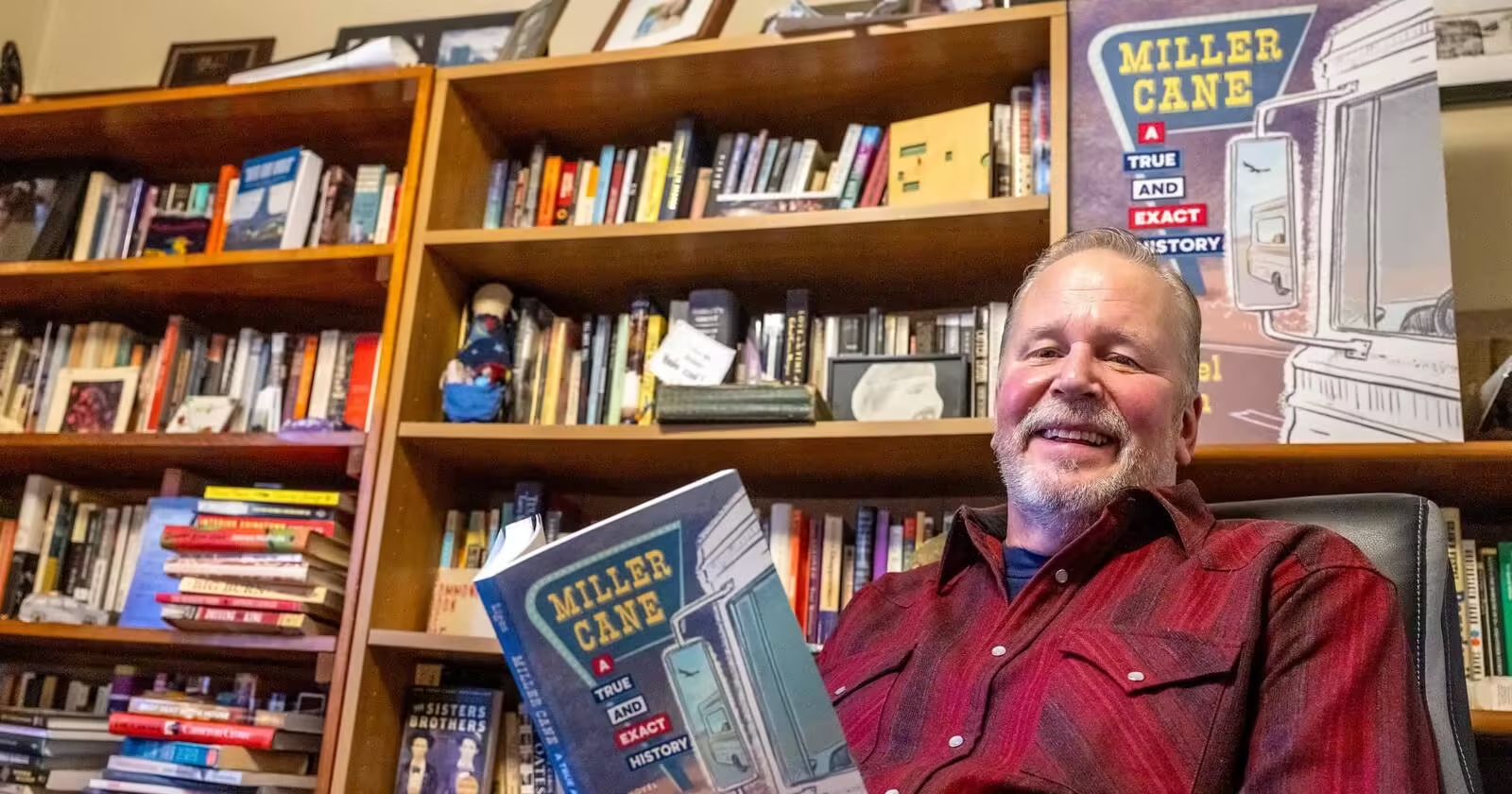

Samuel Ligon has boundless excitement for his latest novel, “Miller Cane: A True and Exact History.”
As he talked about his book over coffee, Ligon poured out all the ways creating Miller helped him grow as a writer: experimenting with collaborative work, bumping up against constant deadlines, diving deep into an American history equally fascinating and troubling. While the work began as a serialized novel in 2018, an expanded and revised version recently came out in book form.
“I think this is my favorite thing that I have done,” said Ligon, who teaches creative writing at Eastern Washington University. “I never would have learned what I learned about this country if I hadn’t written this book.”
The work, he added, pulls together history both real and imagined, complicated characters readers simultaneously love and hate, this country’s near constant experience with mass shootings alongside its fervor for guns.
In truth, summarizing Ligon’s tale is almost impossible. Miller, as its central character, is a deceitful but loveable anti-hero, a conman/historian who shows up at the site of mass shootings to provide survivors with group therapy sessions and use his historical knowledge to bridge connections to lost loved ones. As he leaves a recent tragedy, Miller is asked to rescue the daughter of the woman he longs to call his girlfriend. This begins his and young Carleen’s journey throughout the American West in Miller’s ramshackle motor home.
Carleen and Miller wind through the nation’s back roads, visiting historical sites such as the Whitman Massacre near Walla Walla and the Mansfield, Missouri, home of children’s author Laura Ingalls Wilder. During their travels, Miller, a former history teacher, writes increasingly fanciful histories commissioned by a New York editor for a new textbook.
Ligon’s – and Miller’s – odyssey began in 2018 and 2019 as a serialized novel published in 50 consecutive issues of the Inlander as well as read on Spokane Public Radio. A new version of the work was just published as a book by Slant Books. Ligon will talk about the novel with author and friend Jess Walter at this week’s Northwest Passages event, at 7 p.m. Thursday at the Montvale Event Center, 1019 W. First Ave.
“I’m looking forward to talking with Sam about the challenges of writing a serialized novel, a tradition that goes back to Dostoevsky and Dickens,” Walter wrote in an email, adding that his upcoming discussion with Ligon is “the perfect time to talk about the central theme of this satirical novel: the way American history is tangled up in both hucksterism and the fetishization of firearms.”
Ligon’s early concepts for the serial project centered around the Oregon Trail, but the more he read about the U.S. and westward expansion, the more fascinated he became by the fraud and violence so prevalent in the nation’s past and present. Miller brought everything together, Ligon said. “Guns, fraud, American expansion.”
Writing a serialized novel changed Ligon in personal and professional ways. He read “tons of biographies, ” he said, ranging from Rat Pack celebrity Dean Martin to early Pacific Northwest settlers Marcus and Narcissa Whitman. (The Whitmans appear in his book.)
“And that was a great thing for me,” he said. “I had lost the ability to do deep sustained reading because of my phone.”
He also worked collaboratively, a practice he shunned in previous works. “I believed you didn’t show your work until your work was finished,” he said, adding he worried sharing his drafts would mess with his creative process.
But Miller Cane was different. First, the idea was born when Ligon was approached by then-Inlander editor Jacob Fries to write a serialized novel for the weekly paper. He initially resisted the request, unsure how the constant deadlines might affect his writing.
“Then I realized it was hypocritical of me,” he said, considering he urges his creative writing students to take risks. “If you aren’t taking risks as an artist, you stop growing.”
While somewhat uncommon today, serialized writing has a long history, Walter said. “It’s so fitting that Sam shared Miller Cane as he wrote it, piece by absurd piece, first at the raucous Pie and Whiskey events he started with Kate Lebo, and eventually, with readers in the pages of the Inlander.”
Once Ligon accepted the writing challenge, he engaged in months of research and travel and collaboration. Three writers – Walter, Ligon’s wife Lebo, and New York-based author and pal Robert Lopez – read every draft.
“They were involved in every step – edited every piece of it all the way through,” Ligon said. “This compositional collaboration changed me as a writer. I am definitely the author, but I got a lot of help.”
Ligon said his writing collaborators helped him understand Miller, who he at first “didn’t know anything about.” As the writing progressed, he found Miller’s voice, that of a character both hero and villain, giving and greedy, a teller of tales both true and deceptive.
Readers want complex characters who test their empathy, Ligon said. “If the writing is good, we should be able to empathize with anyone.”
Miller is just such a character, a man who admires his country’s promise while simultaneously profiting from its many failures. Miller’s story, like many of the tales he tells, is one of tragic redemption.
“The history that Miller writes is the absurdity of this present moment as well as a reflection of his own heartbreak,” Ligon said. Through it all, Miller “still has hope for this country.”
Ligon does, too. “I want to believe we can be better than what we are doing right now.”
Source: www.spokesman.com