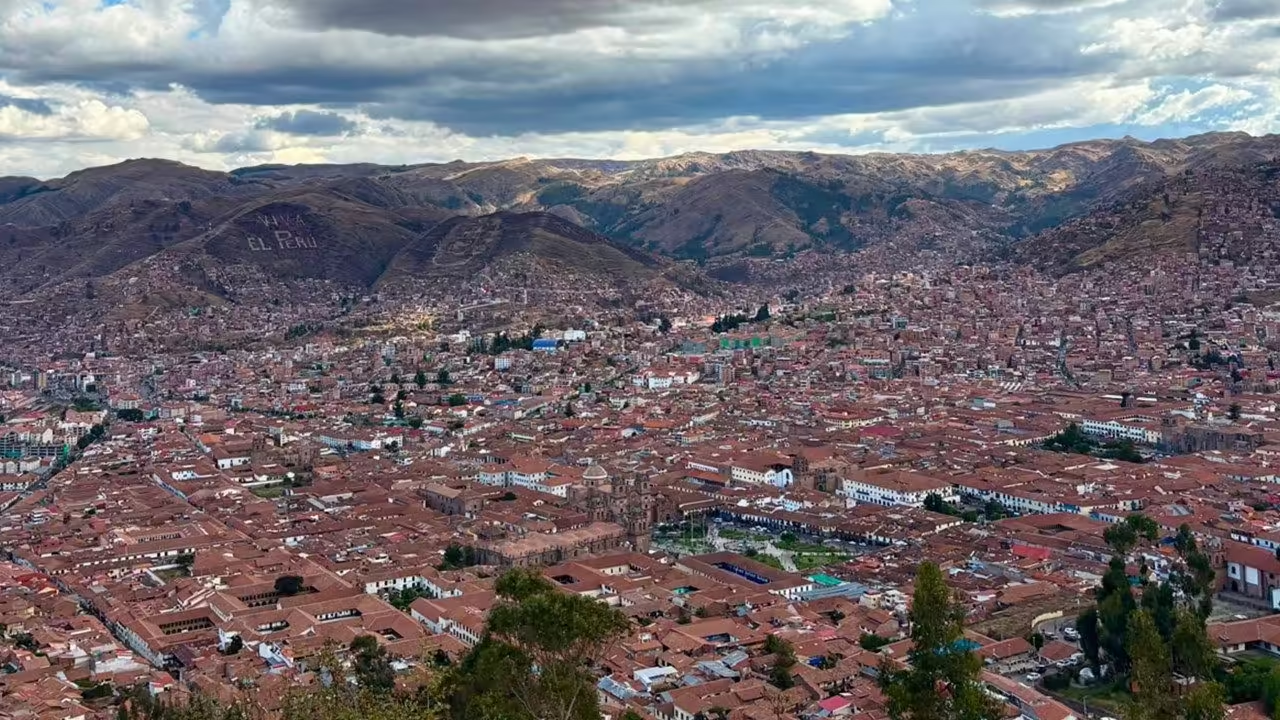

Forty-one years after John Paul II visited Peru’s former Inca capital, Pope Leo XIV will meet representatives of popular devotion at Saqsayhuamán before praying the Angelus in Cusco’s main square, where Andean communities have kept Catholic processions alive for centuries.
By Francesca Merlo – Cusco, Peru
Every Monday of Holy Week, the faithful carry a crucifix out of Cusco’s cathedral and through the city’s streets. The Lord of Tremorsor Lord of the Earthquakes, owes his name to a local tradition that links the image to the earthquake that struck in 1650. In Cusco, he is also known by an affectionate name in Quechua, God – where Tayta means “father”, “lord”, or “sir” and Cha is a suffix used to show affection. On this occasion crowds shower the crucifix with red ñucchu flowers to ask for protection against tremors. For Corpus Christi, a feast celebrated here since the sixteenth century, parishes bring their images of saints and of the Virgin Mary to the cathedral. Several of those parishes grew out of neighbourhoods of the Inca city.
On Sunday, 15 November, Pope Leo will meet some of the people who keep these traditions alive. His first stop is Saqsaywamán, the Inca archaeological site overlooking Cusco, where he will meet the faithful and representatives of popular devotion at 10.30 local time. From there, he will travel down to the Plaza de Armas to pray the Angelus in front of the cathedral at 11.45.

Preparations at Cusco Cathedral
From Inca capital to missionary centre
Above the fountain in the middle of the square stands a statue of Pachacútec, the ninth Inca ruler. In the fifteenth century, he reshaped Cusco as the capital of Tawantinsuyu, an empire that stretched across much of the Andes. The city was a centre of political, military, religious and economic power. After the Spanish conquest, churches and palaces rose over parts of the Inca city, whose layout can still be seen in the historic centre. The cathedral and the Church of the Society of Jesus now face onto the square where the Pope will pray.

Pachacútec, the ninth Inca ruler
Father Luis Jara, the general coordinator of the papal visit in Cusco, told the Bishops’ Conference of Latin America (CELAM) and Vatican News that the city’s importance to the Inca Empire helps explain why it became a centre of evangelisation. Missionaries set out from Cusco, which became the seat of a diocese in 1537, before Lima and Quito had dioceses of their own. In describing the reach of Cusco’s early ecclesiastical jurisdiction, Father Jara put it in terms of today’s geography: from Popayán in Colombia to Tierra del Fuego.
He also spoke of the importance of Marian devotion, particularly to the Immaculate Conception, the patroness of Cusco’s cathedral. He pointed to a local replica of the image of the Immaculate Conception in Rome’s Piazza di Spagna which is venerated by the pope every 8th of December. Father Jara reported that in Cusco about 67% of the population are baptised Catholics but added that the number of those who consider themselves Catholics and are not baptised is likely much higher.
The communities behind the devotions
Every year, communities from across the Andes make their way to the sanctuary of the Lord of Qoyllurit’i in the Sinakara Valley, almost 4,800 metres above sea level. Pilgrims from Andean valleys and mountain villages bring their own music and dances to the sanctuary, braving the glacial winds for the “Snow Star” festival. The pilgrimage is recognised by UNESCO as Intangible Cultural Heritage and is an example of how Andean communities shape the religious life of Cusco well beyond the city itself. At the foot of Mount Ausangate, this vibrant pilgrimage features traditional dances, music, and the symbolic climb of the ukukus toward the glaciers to honor both Christ and the Apusthe sacred spirits of the mountains.
Though on these instances the cold can be braved, for farming and herding families the cold can put a livelihood at risk. The cold brings difficulties, including with farming, in communities who depend on growing crops for income.
In communities such as Phinaya, families raise llamas and alpacas on high-altitude pastures. In Ocongate, where alpaca fibre is a source of income, a new spinning centre is intended to help producers turn the fibre into yarn and felt locally. Peru’s agriculture ministry has provided shelters to protect alpacas and sheep from frost in several highland communities. The regional government has also identified gaps in access to drinking water and sanitation in rural Cusco.
Pope John Paul II spoke directly to the people who work the land in the Peruvian Andes when he visited Cusco in February 1985. When John Paul II visited Cusco on 3 February 1985, he greeted farming communities from across the Peruvian Andes, including those who had wanted to come but could not. He began his homily with the story of Ruth gathering grain. “I greet you with a fraternal embrace,” he told them. He said he had come to express “the deep love he feels for you” and his “profound respect for your cultural and social circumstances.”
During the visit, he also crowned the image of Our Lady of Mount Carmel of Paucartambo.
Forty-one years later
At Saqsayhuamán, giant LED screens and a sound system will allow people across the esplanade to follow Sunday’s encounter. Organisers recall that people could move more freely among the rocks in 1985. This time, Peru’s Ministry of Culture has marked out access routes to protect the archaeological structures, which have now been cornered off for years. Around 4,500 police officers are expected to be on duty in Cusco, and thousands of volunteers will help guide those attending.

LED screens in front of the Cathedral
Down in the Plaza de Armas, posters announcing the visit hang on the Jesuit church as workers put up a platform and screens in front of the cathedral. Nearby, the musicians of Los Chañas rehearsed in traditional dress. One of the songs I heard being rehearsed was a prayer in Quechua, and a bystander explained that they were asking the Lord for forgiveness. He added that for some reason the vast majority of songs from Cusco are sung to sad melodies. If that is true, this one was no exception. Nearby a mother and her son travelled from Chile to see Pope Leo and were busy selling rosaries to help cover the cost of their lenghthy journey.

Roberto and Luvia Lopez from Chile
Pope Leo will fly to Cusco from Chiclayo, where he served as bishop after years as an Augustinian missionary in Peru. After the Angelus, he will leave for Pucallpa to meet missionaries and representatives of Amazonian peoples. Before he leaves the Andes, he will pray in the same square where, on Holy Monday, Cusco comes out to accompany the God.
Source: www.vaticannews.va