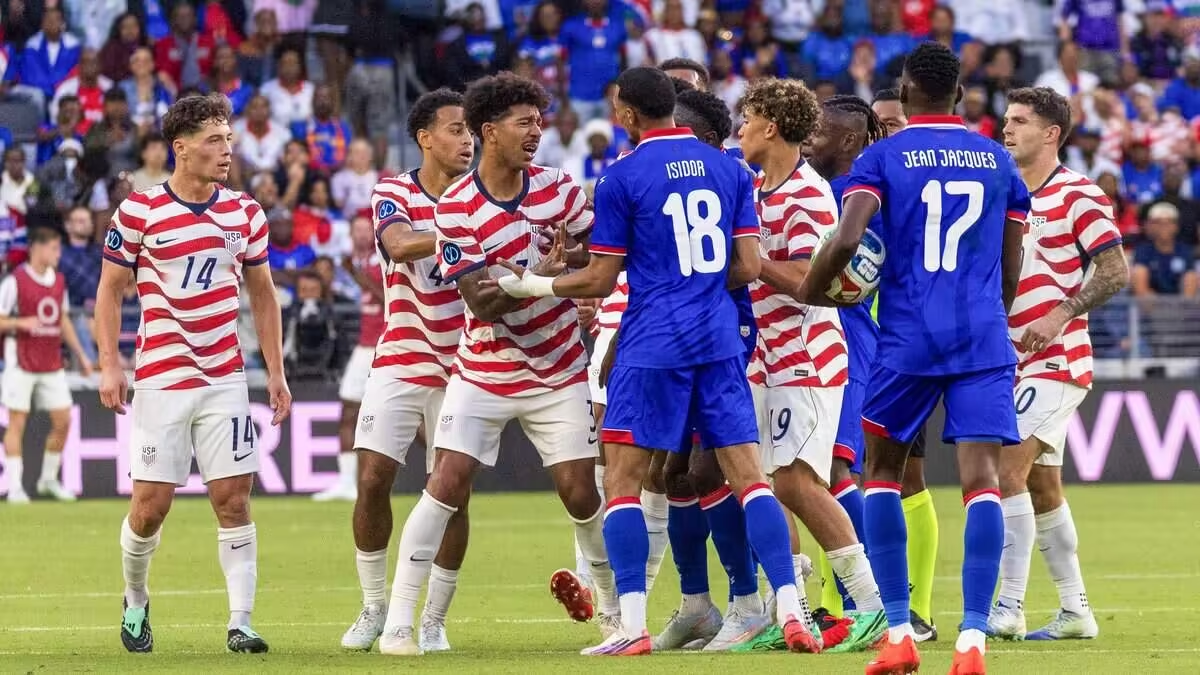

United States defender Chris Richards (3) and Haiti forward Wilson Isidor (18), argued during the first half of the CONCACAF Nations League’s U.S.A vs Haiti quarterfinal soccer game, at Nu Stadium in Miami, Florida, on Saturday, November 14, 2026.
Haitian soccer fans turned Inter-Miami’s Nu Stadium into a sea of blue and red Saturday as the sold-out venue served as the designated home for its national team, Les Grenadiers, as it faced the U.S. Men’s National Team in the first of two quarterfinal matches in the Concacaf Nations League.
The sounds of fast-paced, percussion driven rara and rabòday music played and the rhythms of konpa filled the stands as soccer fans waved Haiti’s blue-and-red national colors, and chanted “Olé, Olé, Olé,” and “Ayiti, Ayiti.”
Haiti’s goalkeeper Alexandre Pierre made two saves against the United States just two minutes into play, eliciting cheers from the crowd. But the enthusiasm took the first of several hits nine minutes into the match when the United States’ Auston Trusty scored the opening goal, prompting chants of “Ayti, Ayiti,” the country’s indigenous Taíno name, from Haitian fans urging their team to fight back.
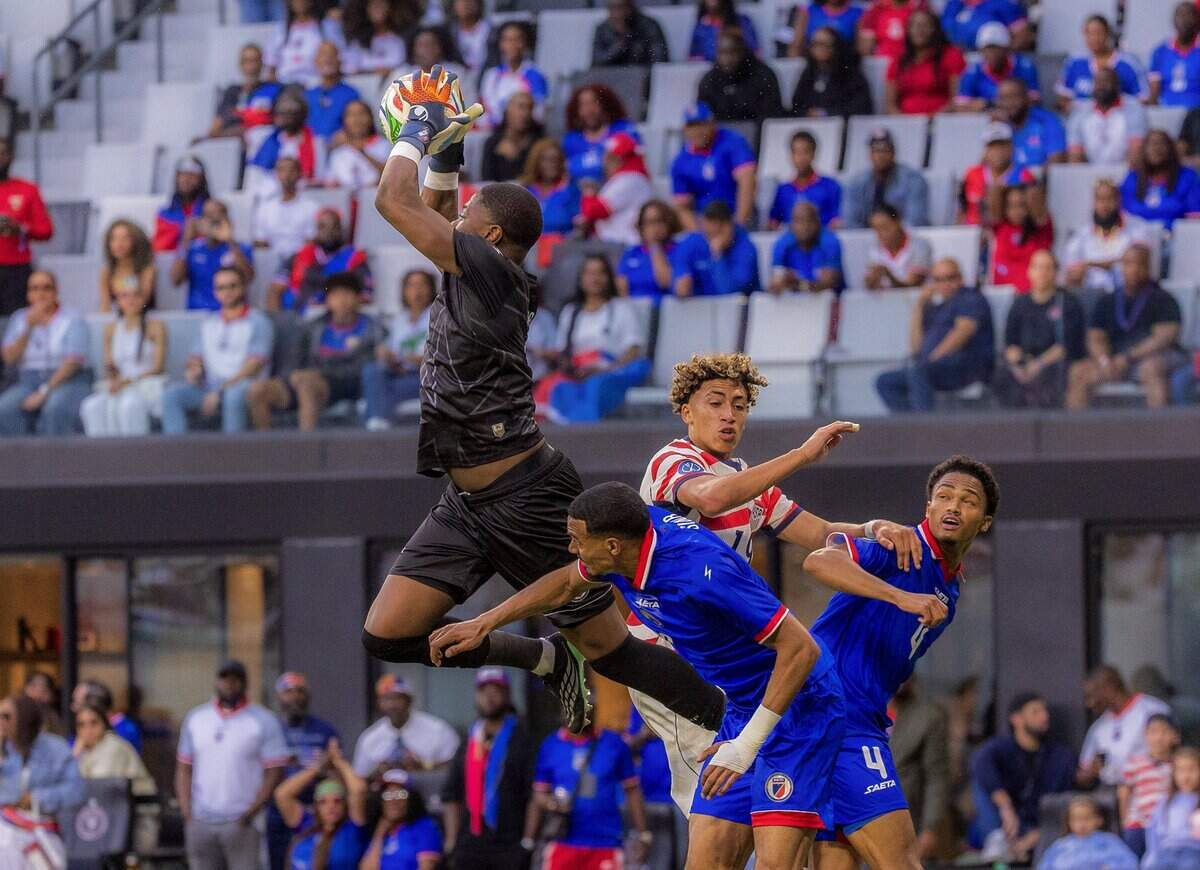
Haiti nearly equalized six minutes later, but a shot at goal was blocked. The United States went on to score again, routing Haiti 6-0.
“It was a difficult match,” David Badia Cequier, who just took over as coach of the Haiti team in August, said after the game. He said there were a combination of circumstances that affected the game, which was basically lost in the last 45 minutes.
“Now we have to look forward,” Badia added, referencing the second leg of the quarterfinal on Tuesday in Cincinnati when the U.S. will play host. The winner of the two-legged series, based on an aggregate score, will advance to the four-match knockout finals in March at SoFi Stadium in Inglewood, California. “We have the chance in three days to show ..what happened today was not something regular.”
READ MORE: Bukele says his forces took back Haiti stadium. But Haiti police say they did it
Badia came into the game with four injured players. But he didn’t want to reflect on that. He said one of the disappointments about Saturday’s loss was the energy emitting from the crowd and fans’ enthusiasm, and being unable in the end to deliver on fans’ expectations.
“When you see the stadium… good atmosphere, everything was perfect for us to play a good game,” he said, “but in the end of course, for us, it’s a little sad what happened today.”
Still, the defeat wasn’t enough, to send some fans rushing out of the stadium.
As the Haitian players prepared to leave the field and the U.S. players ran drills, Haitian supporters continued waving their flags. Egged on by a rara carnivalesque band, they then chanted, “Bukele, Bukele,” invoking the name of El Salvador President Nayib Bukele, who recently deployed his troops to their gang-torn homeland. As the disappointed players stepped closer, the crowd then broke into the final verse of Haiti’s national anthem.
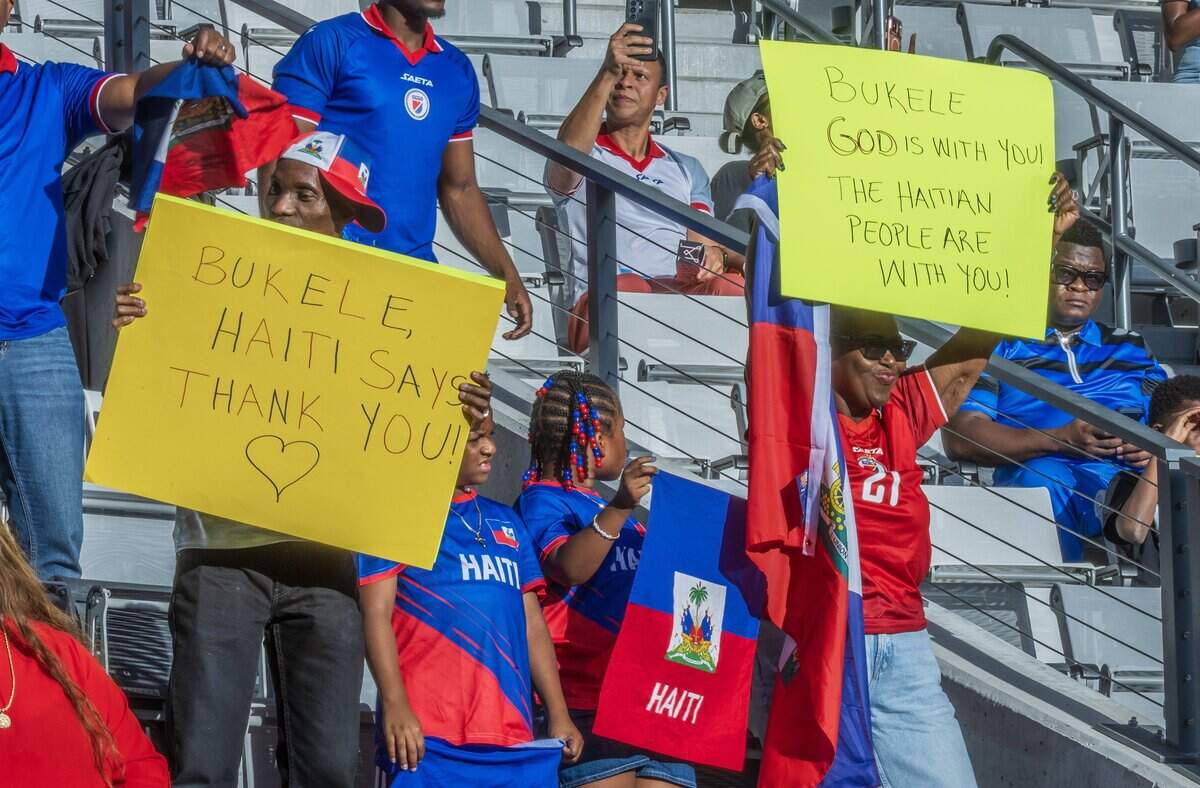
Then, as the final crowds made their way into the lobby to exit the stadium, the fans broke out into a new chant: “Debloke peyi m” — Unlock my country.”
The match marked the second time this year that Haiti’s national soccer team had played before a Miami crowd, after they faced Peru in June in a “home” World Cup warmup. Just like then, the intensity on the field Saturday was matched by the energy in the stands as fans booed the United States and broke out into thunderous cheer when forward Lenny Joseph evaded U.S. defenders with his footwork and scored a goal that was soon deemed out of bounds.
The defeat of Haiti was the U.S.’s team’s biggest win under Mauricio Pochettino, who is leaving to become manager of Manchester United. After the game, he praised the squad, which included several players 20 and younger who were put in the game.
Fans wanted to show support
Marc Jean missed Haiti’s pre-World Cup friendly against Peru in Miami, but traveled to Philadelphia and Atlanta to watch Les Grenadiers face Brazil and Morocco, respectively, after Haiti qualified for its first World Cup appearance in more than a half century. Though Haiti lost both matches and became the first team eliminated in the group matches, its performance had it riding a wave of goodwill into Saturday’s regional tournament.
“The team caught a momentum, and I want to keep that energy going,” Jean, 42, said.
He wanted to show up Saturday, he added, “to show support for the team to make sure they get the 12thman support.”
An engineer who lives in Boca Raton, Jean was with a group of friends. All were dressed in Haiti’s various national team jerseys. But one of them, Lauren Ervin, 42, had bought something extra. She then reached into a bag and pulled out a Team USA jersey.
Ervin, who isn’t Haitian and became a soccer fan after attending the last three World Cups, said she loves “seeing people happy, and I get excited about something different; not politics.”
READ MORE: Joe Gaetjens gave the U.S. its greatest World Cup upset. Then he vanished in Haiti
For Haitians, soccer has offered a rare source of celebration and respite amid political turmoil, deepening humanitarian crisis, surging gang violence — and deportations from the United States.
The country is experiencing one of its worst periods of gang-induced violence in recent history with nearly 1.5 million Haitians forced from their homes. Entire neighborhoods have been overtaken by armed groups. And so to have soccer fields — and until this week the country’s national soccer stadium, Sylvio Cator in Port-au-Prince.
The stadium last hosted the Haitian men’s national soccer team in June 2021, when Les Grenadiers lost a World Cup qualifying match to Canada.
With the area around the stadium increasingly coming under gang control, both the Haitian men and women’s teams have had to look for neutral ground to play home matches.
On Saturday, Miami, which is home to the largest Haitian diaspora in the U.S., played that role after Concacaf agreed to have it serve as Les Grenadiers’ designated home.
Enthused by the decision, Haitians flooded the stadium, making up most fans in the stands. They used their presence not just to cheer on their team but to also show their frustration with the gang violence strangling their homeland and support for Bukele’s military intervention.
Last month, the Central American leader deployed roughly 2,500 soldiers to Port-au-Prince after four of his aviation technicians assigned to the United Nations-authorized Gang Suppression Force were ambushed by gangs and disappeared.
Bukele’s savvy use of communications, taunting of gangs and knack for taking credit for recent security gains carried out by a Haitian police task force employing explosive drones, have Haitians believing that he’s the answer they have been waiting for. Even as Haitian police on Thursday announced that they had reclaimed Sylvio Cator after months of operations against gangs, and turned over responsibility for securing it to the Salvadorans, some Haitians were insisting it was the Salvadorans who did this.
Along with Haitian flags and horns, fans carried homemade signs, one of which read “Bukele Frape Yo” — Bukele hit them — and Salvadoran flags. Others chanted the strongman’s name, along with “Bwa Kale” — the Haitian Creole phrase that’s become a rallying cry for vigilante groups confronting armed gangs and has now found its way into the stands at Haiti soccer matches.
Laurent Hudicourt, one of the few Haitian soccer fans not wearing a national team jersey, decided at the last minute to attend the game.
“I said, I wanted to come support and I like what’s happening right now in Haiti,” the Miami accountant said, reflecting on the timing of the stadium’s recapture in Port-au-Prince and the quarterfinal match. “I feel like it was very symbolic that they got the stadium back before today’s game,” he added. “At the moment it’s positive; hopefully it can be sustained.”
That along with what he sees happening in Haiti soccer, makes him feel “conservatively optimistic.”
“We’ve been deceived so many times with this optimism. It’s tough, but I want to be optimistic,” said Hudicourt, 35. “It’s like that girlfriend that you don’t know if you should trust.”
This story was originally published November 14, 2026 at 8:21 PM.
Miami Herald
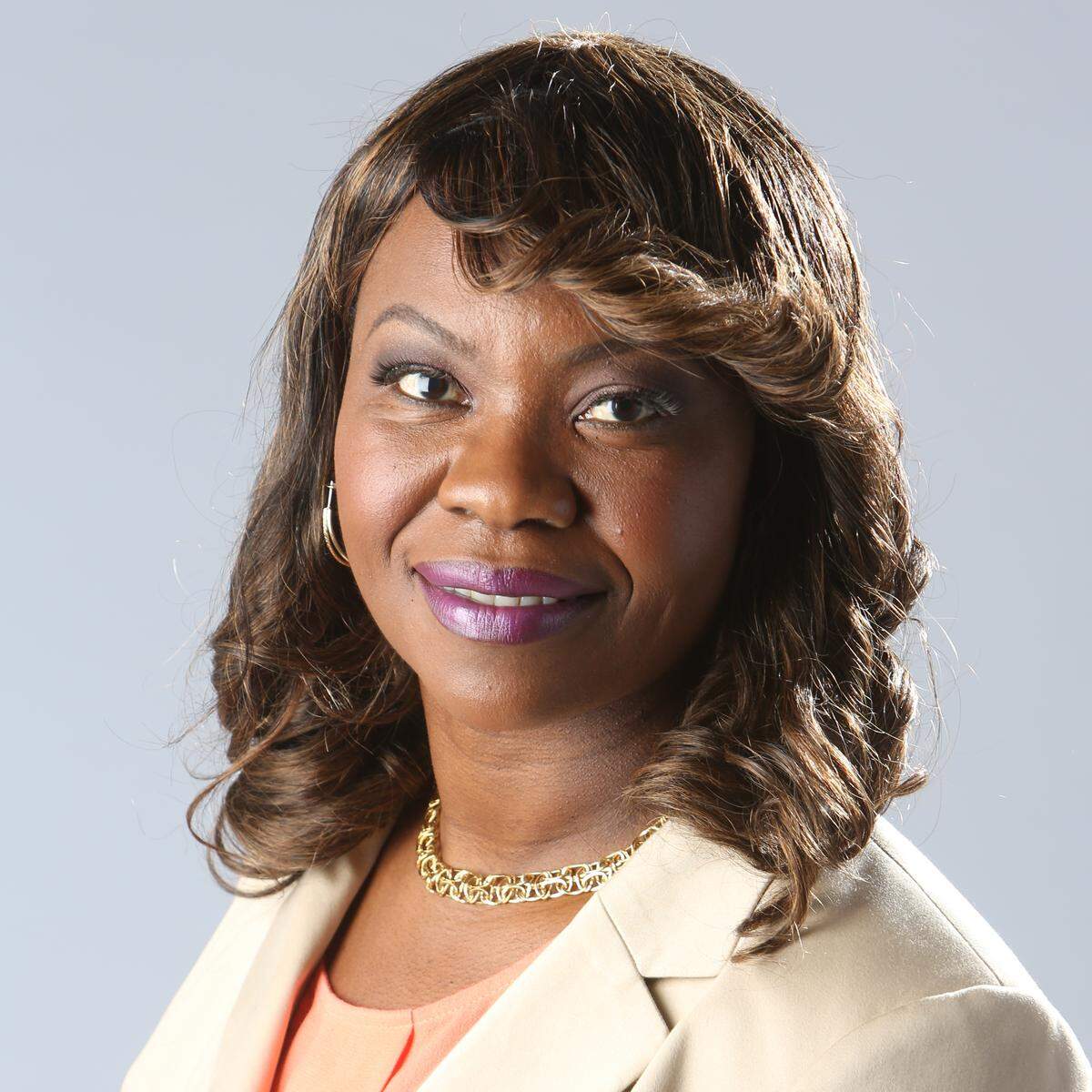
Jacqueline Charles has reported on Haiti and the English-speaking Caribbean for the Miami Herald for over a decade. A Pulitzer Prize finalist for her coverage of the 2010 Haiti earthquake, she was awarded a 2018 Maria Moors Cabot Prize — the most prestigious award for coverage of the Americas.
Source: www.miamiherald.com