

Anticipating the heavy rains expected in the last few daysthe planting of military It was accelerating in the core zone.
According to the weekly report prepared by the Rosario Stock Exchange (BCR)there was a “frantic” advance of the seedersprecisely seeking to avoid floor problems, and around 70% of the planned surface area has already been implemented in the main productive region of the country.
At the same time, with the corn early already covered, the machines prepare to soon also add the late batches, which this year will be fewer.
All this happens with an always important aspect when it comes to projections: How are the margins?
SOYBEANS AND CORN, COMPARED TO LAST YEAR
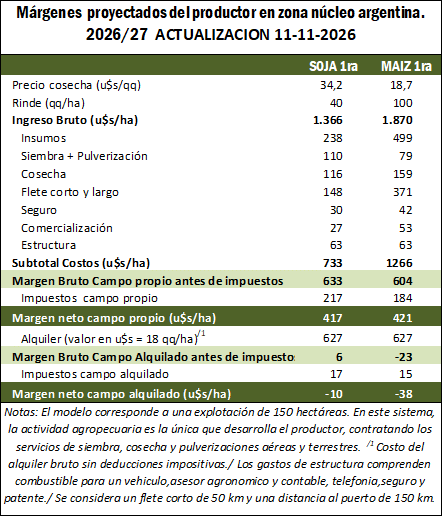
According to the BCR, The first “photo”, compared to last year, is not bad: taking as a reference yields of 40 qq/ha for first class soybeans and 100 qq/ha for cornsoybeans practically maintain their profitability in their own fields, with a net margin that goes from 411 to 417 u$s/ha. Likewise, in rented fields, the loss is slightly reduced, from 14 to 10 u$s/ha.
In the case of corn, however, the situation is deteriorating: The net margin falls from 436 to 421 u$s/ha in own fields and goes from a profit of 19 u$s/ha to a loss of 38 u$s/ha under lease.
These calculations correspond to the last margin update on November 11, 2026. For soybeans, a harvest price of 342 u$s/tn is considered and for corn 187 u$s/tn. A year ago, the values were 324 and 182 u$s/tn, respectively.
The issue is that, although prices improved, production costs also increased: The total cost of planting first-class soybeans went from 670 to 733 US$/ha, while that of corn rose from 1,154 to 1,266 US$/ha.
Added to this is the rent, which practically remains stable, around 627 u$s/ha.. Thus, the improvement in prices is not enough to offset the increase in costs, especially in corn, where the proposition under lease returns to negative ground (and the loss of rentability of the own field as leased is observed).
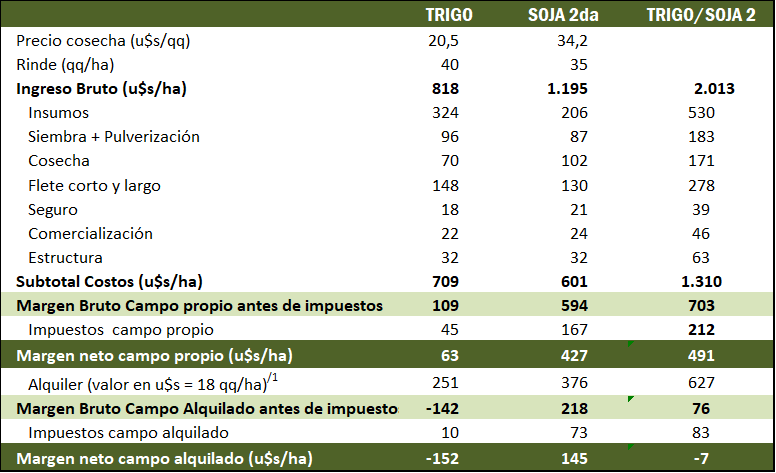
In the plans that include second-grade soybeans, however, the photo is more favorable. The net margin in the own field of second-grade soybeans is 427 u$s/ha when a year ago it was 388 u$s/ha (in the calculation the cost of rent is considered prorated according to the time of crop occupation), while the second-grade wheat/soybean rotation went from 447 to 491 US$/ha.
In rented fields, both schemes also improve: second-grade soybeans reach 145 US$/ha and the wheat/second-grade soybean rotation remains practically in balance, with a loss of just 7 US$/ha.
Wheat continues to be the most committed crop under lease, with a negative margin of 152 u$s/ha.
“However, this campaign there is the possibility of having good water reserves during the critical period of crops, in a context of the Niño year, which opens the opportunity to explore scenarios with greater potential returns. Whether or not this improvement materializes will depend on how climatic conditions evolve in the coming months,” the Stock Exchange clarifies.
SOYBEANS AND CORN, REGARDING OCTOBER
Meanwhile, if the comparison is with respect to October, there the issue does not find positive images: Prime soybeans lost US$36/ha in their own fields and went from a barely positive margin to a negative one under lease.
In corn, the drop was more moderate in own fields (-9 US$/ha), but it reached 21 US$/ha in rented land, deepening the losses.
Also The results of the rotations deteriorated: second-grade wheat/soybeans lost 34 US$/ha in their own fields and 46 US$/ha in rented fields, where they returned to negative territory.
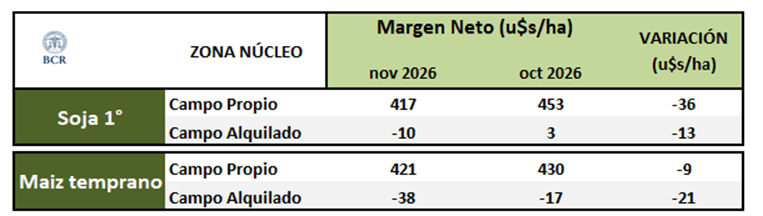
The drop in prices at harvest explains a good part of this retraction: lSoybeans went from 356 to 342 u$s/tn and corn from 193 to 187 u$s/tn.
Source: www.infocampo.com.ar