
Gianni Infantino and Arsene Wenger had been spotted from a distance, walking alongside the artificial pitches staging FIFA’s inaugural Under-15 World Cup & Festival in Baku last month. Both were approached, seemingly without warning, to be given a gift from the Football Union of Russia (FUR) social media team in front of their rolling camera.
It was a small matryoshka doll. “Thank you so much,” said a smiling Infantino, holding the traditional wooden ornament to his chest and offering the man behind the lens a handshake. Wenger, looking a touch more bemused, also gave his thanks before walking away in the short video posted on the FUR’s channels.
The symbolic gestures were no accident. This tournament marked Russia’s return to a FIFA competition for the first time since the invasion of Ukraine in February 2022, so it was hardly surprising that two of the world governing body’s most powerful men were deemed worthy of a thank you by the FUR. Gifts were also handed to players and coaches from Cameroon, South Korea, Bosnia and Peru.
“Many said we were missed at such major tournaments,” said one of the schoolboy players in the FUR’s 18-minute YouTube documentaryfilmed to mark the country’s return to international football and opening with a speech from Paris Saint-Germain goalkeeper Matvey Safonov. “No one was against us.”
Perhaps not in Baku, where Russia finished 19th out of 189 teams, but that sidesteps the more awkward reality.
This weekend marks the fifth anniversary of the Russian men’s team last playing a competitive fixture and opposition to their return is unmoved. Aleksander Ceferin, head of European football’s governing body, UEFA, has repeatedly said the suspension of all Russian international and club teams will not be lifted until the war with Ukraine (another UEFA member) ends. Infantino has given greater encouragement, saying in February that FIFA’s own ban had “not achieved anything”but allowing Russia to play in the Under-15 World Cup remains as far as he wishes to push the matter.
Ice hockey has illustrated the challenges that endure for the outcasts.
The Russian International Ice Hockey Federation (RIHF) recently successfully appealed its suspension from the International Ice Hockey Federation (IIHF) at the Court of Arbitration for Sport (CAS), but its joy was short-lived. Soon after, Norway, Sweden, Denmark and the Czech Republic all said they would refuse to play Russia at next year’s men’s Ice Hockey World Championship in Germany.
The same opposition would inevitably be replicated within European football but Russia sees another door ajar. FUR honorary president Vyacheslav Koloskov considered that CAS ruling a “major success” and — in an interview carried by the Russian TASS news agency this month — raised the prospect of football’s own legal challenge, saying there was “a good chance” teams would be back playing before the end of 2026.
That bullishness, though, neglects the root cause of their ban. Russia was deemed a pariah state in 2022, a threat to the integrity of football’s competitions. Almost five years on, nothing has materially changed that position.
The last competitive fixture for Russia’s men was five years ago yesterday, on November 14, 2021. A draw away to Croatia would have been enough to qualify for the Qatar World Cup, but a 1-0 loss condemned them to a play-off that was never played after their opponents, Poland, said they would refuse to face them, in solidarity with Ukraine. Sweden and the Czech Republic took the same stance, as they were due to face the winners.
Russia’s players are left dejected after being defeated by Croatia, in their last competitive match before being frozen out of football (Denis Lovrovic/AFP via Getty Images)
FIFA, conscious of its biggest tournament looming, suspended all Russia teams in line with UEFA’s ban, saying that a refusal from teams to play them risked “irreparable and chaotic” consequences. The suspension was imposed “until further notice and until the situation improves sufficiently”.
The decisions made by FIFA and UEFA were the subject of challenges at CAS in the summer of 2022 and the verdict handed down there forms the basis of Russia’s ongoing suspension.
It was argued that FIFA breached political neutrality and delivered a “disproportionate” penalty but a majority of the three-person CAS panel found that FIFA’s actions were “reasonable, proportionate and, arguably, necessary”.
That appeal remains the last time that arbitration has been sought on Russia’s footballing exile. CAS confirmed to The Athletic this week that there had been no recent requests from the RUF and any appeal would need to come against a fresh decision made by either FIFA or UEFA.
That is where the ice hockey dispute differs. The RIHF challenged a new IIHF ruling, made in July 2026, not to reintegrate Russia and successfully argued that sufficient evidence to support the ban had not been provided.
But the indefinite nature of the suspension issued by both FIFA and UEFA has already been appealed and dismissed. Any CAS decision can only be challenged at the Swiss Federal Tribunal within 30 days.
Koloskov has suggested that an application for readmission to the executive committees of UEFA and FIFA could open a new avenue for appeal, a point that carries legal weight under the statutes of the two governing bodies, but most of Europe still has no wish to face Russia. That became clear in 2023, when UEFA proposed reintegrating Russia’s under-17 teams, only to face widespread opposition.
FIFA’s position is more nuanced. More than 25 nations from various confederations — including Iran, Egypt, Nigeria and Chile — have had no issue facing Russia in friendlies since 2022, and Infantino has said the reintegration was something he would “definitely” assess.

Russia celebrate in their 3-2 win over Uzbekistan this week (Anvar Ilyasov/Getty Images)
The recent Under-15 World Cup became the first exception to FIFA’s rule. An eight-a-side competition fell outside of the suspension and Russia’s inclusion was approved by the FIFA Council, which did not want to close the door on youngsters from a suspended nation competing. Infantino had previously cited the tournament’s potential to unite nationseven claiming it could help bring Israelis and Palestinians together.
Ukraine boycotted the event, unsuccessfully calling on many others to join them, with Matvii Bidnyi, Ukraine’s minister of youth and sports, saying in quotes reported by the Press Association in September that it represented “the legitimisation of a terrorist state”.
Every nation participating in the Under-15 World Cup, Russia included, had expenses covered by FIFA, which has continued to hand the FUR payments through the FIFA Forward programme. Russian teams might be suspended but the national football association — which did not respond to a request for comment by The Athletic — retains its rights as a FIFA member, including attending Congress, remaining in the international rankings and choosing the next president in March.
UEFA’s most recent financial report, covering 2024-25also detailed that €5.25m (£4.4m; $5.8m) was distributed through investment and solidarity payments, and that €4.2m went to Russian clubs through the Champions League solidarity payment programme. A Russian club team has not featured in a UEFA competition since Zenit were eliminated from the Europa League in February 2022, the same day Russian military operations began in Ukraine.
Russia was sidelined across sports just four days later and have fought legal battles ever since. CAS said last month it had “managed numerous requests for arbitration between 2025 and 2026 by Russian sports bodies” and altered stances in that time have brought signs of reintegration.
The International Olympic Committee lifted its suspension of the Russian Olympic Committee this summer, paving the way for the nation’s athletes to compete at the 2028 Olympics in Los Angeles. Russian (and Belarusian) athletes could compete at the 2024 Paris Olympics and the 2026 Winter Olympics but were only recognised under a neutral flag.
This week, the Russian national anthem was played once more at the Youth Olympics in Senegal, while the International Handball Federation also lifted its ban on Russian teams this summer.
It was in that context that featuring at FIFA’s Under-15 World Cup was considered significant by the FUR, but the path back to international football remains blocked. Ukraine retains political allies in Western Europe and the walls put up to keep Russia out of football will not fall until war ends. There has been little sign of that in a week when American-led peace talks in Abu Dhabi failed to produce a breakthrough.
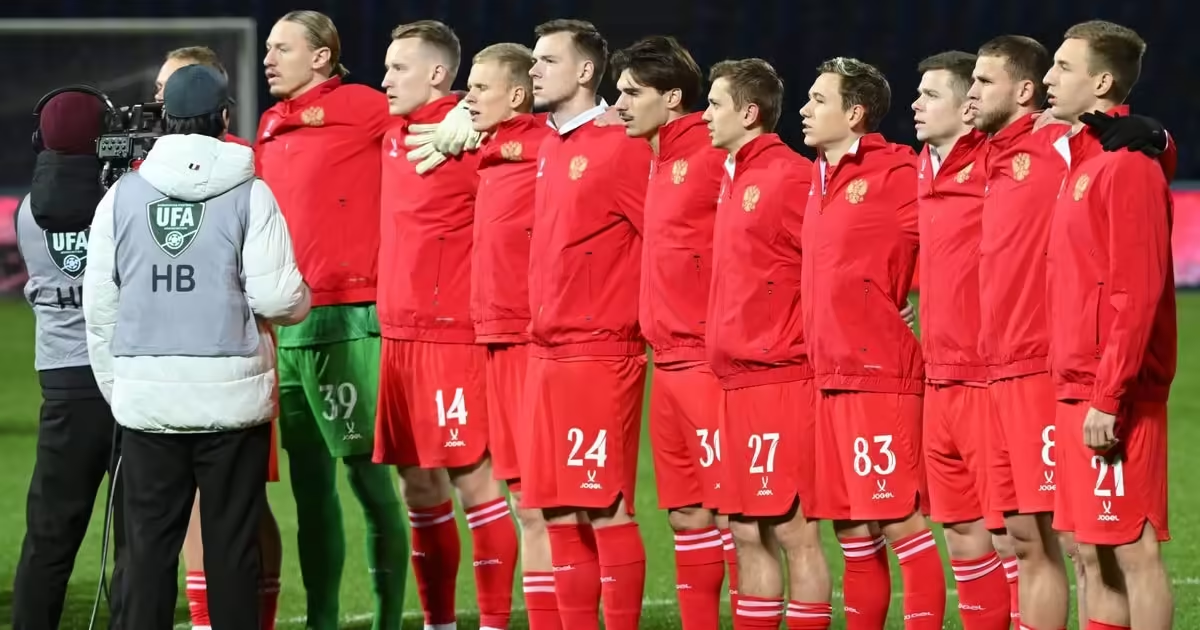
Russia’s suspension has created an alternate existence for its international footballers. Thursday’s 3-2 away win over Uzbekistan was the 31st friendly the men’s team has played since their first ban in 2022, with every opponent a political ally.
Serbia and Belarus are the only UEFA member associations that Russia has faced in the last five years, though a 2-2 draw with Kenya in October 2023 was played in Turkey. Diplomatic relations between Russia and Turkey remain intact, as shown by Galatasaray’s willingness to spend €25million (£21m; $28m) to sign Aleksey Batrakov from Lokomotiv Moscow this summer.
The 21-year-old is one of only four players in the current squad not with a Russian club, along with Safonov, captain Aleksandr Golovin (Monaco) and Aleksei Miranchuk (Atlanta United), who scored the winner in Uzbekistan.
Exhibition games are the only way for Russia to play international football — the women’s team has faced only India and China since March — but the men’s team still draws an engaged audience. Home games regularly attract capacity crowds and have been spread across the country, including Yekaterinburg, Kazan, Kaliningrad, Volgograd and Sochi. Venezuela’s visit on Tuesday will be held in Krasnodar.

Russia fans show their colours in Uzbekistan (Anvar Ilyasov/Getty Images)
“It’s very hard for Russian football without the international games,” Aleksey Kirichek, former executive at Lokomotiv Moscow and committee member at the FUR, tells The Athletic. “You don’t have opportunities to show your skills on an international level.
“Games are still played but it is not high intensity. There’s frustration for the national team but the people are happy that games are still being played. The people in the regions are very enthusiastic that the national team is coming and playing international games. Football players are still heroes to the people there.”
Russia, hosts of the 2018 World Cup, have now missed three major tournaments in a row. A fourth will come and go unless they are welcomed back by December 6, when the qualifying draw for Euro 2028 is made in Belfast.
The ice hockey verdict might offer Russia hope but most of Europe seems happy to leave Russia in the cold.
Source: www.nytimes.com